
OPEC MOMR (Mar – Incorporates Iranian War): In March, crude oil production by countries participating in the DoC (OPEC+) dropped by 7.70mln BPD M/M, to average about 35.06mln BPD, according to available secondary sources
OPEC’s latest Monthly Oil Market Report reveals a significant production drop of 7.70 million barrels per day from OPEC+ countries, indicating tightening supply amidst increasing geopolitical tensions.
Strategy (MSTR) buys 13,927 Bitcoin for aggregate purchase price of USD 1.00bln
US BROKER MOVES: ON upgraded at BofA; BBY double downgraded at Goldman Sachs
OPEC MOMR (Mar – Incorporates Iranian War): In March, crude oil production by countries participating in the DoC (OPEC+) dropped by 7.70mln BPD M/M, to average about 35.06mln BPD, according to available secondary sources
ECB's de Guindos says the impact from war in Iran will depend on the duration of conflict
Six railway facilities targeted in strikes last week have been rebuilt in Iran, state TV reports
Open the platform and use it. The whole workspace is free to try, with no signup and no card. When you want the headlines arriving live instead of on a delay, Newsquawk Pro is £24.99 for 7 days.
SUPPLY
- In March, crude oil production by countries participating in the DoC (OPEC+) dropped by 7.70mln BPD M/M, to average about 35.06mln BPD, according to available secondary sources.
- OPEC+ March crude production breakdown is available at the bottom.
DEMAND
- The demand for DoC crude (i.e., crude from countries participating in the DoC) in 2026 remains unchanged from the previous month’s assessment to stand at 42.9mln BPD.
- Global oil demand growth for 2026 is forecast at 1.4mln BPD Y/Y, unchanged from the previous month’s assessment.
- The OECD is forecast to grow by 0.1mln BPD, while the non-OECD is forecast to grow by about 1.3mln BPD.
- In 2027, global oil demand is forecast to grow by about 1.3mln BPD Y/Y, also unchanged from last month’s assessment.
- The OECD is forecast to grow by 0.1mln BPD, while the non-OECD is forecast to grow by around 1.2mln BPD.
REFINING MARGINS
- In March, refining margins surged across all major regions, given the sharp reduction in product output and rising middle distillate crack spreads, which reached multi-year highs.
- Trade flow constraints and refinery run cuts in the East of Suez contributed further pressure on product margins amid the heavy refinery maintenance season.
TANKERS
- In March, trade disruptions and moves to source alternative supplies pushed dirty tanker spot freight rates to record levels.
- On the West Africa-to-East route, VLCC spot freight rates rose 34%, M/M. Suezmax spot freight rates on the USGC-to-Europe route jumped 104%, M/M.
- Aframax rates were particularly strong West of Suez, with the Intra-Mediterranean route increasing 68%, while the Indonesia-to-East route experienced more limited gains of 8%, M/M.
PRICES
- In March, the OPEC Reference Basket (ORB) value increased by USD 48.46/bbl, month-on-month (m-o-m), to average USD 116.36/bbl.
- The forward curves of the three main crude oil futures benchmarks – ICE Brent, NYMEX WTI and GME Oman – steepened sharply in March, and the calendar spreads between the nearest futures contracts moved into deeper backwardation.
- Traders were pricing in significant short-term supply tightness amid escalating geopolitical tensions. Tight physical crude supply prompted refiners, particularly in the Asia- Pacific and Europe, to compete for available spot cargoes through aggressive bidding.
- Hedge funds and other money managers turned increasingly bullish on oil in March, sharply increasing their net long positions amid supply disruptions and rising oil prices.
ECONOMY
- Following sound global GDP growth in 2025, estimated at 3.3%, the global economy is expected to be able to generally absorb temporary events like trade-related challenges and the current Middle East geopolitical developments.
- While geopolitical developments in the Middle East have been to the fore in recent weeks, US tariff-related developments have been volatile since the beginning of the year. They may become a topic of interest again in the near-term as the US administration may again raise tariffs.
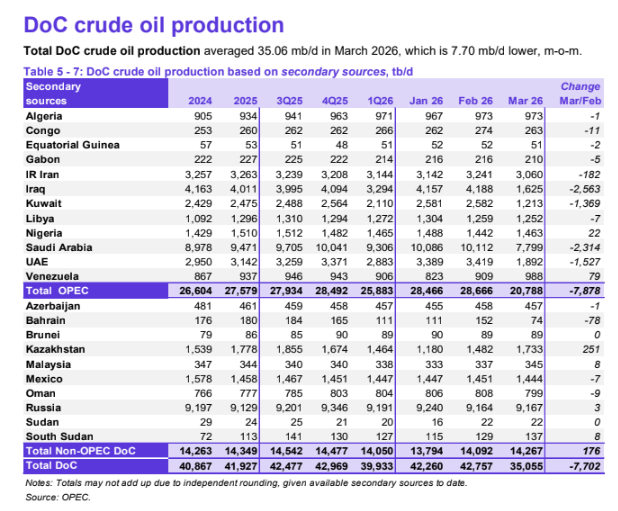
With global oil demand forecasts unchanged and refining margins rising sharply, this production decline could lead to upward pressure on crude prices, especially as traders anticipate supply constraints in the near term.
Related headlines
- US Midterm Update: Latest Polymarket pricing puts Democratic sweep at 50%; Republican midterm 2-day convention to start tonight3 hours ago
- Newsqawk European Market Wrap - 9th September 20265 hours ago
- US EQUITY OPEN: Indices in the red as US/Iran tensions escalate 6 hours ago
- Russian Kremlin spokesperson Peskov says Presidents Putin and Trump did not discuss the possibility of holding a new meeting at APEC, but there is an understanding that such a meeting could take place, Interfax reports7 hours ago
- CRUDE WRAP: WTI (V6) SETTLES USD 3.02 HIGHER AT 96.05/BBL; BRENT (X6) SETTLES USD 3.29 HIGHER AT 101.21/BBL1 hour ago
- US President Trump says after the election, oil prices will tumble lower; gasoline price will take a bit longer1 hour ago
- US President Trump says he thinks war with Iran will end immediately after the election1 hour ago
- US Senator Slotkin says "We hear rumors that Trump is planning to allow Chinese cars to be sold in the U.S., as part of a larger deal"3 hours ago
- Primer: US to sell USD 39bln of 10-year notes at 18:00BST/13:00 EDT3 hours ago
- Trump admin official says buyback increase of part of ongoing approach, reports Fox Business4 hours ago
- [MARKET UPDATE]: Yields rise, supporting the Dollar, weighing on stocks and spot gold after US Treasury announces it will buy a maximum USD 6bln in 10-20yr liquidity support buyback op. on Thursday4 hours ago
- EIA STEO: World oil demand 102.6mln BPD (prev. 102.7mln BPD), 2027 demand 105mln BPD (prev. 105mln BPD). 3 hours ago
- Salesforce (CRM) reportedly held talks to buy Listen Labs, an AI customer research platform, for USD 2bln, according to Business Insider52 min ago
- Enbridge (ENB) reportedly to be near purchases of Pony Express from Tallgrass and to pay about USD 2bln33 min ago
- Swiss Government has banned the purchase and import of gold originating in Sudan4 hours ago
- Pakistani Ambassador says they believe that a better understanding will soon be achieved between the US and Iran, reports ISNA58 min ago
- Pakistan is reportedly considering strikes against Houthi targets in Yemen under the “Makkah Pact” defense framework with Saudi Arabia and Turkey, Kann's Kais reports; strikes may begin in the coming days and will be announced immediately after6 hours ago
- Updated Treasury Buyback Schedule: Maintains guidance from announcement that long dated buyback operations will be at least USD 4bln4 hours ago
- US Quarterly Services Survey (Q2 2026): +3% to USD 6,418.7bln5 hours ago
- A US official tells NewsNation on reports of strikes in Iran near the Strait of Hormuz that there are no attacks being carried out by US forces right now: “We're not currently striking”2 hours ago
The whole workspace, free to try.
Try it free