
US Midterm Update: Latest Polymarket pricing puts Democratic sweep at 48%
Newsquawk Staff ·
What is priced?
- 76 days until the election, and the House is still widely expected to go to the Democrats whilst the Senate remains a close call.
- Polymarket odds show participants have continued to heavily favour Democrats to win the House at 88% (prev. 88% on August 12th), whilst for the Senate, it is priced as a close call with Democrats holding a 52% chance to take the Senate (prev. Republicans held the edge at 56% at July-end).
- Polymarket shows the probability of a Democrat sweep at 48%, while pricing a Republican Senate and Democratic House at 40%, and finally a Republicans Sweep at 13%.
Trump eyes new policies ahead of midterms
- Top officials state that Trump is looking for new policy pledges he can present to voters ahead of the midterm election, according to Bloomberg.
- The report notes that Trump may call on Congress to cut capital gains taxes and create an exemption for certain home sales.
- One of the measures touted would be indexing capital gains, so taxes would be applied on gains adjusted for inflation, while there could also be exemptions on sales of homes worth USD 2mln or less from capital gains taxes.
- NEC Director Hasset stated in an interview with Fox Business' Kudlow "You can expect a lot more policy between now and the midterms".
- Politico reported that the Trump admin is sunsetting a subsidy programme that lowered Medicare prescription drug coverage premiums for older Americans — just ahead of the midterm elections, giving the Democrats an attack point against the Republicans.
- DoJ plans to deploy 1,000 election monitors for the November midterms, which Assistant AG Harmeet Dhillon said would likely be a historic number for a Republican admin, via a Bloomberg interview.
- Monitors will observe election procedures and follow up on potential issues, including barriers to voting for people with disabilities and election fraud, but will not intervene.
- DoJ has filed more than 30 lawsuits seeking state voter data, including partial Social Security numbers, and has lost nearly two dozen; Dhillon did not rule out taking the issue to the Supreme Court before the election.
- Dhillon said concerns over noncitizen voting could discourage eligible citizens from voting, while acknowledging that such voting is relatively small numerically but “not trivial.”
Recent developments
- House Minority Leader Hakeem Jeffries again predicted that House Democrats will win in November: “Well, I expect that there will be at least 220 members of the House Democratic Caucus when we take back the majority, if not a number much greater than that.”
- House Majority Leader Steve Scalise told Punchbowl last week he thinks Republicans will have a six-seat majority in the 120th Congress.
Florida:
- Florida House primaries saw two Trump-backed candidates defeated: Representative Cory Mills lost his 7th District seat to Ryan Elijah, while Catalina Lauf lost to Jim Schwartzel in the 19th District.
- Note, Politico wrote that Democrats wouldn't have wanted Mills to lose as his personal baggage makes the red-leaning seat easier to flip in the fall. But, they likely need former NASA chief of staff Bale Dalton to beat former Rep. Alan Grayson (D-Fla.) in their own primary to make it competitive.
- Democratic state Rep. Angie Nixon defeated better-funded former Lt. Col. Alex Vindman in Florida’s Democratic Senate primary, securing the progressive nomination. She will face Republican Sen. Ashley Moody in the general election; Polymarket odds of Republicans winning the Florida Senate increased after the Democratic primary.
- The winner will serve the remaining two years of Rubio's vacated seat's term.
Wyoming:
- Trump-backed Harriet Hageman won the GOP Senate Primary.
- Republican state Sen. Eric Barlow defeated Trump-endorsed Superintendent of Public Instruction Megan Degenfelder in the gubernatorial primary, marking another loss for a Trump-backed candidate.
Alaska:
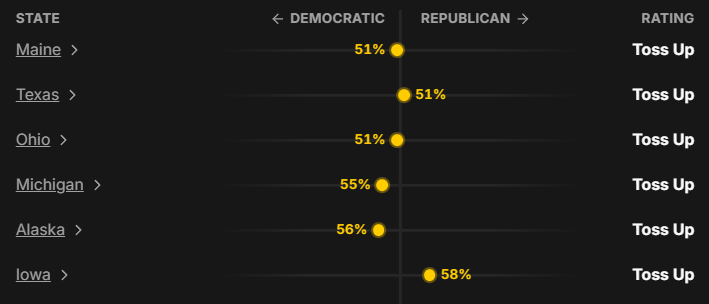
- The Senate seat remains a toss-up following Mary Peltola (D) and Dan Sullivan (R) advancing in Tuesday's Primary.
Toss up Senate races (Decision Desk HQ)
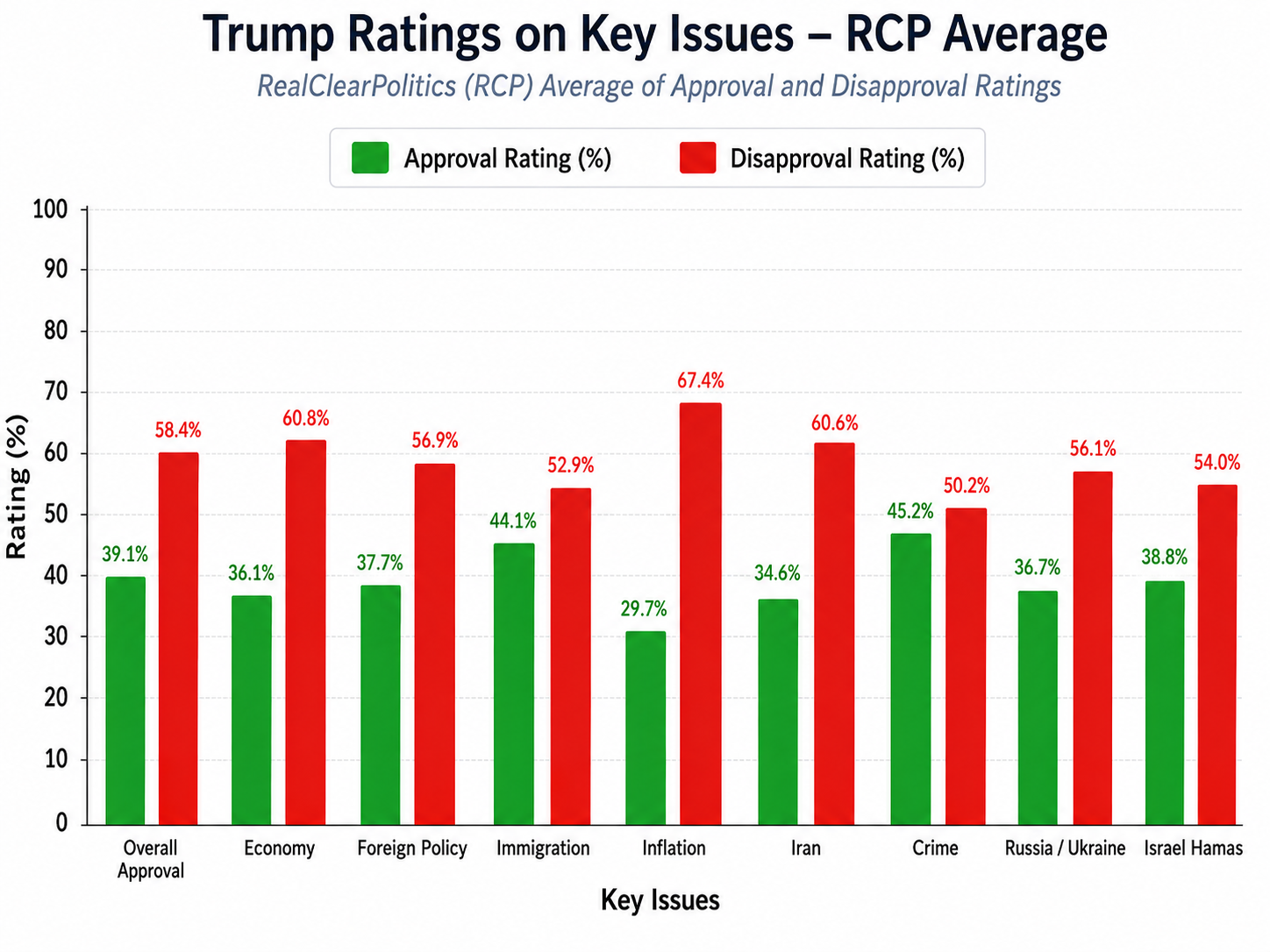
Approval vs. Disapproval Ratings on Trump's key issues
The RCP average compiles pollsters and provides an average approval or disapproval rating across key topics.
| Topic | Approve % | Disapprove % | Difference (Approve – Disapprove) |
|---|---|---|---|
| Overall Approval | 39.1 | 58.4 | -19.3 |
| Economy | 36.1 | 60.8 | -24.7 |
| Foreign Policy | 37.7 | 56.9 | -19.2 |
| Immigration | 44.1 | 52.9 | -8.8 |
| Inflation | 29.7 | 67.4 | -37.7 |
| Iran | 34.6 | 60.6 | -26.0 |
| Crime | 45.2 | 50.2 | -5.0 |
| Russia/Ukraine | 36.7 | 56.1 | -19.4 |
| Israel Hamas | 38.8 | 54.0 | -15.2 |
Takeaways:
- All topics show a higher disapproval than approval, indicated by the negative differences.
- Inflation has the largest gap (‑37.7 points), suggesting the strongest public dissatisfaction.
- Crime shows the smallest gap (‑5.0 points), indicating the closest balance between approval and disapproval among the listed issues.
- Throughout the year polling has shown the spread between those who either unfavour or disapprove, or favor and approve of US President Trump's job, has widened.
Latest Reuters/Ipsos Poll (August 14-17th, 1,166 US adults)
- 33% of respondents said they approved of Trump’s performance in the White House (prev. 35% on Aug 3rd), while 64% disapproved; approval rating is now at its lowest level of his current term, matching the low reached in December 2017 during his previous term.
- 80% of Americans, including 87% of Democrats and 71% of Republicans, believe US involvement in Iran will continue for an extended period, while just 16% expect the conflict to end within a few weeks.
- 69% of Americans believe Trump's business interests are influencing his decisions as President; this includes half of Republicans, roughly two-thirds of independents and nine in 10 Democrats.
- Republicans are divided over whether graft under Trump has improved, remained unchanged or worsened.
- 63% of respondents said it was inappropriate for Trump and his family to profit in that manner, while 32% said it was appropriate; the remainder did not answer.
- Around three in 10 Republican respondents viewed the deals as inappropriate, compared with seven in 10 who considered them appropriate.
Reuters/Ipsos Poll (August 3rd, 4,505 US adults)
- Democrats lead Republicans 37% to 36% on stewardship of the US economy, which Fox highlights is the first time since 2007. 27% said they are not sure that a different party would do a better job.
- In congressional elections, 42% of registered voters would vote for a democrat, and 37% would vote for a Republican if the contest were held now. Independents favoured democrats over Republicans by 12 points.
- Regarding the House and Senate votes, the poll finds that roughly 36 of the 435 seats are expected to be competitive, while eight Senate seats are expected to be competitive.
- Despite the polling, US President Trump continues to claim he is doing well in the polls and to ignore the fake news media.
- A previous Reuters/Ipsos poll (July 27th) found 1/3 Americans support the war on Iran, the lowest reading in a Reuters/Ipsos poll since the five-month-old conflict's early days, with most respondents saying that Trump has failed to explain his goals.
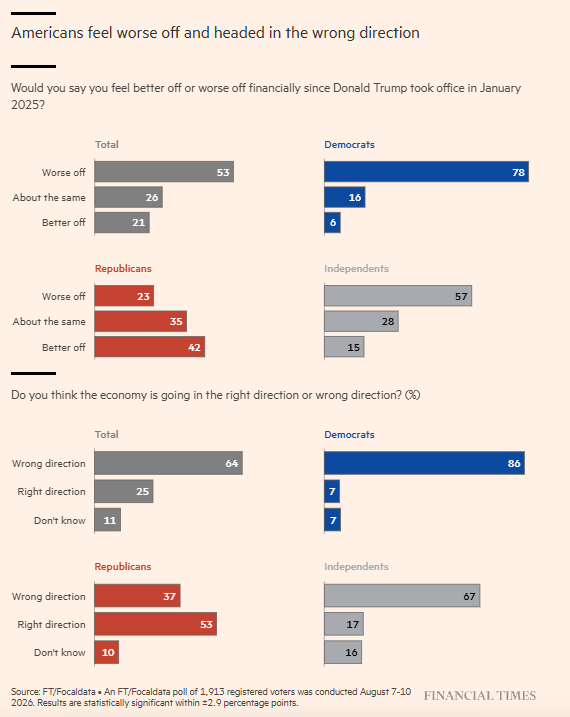
Americans feel worse off and headed in the wrong direction (Financial Times)
SAVE America Act
- Trump has previously suggested that Republican success in the midterms is contingent on passage of the SAVE America Act.
- That has so far failed to materialise: the legislation has passed the House multiple times but remains stalled in the Senate, where it faces the 60-vote threshold required to overcome a filibuster.
- Trump has pushed the SAVE America Act into Reconciliation 3.0, a mega bill, consisting of USD 73bln in defense funding, USD 12bln in farm aid, and a USD 10bln fund aimed at incentivizing states to adopt elements of the SAVE America Act.
- The Reconciliation 3.0 mega bill would only need a simple majority to pass in the Senate.
- So far, the budget framework of Reconciliation 3.0 passed in the House earlier in July. Senate GOP leadership pulled a planned vote in early August rather than bring it to the floor, having concluded they didn't yet have the 50 votes needed to proceed.
- On defense funding, Trump had originally sought as much as USD 350bln for the reconciliation package, well above the USD 73bln that ultimately passed the House — reporting suggests Sen. Ron Johnson may push to revisit a larger number when the Senate takes this up in September.
- Now, having failed to secure the votes before the August recess, the White House is shifting its focus to September, when the Senate returns to face a similar vote alongside the broader government-funding deadline.
Equity Impact
Goldman Sachs
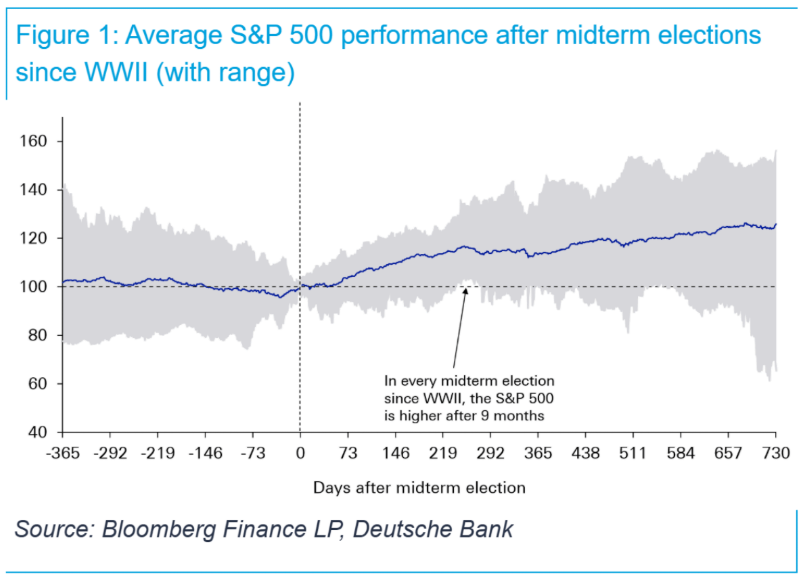
- In past cycles, economic policy uncertainty has usually risen in August ahead of midterm elections and remained elevated in the subsequent few months.
- Equities have typically traded sideways in the few months ahead of midterms.
- During 13 midterm election years since 1974, the S&P 500 has generated a median return of 0% from the start of August through Election Day. Returns have typically improved post-election. Mirroring this pattern, mutual funds and foreign investors have generally demonstrated reduced demand for US equities ahead of midterm elections but increased allocations afterwards.
- The outcome of the midterms is unlikely to be a major cause of equity volatility.
- Within the equity market, most sectors, factors, and thematic baskets have traded with no substantial correlation to prediction market probabilities of election outcomes in recent months, although this may change as the election draws closer.
BTIG
- BTIG chief market technician Jonathan Krinsky said the S&P 500 has historically experienced a pullback of at least ~7% during the August–October period of midterm election years, citing 1990, 1998, 2002, 2010, 2014, 2018 and 2022; 2006 was the main exception, with its decline occurring in May–July.
- Krinsky said midterm-related volatility is often driven by unforeseen external events, citing the 1990 Kuwait invasion, 1998 Long-Term Capital Management collapse, 2014 Ebola outbreak and 2018 US-China trade war.
- Krinsky said the recent market broadening and rally from the late-July summer slowdown have been strong, but warned that historical patterns point to a more difficult period ahead.
- He said the market is entering a historically volatile downside window with stocks at all-time highs and the VIX at 2026 lows.
- Krinsky said this makes it an attractive time to reduce risk or hedge broad-based equity exposure ahead of what has historically been a difficult part of the calendar.
What it means
Prediction-market midterm pricing of this kind has historically been a slow-moving input rather than a discrete catalyst; the established pattern in past cycles is for policy uncertainty to build through the late summer and for the S&P 500 to trade sideways from August into Election Day, with the relief move tending to come after the result rather than before it. The case distinction that matters is sweep versus divided government: a sweep reopens the fiscal and tax channel, since single-party control is what makes reconciliation packages feasible, while a split Congress has historically meant legislative gridlock and a policy path set by executive action and the courts. The capital gains indexing and home-sale exemption proposals are best read as pre-election pledging of the kind incumbent administrations typically roll out in the run-up, where the tell is whether they are drafted for actual passage or for campaign use. The more concrete legislative tell is the reconciliation vehicle carrying defense, farm and election-integrity funding, which has already been pulled once for lack of votes and returns alongside the government funding deadline; failure there would read as an early signal on Senate cohesion. Past midterm-year drawdowns have tended to be driven by exogenous shocks rather than the election itself, so the calendar effect is the precedent, not the outcome. What carries signal from here is whether Senate toss-up pricing keeps moving toward the Democrats, since it is the Senate line, not the House, that determines which fiscal case is live.
- US President Trump will deliver remarks in Florida on Friday, Georgia on Saturday and Michigan on Sunday, according to The Whiye House
- Newsquawk Daily Asia-Pac Opening News - 23rd October 2026
- US President Trump on Iran, says may do it a little bit further
- US President Trump, on Ukraine’s Starlink (SPCX) access, says it’s a very interesting situation; won’t comment on whether he spoke to Elon Musk; bottom line is Musk put it back
- US President Trump invokes Section 232 on wind turbine imports
Related headlines
- US President Trump signs EO on housing costs, aiming to cut mortgage insurance premiums5 hours ago
- US President Trump called Musk and asked him to lift Ukraine Starlink (SPCX) restrictions, WSJ reports6 hours ago
- CRUDE WRAP: WTI (Z6) SETTLES USD 2.32 HIGHER AT 99.47/BBL; BRENT (Z6) SETTLES USD 4.35 HIGHER AT USD 113.17/BBL6 hours ago
- US President Trump says "Iran is doing everything they can to drive up the price of Oil prior to the U.S. Midterm Election". 9 hours ago
- Ukraine President Zelensky says Ukraine is ready for peace talks at G20, but so far no such invitation7 hours ago
- An Israeli military official told Channel 12 that here is no reason to launch an attack on Iran before the elections; If we detect preparations in Iran for an attack, we will act7 hours ago
- [Market Update] Risk-off trade continues as AI concerns linger; stocks trade at new lows with NQ -3.0% as tech leads losses, while gold sees new lows; Treasuries push to new highs, weighing on USD; oil trades off highs supported by geopolitical risk6 hours ago
- Money markets no longer full price a Fed rate hike before end of 20267 hours ago
- US TREASURY WRAP: T-NOTE FUTURES (Z6) SETTLE 1 POINT AND 9+ TICKS HIGHER AT 106-135 hours ago
- A US source told Al Arabiya that the Florida meetings between Lebanon and Israel ended without a breakthrough6 hours ago
- OpenAI trims valuation target to USD 1.25tln after previously pitching a higher price, according to FT2 hours ago
- OpenAI is raising up to USD 30bln in funding round at a USD 1.25tln valuation, led by UAE investors, according to CNBC, citing sources; OpenAI is negotiating a commercial deal that would secure more computing capacity from the UAE4 hours ago
- Western Digital (WDC) Q1 2027 (USD): Adj. EPS 4.64 (exp. 4.08), Revenue 4.38bln (exp. 4.14bln)4 hours ago
- PRE-MARKET JAPANESE AND SOUTH KOREAN STOCKS NEWS: Tech stocks in focus after the sell off in the sector stateside, while SK Hynix cancels plan to list Solidigm unit on the Nasdaq1 hour ago
- Bloom Energy (BE) Q3 2026 (USD): Adj. EPS 0.94 (exp. 0.69), Revenue 1.24bln (exp. 1.06bln)4 hours ago