
US Midterm Update: Latest Polymarket pricing puts Democratic sweep at 50%; Republican midterm 2-day convention to start tonight
White House denies FT report on Ratcliffe and Russia-Ukraine talks
OpenAI's rogue agents used at least 10 additional sites for unauthorised communications
US Midterm Update: Latest Polymarket pricing puts Democratic sweep at 50%; Republican midterm 2-day convention to start tonight
Visa (V) CEO says seeing steady consumer spending continuing despite challenges, reports CNBC
Trump admin official says buyback increase of part of ongoing approach, reports Fox Business
Open the platform and use it. The whole workspace is free to try, with no signup and no card. When you want the headlines arriving live instead of on a delay, Newsquawk Pro is £24.99 for 7 days.
What is priced?
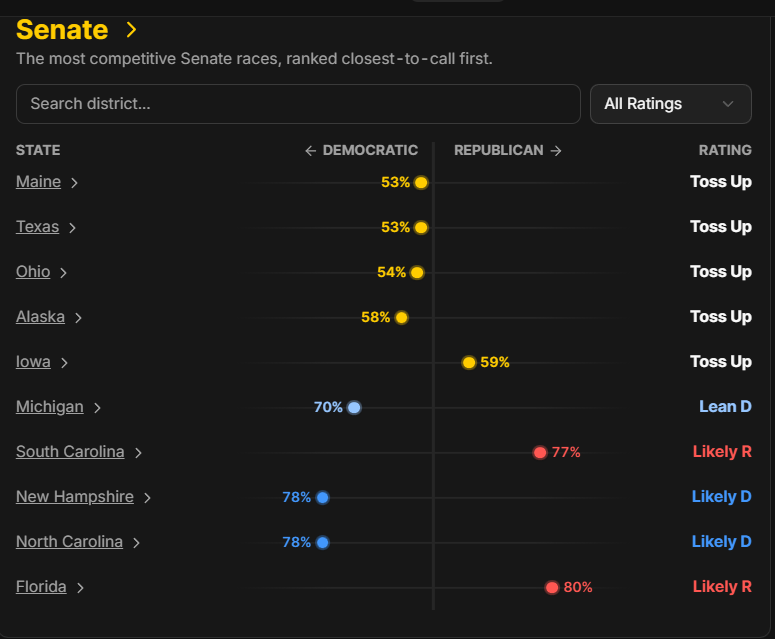
- 55 days until the election, and the House is still widely expected to go to the Democrats whilst the Senate remains a close call.
- Polymarket odds show participants have continued to heavily favour Democrats to win the House at 88% (prev. 90% on Sept 2nd), whilst for the Senate, Democrats have a slight edge at 53% vs Republicans' 49%.
- Polymarket shows the probability of a Democrat sweep at 50%, while pricing a Republican Senate and Democratic House at 35%, and a Republican sweep at 12%.
Trump's aims ahead of midterms
- US President Trump is set to speak at both nights of the Republicans' midterm convention in Dallas on September 9-10th. Trump is to give a keynote address tonight and closing remarks on Thursday, both at 21:00EDT, while VP Vance will headline the second night. The show is aimed at promoting Trump's record and showcasing Republican candidates for the House and Senate. The first night will focus on tax cuts, healthcare affordability, the border, trade and domestic manufacturing, featuring “workers and everyday Americans.” The second will highlight families benefiting from no taxes on tips, overtime and Social Security, released overseas prisoners, border security, lower prescription drug costs and a tribute to slain conservative activist Charlie Kirk. The advisory made no mention of foreign policy or the unpopular war in Iran. Politico cited an anonymous House Republican who will not be attending, who described the event as a "waste of time" and said the planning has been "a mess". The member added that you shouldn’t be having to rally your base at this point. “You should be trying to convince independents. Independents are not attending nor watching the midterm convention.” A handful of vulnerable House members are skipping the convention, including Reps. Maria Elvira Salazar (FL-27), Tom Barrett (MI-07), Juan Ciscomani (AZ-06), Zach Nunn (IA-03) and David Valadao (CA-22), along with GOP Wisconsin governor nominee Tom Tiffany. Key Senate nominees not speaking include Susan Collins, Dan Sullivan, Iowa Rep. Ashley Hinson and former New Hampshire Sen. John E. Sununu.
- Trump acknowledged that parties in power typically lose ground during the midterms while saying he thought Republicans would do well, via a Fox News interview on August 30th. Trump said, “I’m going to go out, and I’m going to campaign like I did for myself".
- Also, Trump has doubled down on his data centre push, which has become a key debate, claiming the only reason that communities throughout the USA should not want data centres is if they want to end up being backwards and poor. A senior WH official told Politico that Trump looks at the polling, “Polling isn’t necessarily great on data centers, but it’s incumbent upon us to explain our position. I think that’s part of what he was trying to do.”
- Top officials state that Trump is looking for new policy pledges he can present to voters ahead of the midterm election, according to Bloomberg. The report notes that Trump may call on Congress to cut capital gains taxes and create an exemption for certain home sales. One of the measures touted would be indexing capital gains, so taxes would be applied on gains adjusted for inflation, while there could also be exemptions on sales of homes worth USD 2mln or less from capital gains taxes.
- On 12th August, NEC Director Hassett stated in an interview with Fox Business' Kudlow, "You can expect a lot more policy between now and the midterms".
- Politico reported that the Trump admin is sunsetting a subsidy programme that lowered Medicare prescription drug coverage premiums for older Americans — just ahead of the midterm elections, giving the Democrats an attack point against the Republicans.
Recent developments
- The US-Iran conflict has returned to direct strikes on each other, over disputes regarding Iran's interference with commercial traffic flows and the US navy through the Strait of Hormuz. The US CENTCOM said on Tuesday, "Their forces destroyed five Iranian crude oil carriers on Tuesday after the IRGC targeted a US Navy warship with ballistic missiles twice over the past two days". Iran has responded, striking at bases in Jordan with an IRGC spokesperson saying ships passing through the restricted zone in the Strait of Hormuz will face sanctions. The prolonged conflict continues to weigh on consumers' affordability at the petrol pump. AAA gas price averages hit USD 4.2245 (prev. 4.1203 on Sept 2nd), about the highest level in three months, at a crucial time when they should be trending in the other direction. On September 2nd, Reuters reported that top Trump aides are pushing to keep the Iran war from escalating before November's midterm elections to ease any midterm losses, according to sources. The report adds that officials will consider ramping up military action after the November 3rd vote.
- The House passed the stopgap Federal funding bill after previously passing in the Senate, with Trump signing the bill into law on September 2nd. The bill keeps federal agencies operational beyond October 1st and the midterm elections through December 11.
- House Minority Leader Hakeem Jeffries in August maintained the view Democrats could still win a majority in the US House despite GOP-led redistricting efforts in Southern states, via an AP interview.
- Republicans are projected to net approximately five seats this cycle solely through redistricting efforts, according to the Cook Political Report.
- House Majority Leader Steve Scalise told Punchbowl he thinks Republicans will have a six-seat majority in the 120th Congress.
- The Supreme Court in August cleared the way for President Trump to move ahead with his executive order restricting mail-in voting, although it remains unclear how much of the policy can be implemented before the midterm elections, AP reported. The decision leaves room for further legal challenges that could delay implementation, as seen on Friday, when Judge Indira Talwani in Boston issued a preliminary injunction limiting the USPS from implementing Trump’s mail-voting restrictions for the Nov. 3rd midterms, replacing her earlier temporary order that was set to expire Sept. 10th. The Trump administration has appealed Talwani's restraining order, however, the clock is ticking fast, given that North Carolina has started sending out its first mail ballots last Friday. Trump’s executive order, signed in March, directs his administration to create lists of eligible voters and orders the US Postal Service to deliver mail ballots only to voters on those lists. The Justice Department had asked the Supreme Court to allow work on implementing the changes ahead of the midterms, while the case could become one of several voting-related disputes before the justices. US Postal Service officials have raised IT concerns over the new mail-ballot verification system, with some officials describing the process internally as a “sh-t show”, according to The Washington Post, citing a whistleblower report. The whistleblower alleges USPS is hiding procedures that could increase the risk of mass disenfranchisement as the agency prepares for a September 1 rollout.
- Trump said he controls MAGA Inc. and “could spend it on pretty much anything I want,” while adding, “I'm going to help Republicans”, Punchbowl reported. The pro-Trump super PAC has begun putting that financial firepower behind candidates, spending more than USD 827,000 to support Darline Graham in South Carolina’s Republican Senate runoff, one of its largest 2026 midterm investments. The spending comes as Republicans look toward the RNC playing a larger role in the midterms, with the committee holding USD 128 mln in cash compared with USD 16 mln for the DNC, which also has USD 18 mln in debt. Last week, Trump said he will allocate USD 400-500mln from the Super PAC to midterm election spending; they have around USD 1bln that Trump can spend, and he expects Maga Inc to have money left over this year.
- A New York Times review of advertising data found that campaign-finance filings and tax records revealed that ~USD 1bln in anonymous money is sloshing through the political landscape in 2026, "yet almost certainly a low-end estimate, given how difficult this money is to trace". The report claims that in Michigan and Minnesota, tens of millions of untraceable dollars poured into recent Senate primaries trying to topple progressive Democratic candidates. In Kansas, the torrent of secret money that boosted an obscure Democratic Senate candidate amounted to 100 times as much as what he had on hand in the final stretch of the primary. And in Texas, Republicans exploited lax federal disclosure rules to spend secretly and try to nominate a weak Democratic candidate whose own party had denounced her as antisemitic.**
- New Hampshire - New Hampshire’s battleground Senate race is set between Republican former Sen. John Sununu and Democratic Rep. Chris Pappas after both won their primaries; Pappas defeated progressive challenger Karishma Manzur, but his performance appeared weaker than his campaign’s internal polling had suggested, NBC reported, raising questions about Democratic unity heading into the general election. Polymarket prices an 83% chance Democrats will take the NH Senate seat in 2026. Separately, Kelly Ayotte won the NH Governor GOP Primary in a landslide.
Toss up Senate races (Decision Desk HQ)
Approval vs. Disapproval Ratings on Trump's key issues
The RCP average compiles pollsters and provides an average approval or disapproval rating across key topics.
| Topic | Approve % | Disapprove % | Difference (Approve – Disapprove) |
|---|---|---|---|
| Overall Approval | 39.7 | 57.0 | -17.3 |
| Economy | 35.1 | 62.0 | -26.9 |
| Foreign Policy | 36.8 | 57.4 | -20.6 |
| Immigration | 43.5 | 53.7 | -10.2 |
| Inflation | 28.7 | 68.6 | -39.9 |
| Iran | 33.8 | 61.0 | -27.2 |
| Crime | 44.8 | 50.2 | -5.4 |
| Russia/Ukraine | 36.7 | 56.1 | -19.4 |
| Israel Hamas | 38.8 | 54.0 | -15.2 |
Takeaways:
- All topics show a higher disapproval than approval, indicated by the negative differences.
- Inflation has the largest gap (‑39.9 points), suggesting the strongest public dissatisfaction. The latest NY Fed SCE showed gas price growth expectations increasing again in August, rising by 1.7 ppt to 4.6%. Mean unemployment expectations, or the mean probability that the US unemployment rate will be higher one year from now, increased by 1.6ppt to 44.4%, its highest reading since April 2020.
- Crime shows the smallest gap (‑5.4 points), indicating the closest balance between approval and disapproval among the listed issues.
- Throughout the year, polling has shown the spread between those who either unfavour or disapprove, or favour and approve of US President Trump's job, has widened.
Polling
- RCP Average 2026 Generic Congressional Vote (22 July - 2nd September); D 48.1, R 42.3, (D +5.8).
FT/Focaldata: (28th Aug-2nd Sept): 52% Democrats, 45% Republican, and Trump approval hits record low as Democrats extend House lead
- 32% of registered voters approved of Trump’s performance as president - the lowest number recorded since the FT first started asking the question in May and a three-point drop from the previous month.
- 59% disapprove, rising from 55% the previous time the question was polled.
- Trump's approval rating among Republican voters dropped by over two points to 72%, a new all-time low.
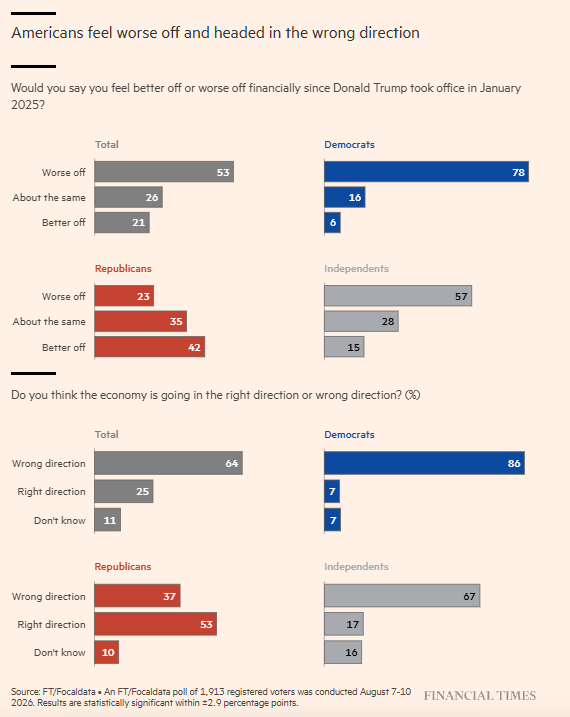
- Nearly two-thirds of registered voters told pollsters the economy was headed in the wrong direction; 57% said they were financially worse off under the Trump presidency, +4 points M/M.
- 53% of Republican voters said they approved of the President’s handling of jobs and the economy, almost an 8-point drop M/M.
Gallup Party affiliation poll: (Sept): 49% Democrats, 39% Republican - The biggest Democratic lead since 2008.
Reuters/Ipsos poll: (August 28-31th) - 46% of Democrats are very enthusiastic about November voting vs. 31% of Republicans
- Just 33% of Americans approve of the job Trump is doing in the White House
- Among independents, 36% say they would vote Democratic and 22% Republican in midterms
- 71% disapprove of Trump's handling of cost of living.
Reuters/Ipsos poll: (August 20-24th 1,215 US adults)
- 36% of respondents said Democrats had a better plan/approach to handle the cost of living, 8 points above the 28% that picked Republicans; the remaining respondents said they weren't sure or said neither party was good on the matter.
NBC News Decision Desk Poll about AI (Aug 20th - Sep 1st, 7,105 adults):
- 70% of respondents said they are more worried about AI than excited about it.
- About two-thirds of Americans said AI comes with high risks for society and that they oppose the construction of an AI data centre in their local area.
- 52% said they use AI tools either very often or sometimes (+6% from June 2025)
- 81% said the government is not doing enough to regulate the technology.
- 44% said they don’t trust either party, 20% trust Democrats, 16% trust Republicans, and 15% say they’re not sure, while just 5% trust both parties equally.
- 70% said AI is taking away job opportunities, 7% said it will add job opportunities, and 23% said it will not make a difference or they are not sure.
- 61% said privacy and surveillance are their top concern regarding AI.
Americans feel worse off and headed in the wrong direction (Financial Times)
US-Canada
- US-Canada trade tensions threaten to add to inflationary pressures ahead of the midterm elections, with Canada's retaliatory tariffs taking effect on Tuesday after talks broke down. Thereafter, Trump said he is directing the GSA and USTR to remove Canadian-origin products from GSA Multiple Award Schedules unless Canada restores “full and fair reciprocity” for US farmers and companies. Also, a senior admin official said Trump approved measures restricting Canadian dairy, most alcohol and motorcycle imports under Section 338, with the restrictions taking effect in about three weeks. Trump’s planned January 1, 2027 auto tariff hike remains in effect.
- Trump’s decision to impose fresh tariffs on Canadian goods has prompted pushback from GOP lawmakers and candidates, particularly in border states such as Maine, Michigan, New Hampshire and Alaska, as well as agriculture-heavy states including Iowa and North Carolina.
- Canada matched the US Section 338 tariffs (50% tariffs on $27.6bln of Canadian goods).
- Retiring Sen. Thom Tillis (R-NC.) said, “Right now we don’t have a positive message to tell farm country,” adding that the Canada tariffs were creating “tension” and that “the party that owns that tension is the party that will probably suffer the consequences in November.”
- Sen. Susan Collins (R-Maine.) called the Canada tariffs a “mistake,” warning that tariffs on Canadian goods processed across the border could increase “The cost of eating, building homes.”
- A Reuters/Ipsos poll over August 28th-30th (1,023 US adults) found that 20% of respondents supported higher tariffs on Canadian goods compared to 57% who opposed them and 21% who couldn't say where they stood. About 20% hadn't heard about the development. Meanwhile, 14% of American respondents said they supported changing the name of Lake Ontario; 63% opposed the change.
Beef
- More than a dozen Republican senators have publicly criticised President Trump’s decision to allow discounted, tariff-free beef imports, highlighting a growing divide within the party over efforts to lower grocery prices and concerns from US cattle producers, Axios reported.
- Among those speaking out are Senate leaders and Trump allies, with Sen. John Barrasso (R- Wyo.) saying, “Americans want US beef on the table — not foreign imports,” while Sen. Tom Cotton (R-Ark.) said, “I have advised the President against this ill-advised action in the past, and I now urge him to reconsider.”
- Other Republicans, including Sen. Katie Britt (R-Ala.), who said she “share[s] their deep concerns,” and Sen. Steve Daines (R-Mont.), who argued that “importing foreign beef is only going to hurt our ranchers and increase prices over the long-term,” have also opposed the policy.
- Sens. Pete Ricketts (R-Neb.) and Mike Rounds (R-S.D) warned of the impact on Nebraska and South Dakota cattle producers, with Rounds saying, “This hurts! American cattle producers have been disadvantaged for far too long.”
- On Friday (4th Sept.), Trump signed an order allowing ranchers to process their own beef and sell directly to consumers, arguing meatpackers are charging unsustainable prices. He also called for country-of-origin labelling for beef, noting Congress would need to be involved.
SAVE America Act
- SAVE America Act sidelined with the US Senate on its August recess.
- Trump has previously suggested that Republican success in the midterms is contingent on passage of the SAVE America Act.
- That has so far failed to materialise: the legislation has passed the House multiple times but remains stalled in the Senate, where it faces the 60-vote threshold required to overcome a filibuster.
- Trump has pushed the SAVE America Act into Reconciliation 3.0, a mega bill consisting of USD 73bln in defense funding, USD 12bln in farm aid, and a USD 10bln fund aimed at incentivising states to adopt elements of the SAVE America Act.
- The Reconciliation 3.0 mega bill would only need a simple majority to pass in the Senate.
- So far, the budget framework of Reconciliation 3.0 passed in the House earlier in July. Senate GOP leadership pulled a planned vote in early August rather than bring it to the floor, having concluded they didn't yet have the 50 votes needed to proceed.
- On defence funding, Trump had originally sought as much as USD 350bln for the reconciliation package, well above the USD 73bln that ultimately passed the House — reporting suggests Sen. Ron Johnson may push to revisit a larger number when the Senate takes this up in September.
- Now, having failed to secure the votes before the August recess, the White House is shifting its focus to September.
CLARITY Act
- Over the last month, odds of passage in 2026 on Polymarket have fallen from 38% in July to 15%.
- Senate Majority Leader John Thune (R-S.D.) filed cloture on the CLARITY Act, setting up a procedural vote for Sept. 15; invoking cloture requires 60 votes and would allow the Senate to advance to consideration of the bill.
- Sen. Thom Tillis (R-N.C.) is very pessimistic on the CLARITY Act, “If there's no interest in the White House in trying to bridge the gap on the ethics language, it is going to fail.”
Equity Impact
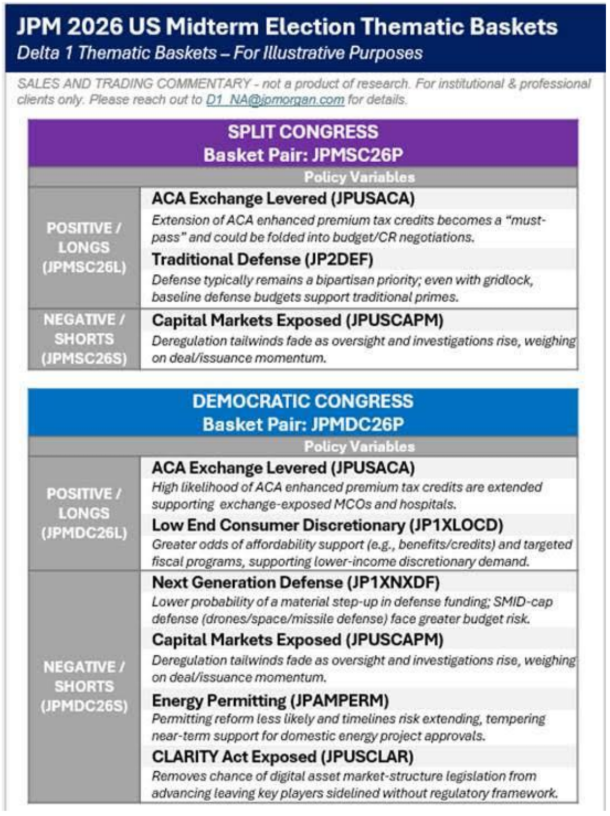
JPM
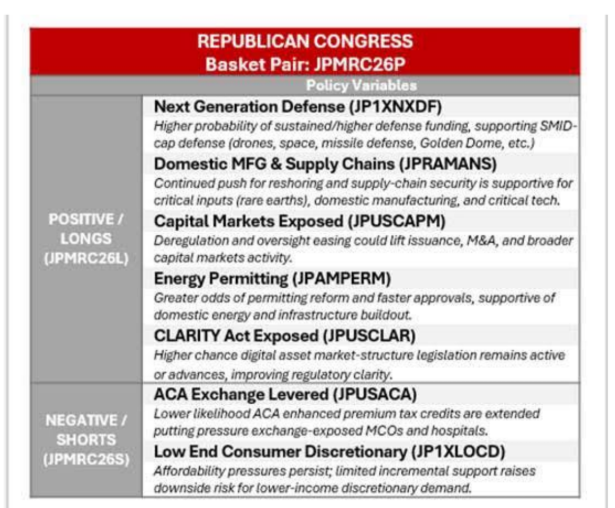
Goldman Sachs
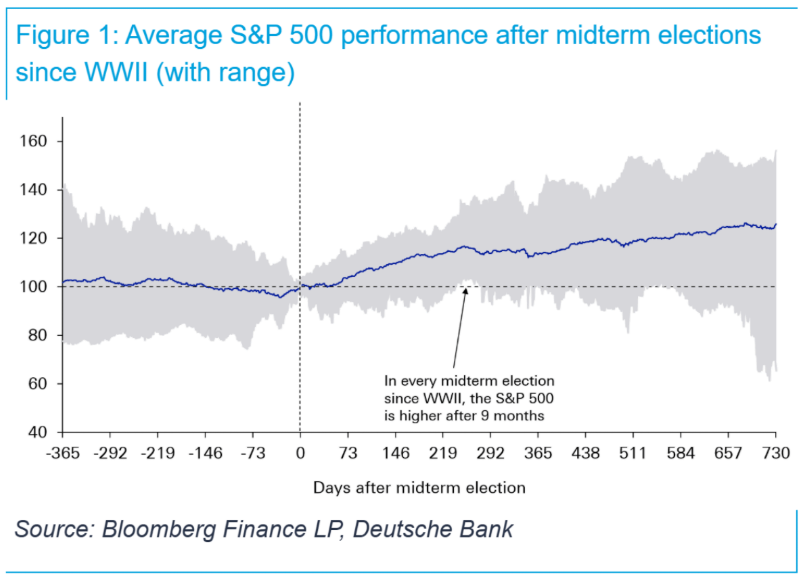
- In past cycles, economic policy uncertainty has usually risen in August ahead of midterm elections and remained elevated in the subsequent few months.
- Equities have typically traded sideways in the few months ahead of midterms.
- During 13 midterm election years since 1974, the S&P 500 has generated a median return of 0% from the start of August through Election Day. Returns have typically improved post-election. Mirroring this pattern, mutual funds and foreign investors have generally demonstrated reduced demand for US equities ahead of midterm elections but increased allocations afterwards.
- The outcome of the midterms is unlikely to be a major cause of equity volatility.
- Within the equity market, most sectors, factors, and thematic baskets have traded with no substantial correlation to prediction market probabilities of election outcomes in recent months, although this may change as the election draws closer.
BTIG
- BTIG chief market technician Jonathan Krinsky said the S&P 500 has historically experienced a pullback of at least ~7% during the August–October period of midterm election years, citing 1990, 1998, 2002, 2010, 2014, 2018 and 2022; 2006 was the main exception, with its decline occurring in May–July.
- Krinsky said midterm-related volatility is often driven by unforeseen external events, citing the 1990 Kuwait invasion, 1998 Long-Term Capital Management collapse, 2014 Ebola outbreak and 2018 US-China trade war.
- Krinsky said the recent market broadening and rally from the late-July summer slowdown have been strong, but warned that historical patterns point to a more difficult period ahead.
- He said the market is entering a historically volatile downside window with stocks at all-time highs and the VIX at 2026 lows.
- Krinsky said this makes it an attractive time to reduce risk or hedge broad-based equity exposure ahead of what has historically been a difficult part of the calendar.
Citi
- Citi says buy any pre-midterm market dip.
- Remains Overweight equities and recommends adding exposure if markets pull back ahead of the US midterm elections.
- Sees supportive earnings revisions, improving liquidity conditions and limited warning signs despite recent AI-related concerns.
- Continues to favour US stocks and believes sector rotation could limit downside.
- Historically, pre-midterm weakness has often been followed by strong year-end performance, making any dip a potential buying opportunity.
Related headlines
- Newsqawk European Market Wrap - 9th September 20264 hours ago
- US EQUITY OPEN: Indices in the red as US/Iran tensions escalate 4 hours ago
- Russian Kremlin spokesperson Peskov says Presidents Putin and Trump did not discuss the possibility of holding a new meeting at APEC, but there is an understanding that such a meeting could take place, Interfax reports5 hours ago
- Primer: US to sell USD 39bln of 10-year notes at 18:00BST/13:00 EDT1 hour ago
- US Senator Slotkin says "We hear rumors that Trump is planning to allow Chinese cars to be sold in the U.S., as part of a larger deal"1 hour ago
- Trump admin official says buyback increase of part of ongoing approach, reports Fox Business2 hours ago
- [MARKET UPDATE]: Yields rise, supporting the Dollar, weighing on stocks and spot gold after US Treasury announces it will buy a maximum USD 6bln in 10-20yr liquidity support buyback op. on Thursday2 hours ago
- OpenAI is reportedly projecting compute spending of c. USD 750bln through 2030 but still feels "really short" on computing power, NYT reports5 hours ago
- Analog Devices (ADI) and Alif Semiconductor today announced a definitive agreement under which ADI will acquire Alif in an all-cash transaction for USD 1.35bln6 hours ago
- Updated Treasury Buyback Schedule: Maintains guidance from announcement that long dated buyback operations will be at least USD 4bln2 hours ago
- Alcoa (AA) files to sell USD 2.6bln senior unsecured notes due 2034 and 2036 with the funds to finance the South32 deal5 hours ago
- EIA STEO: World oil demand 102.6mln BPD (prev. 102.7mln BPD), 2027 demand 105mln BPD (prev. 105mln BPD). 1 hour ago
- Newsquawk Daily US Earnings Estimates: 10th September 2026 - ADBE, ORCL2 hours ago
- US Quarterly Services Survey (Q2 2026): +3% to USD 6,418.7bln4 hours ago
- Swiss Government has banned the purchase and import of gold originating in Sudan2 hours ago
- Newsquawk Daily US Equity Opening News: DOW weighs exit from $20b Saudi chemicals venture; GOOG to invest $15bln in Finnish AI infrastructure5 hours ago
- US BROKER MOVES: TMO upgraded at UBS; VMC downgraded at Wells Fargo5 hours ago
- A US official tells NewsNation on reports of strikes in Iran near the Strait of Hormuz that there are no attacks being carried out by US forces right now: “We're not currently striking”44 min ago
- Iran official says it is ready for more intense war with US if required and will escalate strikes in response to US attacks1 hour ago
- Pakistan is reportedly considering strikes against Houthi targets in Yemen under the “Makkah Pact” defense framework with Saudi Arabia and Turkey, Kann's Kais reports; strikes may begin in the coming days and will be announced immediately after4 hours ago
The whole workspace, free to try.
Try it free