
Midterm Preview: Democrats Eye Sweep: House Likely, Senate Within Reach
Newsquawk Analysts ·
Summary
- Next Tuesday (November 3rd), voters head to the polls to decide 35 Senate seats, all 435 House seats, 36 governorships, and public utility commissioners in 9 states.
- Midterm elections, which take place two years into a presidency, are viewed as a referendum on the ruling party’s handling of key issues. Trump’s approval ratings are among the lowest for a sitting president in the post-World War II era, weighed down by higher energy, mortgage and healthcare costs. According to the RCP Average, Trump’s handling of inflation is viewed most negatively, whilst his handling of crime receives the best rating.
- 35 of 100 Senate seats are up for election, of which 22 are held by Republicans and 13 by Democrats. The current balance of power in the Senate favours the Republicans, who have 53 seats to the Democrats’ 45, with 2 Independents caucusing with the Democrats. Polls show the Senate race remains close, with the majority of key races in Republican-held seats, leaving the party vulnerable (Alaska, Iowa, Kansas, Maine, Ohio, Texas, and North Carolina). Polymarket is more confident than pollsters, pricing a 69% chance of the Democrats winning the Senate, which would require a net gain of 4 seats. DDHQ forecasts a narrow win for the Democrats, D 52 - R 48.
- All 435 House of Representatives seats are up for election, and the Democrats are widely expected to take a majority, which markets price at 94%. Republicans currently hold a slim House majority, with 218 seats to the Democrats’ 214, plus 1 Independent and 2 vacancies, meaning Democrats need a net gain of three seats to win control. DDHQ forecasts a Democratic win, D 239 - R 196.
- Balance-of-power betting odds have increasingly favoured a Democratic sweep, following President Trump’s declining approval ratings amid an Iran war that has weighed on the cost of living for Americans through higher diesel and gasoline prices. Americans’ concerns over AI security and privacy, along with higher utility bills linked to AI data centres, have made AI a new issue for voters in the upcoming election; meanwhile, elevated mortgage rates continue to put homeownership out of reach for many voters.
- Polymarket odds of congressional outcomes are: Democratic sweep (70%); Democratic House and Republican Senate (24%); and Republican sweep (6%).
- Extra focus will be on gubernatorial and Public Utility Commission (PUC) commissioner elections, as near-term data-centre policy is likely to be set at the state level. Gubernatorial elections will take place in 36 states: 18 Democratic-held and 18 Republican-held. Governors appoint PUC commissioners in around 40 states, while in 10 states, commissioners are directly elected; 9 of these states will hold PUC commissioner elections in November.
- Traders will be attentive to the gubernatorial races for any potential change in stance on the AI trade at either the state or local level. Any delay to data-centre capex plans or to AI model development spending will be a focus. Incumbents are likely to outperform newer entrants: hyperscalers with existing data-centre capacity, secured grid connections and strong balance sheets are better placed to absorb delays or stricter rules.
- Democratic sweep (D House, D Senate): Consumer-facing and healthcare names stand to benefit from softened SNAP and Medicaid cuts, as well as the potential reversal of recent healthcare changes (e.g., restoring enhanced ACA subsidies). AI-exposed names face mainly state-level build-out risk, financials lose deregulatory upside, and the end of Reconciliation 3.0 removes the main Treasury supply risk.
- Split Congress (D House, R Senate): Gridlock raises shutdown and debt-limit risk, keeps healthcare policy largely unchanged and borrowing near baseline, and offers modest relief on SNAP cuts. It also leans USD-negative, given the downside risks to growth.
- Republican sweep (R House, R Senate): A pro-AI, deregulatory agenda supports AI-exposed stocks, financials, defence and nuclear names. Meanwhile, Reconciliation 3.0 keeps Treasury supply risk alive, and SNAP and tax-credit cuts weigh slightly on staples, retail and restaurants.
Recent Developments
- Earlier in the week, Trump said that he would respect next week's midterm results "if they're honest elections".
- House: Crystal Ball shifted 12+ races towards Democrats in the past week, and nearly 50 in October alone. TX-15, which Trump won by nearly 20 points, moved from Toss-up to Lean D, and Crystal Ball says Democrats could pick up as many as four seats in Pennsylvania alone, more than the three they need to flip the chamber.
- Senate: Crystal Ball moved three races towards Democrats: Florida from Safe R to Likely R, citing encouraging early-vote numbers; South Carolina from Likely R to Lean R; and North Carolina from Lean D to Likely D. It says Democrats have the inside track to a narrow 51–52-seat majority.
- Politico reported, citing six people involved in internal GOP conversations, that House Republicans are now privately debating how many seats they’ll lose, not whether they’ll lose the majority, with incumbents in once-safe seats pleading for last-minute money; three of those people said some incumbents even stopped their own polling weeks ago to save cash.
- Alaska Senate: The NYT reported that Peltola campaign members, her lawyers and senior Democratic Senatorial Campaign Committee (DSCC) aides helped put a second "Dan Sullivan" on the ballot to confuse voters; Peltola's campaign denies involvement, and the NYT notes ballot stacking is common and widely considered legal. Federal prosecutors and Alaska's governor have opened investigations, and Trump called for Peltola to withdraw and face prosecution. The DOJ is suing to block certification of the result if Sen. Dan Sullivan loses, though it says it is not seeking to stop certification and only wants ballots preserved so officials can check whether voters were misled. Judge Sharon Gleason has let Democrats and voter groups intervene against the suit, with a ruling on bids to dismiss it possible as early as this weekend.
- Trump said anyone who reports voter fraud, whether from past elections or the upcoming 2026 midterms, will be paid USD 1mln if their tip leads to the arrest and conviction of those responsible.
- The US has told Gulf allies to prepare for a short military campaign against Iran after the midterms, and is moving Patriot defences, restocking munitions and adding a carrier group and Marine unit to the region, the WSJ reported. Trump hasn't decided but is leaning towards a large post-election strike on Iranian infrastructure and nuclear sites.
- Trump rallied in West Texas for Ken Paxton, who is in a tight Senate race against Democrat James Talarico. At the rally, Trump announced a draft EPA rule rolling back Biden-era methane leak requirements for oil and gas companies, which Paxton was the first to sue over in 2024. Trump claimed the rollback would save consumers and producers USD 45bln, unlock more Texas natural gas and add 210mln barrels of oil.
- Trump is swapping some Canadian goods on the Section 338 tariff list: plywood, some paper, machinery, refrigeration equipment and packing crates come off; valves, carpets, waste products and others go on. The WSJ reported that the exemptions were requested by Sen. Susan Collins, who is in a tight re-election race in trade-dependent Maine; they could also help Republicans such as Mike Rogers in Michigan and John Sununu in New Hampshire, who have criticised the Canada tariffs.
- Trump said Audi has committed USD 4.2bln to a plant in Macon that will produce 200,000 cars a year, with construction beginning next month, in a move seen as aimed at boosting Republicans in Georgia’s tight Senate race. Audi said the plant, its first in Georgia, would create about 4,500 jobs, with construction starting in 2027 and production in the early 2030s.
- The DOJ told a federal court that no FBI or ICE staff will serve as midterm election monitors, though Bureau of Prisons, ATF and DEA employees will; monitors will be unarmed and limited to observing and taking notes. The filing responds to an NAACP lawsuit arguing the plan amounts to voter intimidation, Reuters reported.
Senate
The current balance of power in the Senate favours the Republicans, who have 53 seats to the Democrats’ 45, with 2 Independents caucusing with the Democrats. Polymarket prices a 69% chance of the Democrats winning the Senate.
35 of the 100 seats are up for election, comprising 33 Class 2 seats and two special elections (Florida and Ohio, Class 3). Of these, 22 are held by Republicans and 13 by Democrats. Democrats need a net gain of 4 seats to regain Senate control.
As it stands, Cook Political Report (CPR) describes a Democratic majority as within reach and forecasts a net gain of 2–6 seats for the Democrats. CPR rates seven Senate seats as Toss-ups: Alaska, Iowa, Kansas, Maine, Ohio and Texas, all Republican-held, and Democratic-held Michigan. With six of the seven Toss-ups held by Republicans, the ratings highlight the vulnerability of the Republicans’ Senate majority amid Trump’s declining approval. Democratic-held New Hampshire and Minnesota are rated Lean D. Two races are rated Likely D: Democratic-held Georgia and Republican-held North Carolina. Republican-held South Carolina is rated Lean R, while Nebraska and Mississippi, both Republican held, are rated Likely R.
Decision Desk HQ (DDHQ) leans more Democratic than CPR: it rates Alaska and Michigan Lean D (CPR: Toss-up) and New Hampshire and Minnesota Likely D (CPR: Lean D), leaving four Toss-ups to CPR’s seven. It is more Republican-leaning only on Kansas (Lean R vs. Toss-up), and rates Nebraska (Lean R) and Florida (Likely R) more competitive than CPR (Likely R and Solid R).
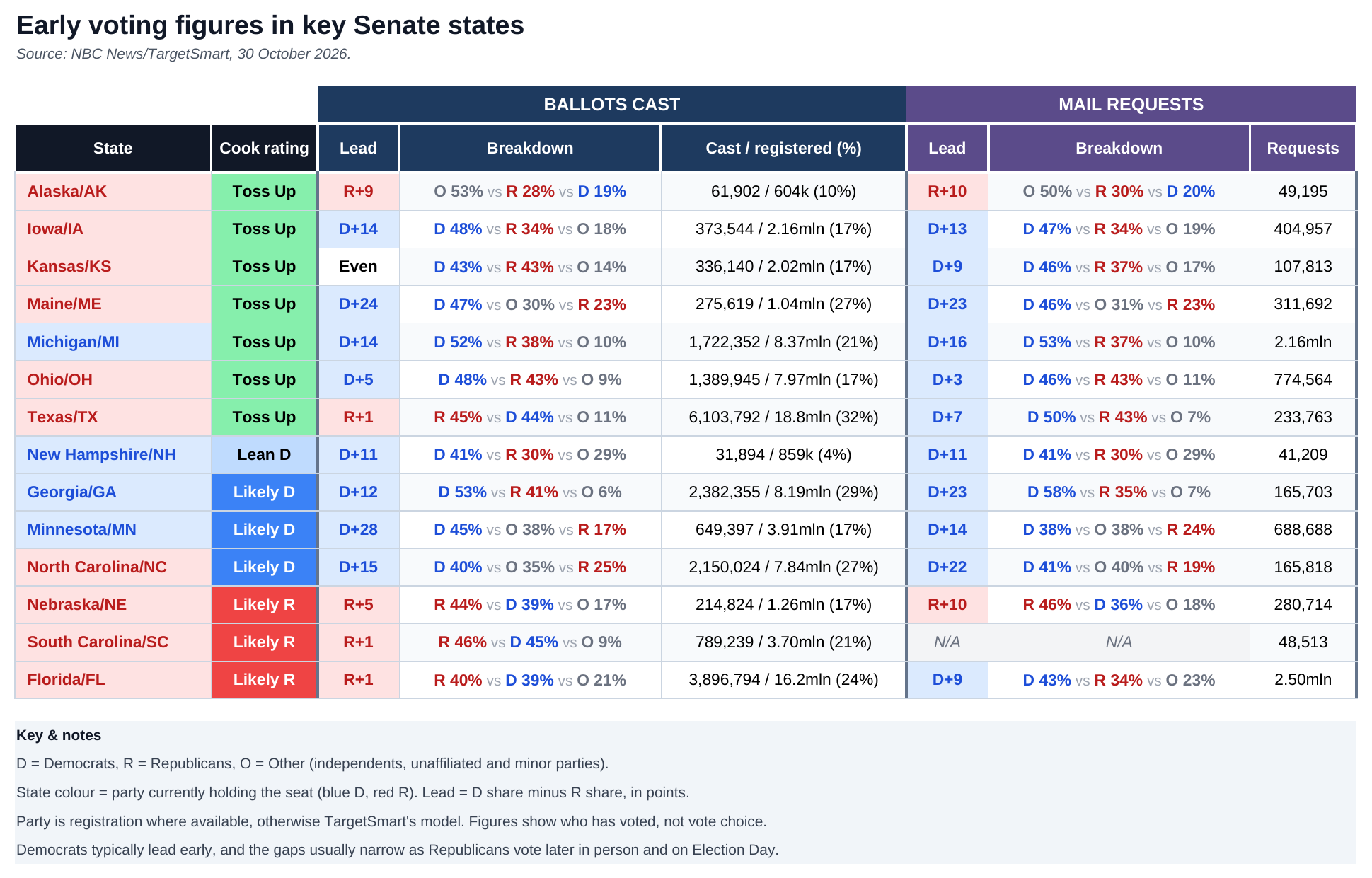
Early Voting in Key Senate Races (NBC/TargetSmart - 30th October)
- National: 43,918,953 early ballots cast (20.4mln by mail, 23.5mln in person). Registered Democrats lead registered Republicans 47%–35% (D+12); Mail ballots requested or sent (105.98mln): 46%–31% (D+15).
- Senate battlegrounds (AK, GA, IA, KS, ME, MI, NC, NH, OH, TX): 14,827,567 early ballots cast (2.8mln by mail, 12mln in person). Registered Democrats lead registered Republicans 46%–40% (D+6); Mail ballots requested or sent (4.42mln): 49%–37% (D+12).
- Two differences from the national figure stand out: battleground early voting is mostly in person (about 81%), while nationally it is more evenly split and the registered Democratic lead is 6 points wider (D+12 vs D+6).
- Registered Democrats lead among early ballots cast in 8 key Senate states, from D+5 in Ohio to D+28 in Minnesota. Registered Republicans lead in five (Alaska R+9, Nebraska R+5; Texas, South Carolina and Florida are all R+1), and Kansas is now even.
- In four states (Iowa, Maine, Minnesota, Ohio), registered Democrats' lead among ballots cast is wider than their lead among mail requests.
- Nebraska stands out: registered Republicans lead requests by 10 and now lead ballots cast by 5, up from 1 earlier this week.
- The figures show who has voted, not how. Registered Democrats typically lead early, and the gaps usually narrow as Republicans vote later in person and on Election Day.
Key Senate Races (CPR/DDHQ)
Alaska (R – Toss-up/Lean D): Incumbent Dan Sullivan (R) vs. Mary Peltola (D). Last won by D in 2008.
- The RCP Average has Peltola leading 49.4 to Sullivan’s 48.2, and DDHQ gives Peltola a 61% chance of winning. Peltola is casting herself as an independent who breaks with national Democrats on resource development, firearms and border security. Sullivan is countering by tying her to “D.C. Democrats” and “Lower 48 liberals,” while facing headwinds from Alaska’s high cost of living and frustration with the current administration.
Iowa (R – Toss-up): Open seat – Ashley Hinson (R) vs. Josh Turek (D). Last won by D in 2008.
- The RCP Average has Turek leading 46.1 to Hinson’s 45.5, while DDHQ gives Republicans a 54% chance of winning. The race is focused on the state’s severe cancer crisis: Turek is emphasising healthcare access and environmental contaminants, while Hinson is stressing expanded screening and rural cancer care. Other key themes include Trump, tariffs and rising fertiliser costs, with Republicans facing broader concerns over the economy and healthcare funding.
Kansas (R – Toss-up/Lean R): Incumbent Roger Marshall (R) vs. Adam Hamilton (D). Last won by D in 1932.
- The RCP Average puts Marshall at 45.9 to Hamilton’s 46.1, while DDHQ gives Marshall a 63% chance of winning. Cook recently shifted Kansas to toss-up from lean Republican, citing Hamilton’s standing as a moderate candidate, along with a drop in support for Trump among farmers hit by rising fuel and fertiliser prices since the start of the Iran war. Hamilton has also picked up notable endorsements, including from two former Republican governors of Kansas, Mike Hayden and Bill Graves. Marshall, meanwhile, has come under scrutiny over his use of taxpayer money and over lawsuits he brought against hundreds of patients for unpaid medical bills. At a debate at the Kansas State Fair last month, Marshall drew repeated boos from the crowd as he defended Trump’s tariffs.
Maine (R – Toss-up): Incumbent Susan Collins (R) vs. Troy Jackson (D). Last won by D in 1988.
- The RCP Average has Jackson ahead 48.8 to Collins’ 47.2, and DDHQ gives Jackson a 56% chance of winning. Jackson, a former Maine Senate President, became the Democratic nominee in July after Graham Platner withdrew. Collins is running on her local record and her work on the Appropriations Committee, including the TICK Act. Jackson is tying Collins to Trump and focusing on abortion, immigration enforcement, the Iran war and Trump’s tax-and-spending bill, which slashed Medicaid. Collins has sought to distance herself from Trump on Canadian tariffs, ICE policy and spending cuts. At the Oct. 8 debate, Collins said high earners should pay more into Social Security, siding with Jackson on an idea most Republicans have avoided.
Michigan (D – Toss-up/Lean D): Open seat – Abdul El-Sayed (D) vs Mike Rogers (R). Last won by R in 1994.
- El-Sayed leads the RCP Average 48.8 to Rogers’ 45.6, and DDHQ gives him a 69% chance of winning. El-Sayed is pushing single-payer healthcare, attacking Rogers’ House record on opioids and prescription drug prices, and blaming Trump for chaotic tariffs. Rogers is breaking with Trump to call for an end to the tariff war with Canada and has accused drugmakers of ripping off Americans, saying Michiganders pay four times more than Canadians for the same drugs. On Social Security, El-Sayed has said, “I will end the cap on Social Security tax to make sure the rich pay their fair share.” Rogers, meanwhile, has said of El-Sayed: “He wants Medicare for All. I want Medicare for seniors.”
Ohio (R – Toss-up): Incumbent Jon Husted (R) vs. Sherrod Brown (D). Last won by D in 2018.
- This is a special election for the Class 3 seat vacated by JD Vance when he became Vice President. Governor DeWine appointed Husted to the seat in 2025. The RCP Average has Brown ahead 47.9 to Husted’s 45.3, and DDHQ gives Brown a 55% chance of winning. The race is focused on data centres. Trump defends their expansion as necessary to compete with China on AI, while critics point to their electricity demand, water usage and impact on utility bills. Husted supports data-centre development but backed legislation requiring large power users to shoulder more of the costs, which was blocked by Senate Democrats. Brown has attacked Husted over tax breaks and the costs data centres impose on Ohioans.
Texas (R – Toss-up): Open seat – Ken Paxton (R) vs. James Talarico (D). Last won by D in 1988.
- The RCP Average has Talarico leading 48.6 to Paxton’s 46.5, and DDHQ gives the seat a 57% chance of turning blue. Talarico has focused on tax loopholes, AI data centres, healthcare, student loans and capitalism, while attacking Paxton’s record, including his securities-fraud case and allegations of bribery and abuse of office. Talarico proposes applying the Social Security payroll tax to earnings above USD 400,000. On programmes that include Social Security, Medicare, and Medicaid, Paxton has said, “Making some reasonable cuts to mandatory spending—you’re gonna have to do it".
Other Senate Races to Watch
Florida (R – Solid R/Likely R): Incumbent Ashley Moody (R) vs. Angie Nixon (D). Last won by D in 2012.
- This is a special election for the Class 3 seat vacated by Marco Rubio when he became Secretary of State. Governor DeSantis appointed Moody to the seat in 2025. Moody leads the RCP Average 49.4 to Nixon’s 43.2, and DDHQ gives her a 78% chance of winning. In a fundraising email, Moody’s campaign pointed to two polls showing a dead heat and called the race the most important Senate special election of 2026.
Georgia (D – Likely D): Incumbent Jon Ossoff (D) vs. Mike Collins (R). Last won by R in 2016.
- The RCP Average has Ossoff ahead 51.2 to Collins’ 43.0, and DDHQ gives Democrats an 89% chance of winning.
Minnesota (D – Lean D/Likely D): Open seat – Peggy Flanagan (D) vs. Michele Tafoya (R). Last won by R in 2002.
- The RCP Average puts Flanagan ahead 47.8 to Tafoya’s 42.7, and DDHQ gives Democrats an 81% chance of holding the seat.
Nebraska (R – Likely R/Lean R): Incumbent Pete Ricketts (R) vs. Dan Osborn (I). Last won by D in 2006.
- The RCP Average has Ricketts ahead 48.0 to Osborn’s 43.0, and DDHQ gives Ricketts a 73% chance of winning.
New Hampshire (D – Lean D/Likely D): Open seat – Chris Pappas (D) vs John E. Sununu (R). Last won by R in 2010.
- Pappas leads the RCP Average 49.4 to Sununu’s 42.7, and DDHQ gives him an 84% chance of winning. The Washington Post reports that when asked why they support Pappas, voters rarely mentioned him by name; many instead cited their opposition to Trump.
North Carolina (R – Likely D): Open seat – Michael Whatley (R) vs. Roy Cooper (D). Last won by D in 2008.
- The RCP Average has Cooper leading 50.0 to Whatley’s 40.8, and DDHQ gives Democrats an 84% chance of winning.
South Carolina (R – Lean R): Incumbent Darline Graham (R) vs. Annie Andrews (D). Last won by D in 1998.
- Graham leads the RCP Average 47.0 to Andrews' 44.6, and DDHQ gives her a 65% chance of winning.
House
Republicans currently hold a slim majority in the House, with 218 seats to the Democrats’ 214, plus 1 Independent who sits with the Republicans and 2 vacancies.*
All 435 seats are up for grabs on Tuesday, as is the case every two years. History suggests the ruling party struggles in the midterms: since 1938, the president’s party has lost House seats in 20 of 22 midterm elections.
CPR highlights the vulnerability of Republican-held House districts, and after shifting 19 more races towards Democrats on October 23rd, it now views Democrats as favoured outright in the 218 seats needed for a majority, estimating the most likely outcome to be a Democratic gain of 12 to 22 seats.
DDHQ projects a notable Democratic win in the House, at 239 seats to the Republicans’ 196. Betting markets price a 94% chance of Democrats winning the House.
*Rep. Tony Gonzales (R-TX) and Rep. Sheila Cherfilus-McCormick (D-FL) both resigned in April this year.
Governors
There are 36 governorships up for grabs, split evenly between Republicans and Democrats: 18 Democratic-held and 18 Republican-held. Most governors serve four-year terms, though governors in Vermont and New Hampshire serve two-year terms. 36 governorships are contested in every midterm, 11 alongside the presidential election and 5 in odd-numbered years, with Vermont and New Hampshire counted in both the midterm and presidential totals.
DDHQ notes Democrats are favoured to win 22 of the 36 governorships. DDHQ forecasts Democrats flipping five Republican-held governorships (Alaska, Georgia, Iowa, Nevada and Ohio) and Republicans flipping Democratic-held Kansas, for a net Democratic gain of four.
CPR rates four governor races as Toss-ups: Republican-held Georgia and Nevada, and Democratic-held Kansas and Wisconsin. Six lean Democratic: Arizona, Michigan and Oregon, all Democratic-held, and Republican-held Alaska, Iowa and Ohio. Three races lean Republican: Florida, Nebraska and Texas, all Republican-held. New Hampshire, Oklahoma and Vermont, all currently Republican-held, are rated Likely R.
At the 2026 midterms, governor races matter far more to markets than in recent elections for one major reason: the AI build-out. The rapid development of AI models has sharply increased voter concerns over privacy, security, regulation and utility bills. However, given the competitive AI race between the US and China, Congress and the White House are unlikely to take a strong stance against AI that would erode the US lead. National security concerns have frequently been cited to restrict advanced chip sales to China, and the same reasoning is likely to apply to AI more broadly, making a significant near-term federal clampdown unlikely. This dampens the near-term impact of the congressional outcome on the AI trade, shifting greater importance onto the gubernatorial elections.
In 36 of 50 states, the governor appoints the Public Utility Commission (PUC) commissioners. Only Virginia and South Carolina put the legislature in charge of appointments. Meanwhile, Tennessee and North Carolina take a hybrid approach, in which the governor and legislature each make appointments to a set number of seats.
Governors also control tax breaks and environmental permits and issue executive orders. So far, governors appear divided on AI. In New York, Governor Hochul took a restrictive position, signing an executive order in July 2026 imposing the nation’s first statewide moratorium on new data centres consuming 50MW or more, pending assessments of their impact on energy demand, water use, air quality and local communities. In August, the Texas governor, Greg Abbott, ordered the PUC and the Electric Reliability Council of Texas (ERCOT) to audit every data centre in ERCOT’s interconnection queue before approving any more, and to deny grid connection to any non-compliant project. The order acknowledged that GW requests to the Texas grid had risen to more than five times Texas’s record peak demand, with around 90% of new power requests coming from data centres.
In 10 of 50 states, PUC commissioners are directly elected, and 9 of these will hold PUC commissioner elections in November: Alabama, Arizona, Georgia, Louisiana, Montana, Nebraska, North Dakota, Oklahoma and South Dakota. Mississippi’s PUC commissioner election takes place in November 2027.
PUCs set the price and terms on which utilities connect and supply data centres, and decide who pays for the new power plants and grid infrastructure they require. PUCs have generally allowed data centres to proceed, but in a rare case one blocked the associated power facility. The North Carolina Utilities Commission rejected Duke Energy’s proposed USD 584mln, 255MW natural gas-fired combustion turbine, located next to the site of a planned USD 10bln Amazon data centre. The commission cited uncertainty around load growth, the cost of the proposal, and unanswered questions about data-centre demand and who would pay for the project.
PUCs have increasingly made data-centre operators pay for the infrastructure they need, a shift kick-started by the spike in PJM capacity prices around 2024. In 2025, Ohio’s PUC (PUCO) required large new data-centre customers to pay for at least 85% of the energy they subscribe to, even if they use less, to cover the costs of the infrastructure needed to supply those facilities. In August 2026, Georgia Power’s contract with OpenAI was approved, under which OpenAI will pay the full cost of the infrastructure needed to serve it and has committed up to 1,000MW of flexible demand response.
Governors will be wary of voters’ elevated concerns about AI. They will also be mindful of the competition between states for data-centre construction and its economic benefits, such as jobs and GDP, and therefore of the opportunity cost of being restrictive on AI.

Key Governor Races To Watch - Morgan Stanley

Key Issues
Inflation: Energy prices have been among the top concerns for Americans, given the surge in gas and diesel prices YTD, largely due to the US-Iran war and, to a lesser extent, Russia-Ukraine. Lower-income households have been particularly vulnerable to the combination of a 38% Y/Y rise in the national average gas price (AAA), a 71% Y/Y increase in diesel prices, a 30-year mortgage rate of 7.2% (6.3% a year ago) and rising healthcare costs. In the New York Fed’s Survey of Consumer Expectations, median one-year-ahead inflation expectations rose to 3.9% in September from 3.6%, the highest reading since May 2023.
Higher mortgage rates will extend the pressure to middle earners, through higher borrowing costs when refinancing, and to younger people trying to afford their first home. According to a June Gallup poll, 77% of adults earning less than USD 50,000 a year said gas prices had caused them hardship, including 28% who called it severe. Among middle-income adults, 65% reported some hardship, including 13% describing it as severe, while among adults earning USD 100,000 or more, 59% reported hardship, including 8% severe. An October CNBC/SurveyMonkey survey found renters are nearly twice as likely as mortgage holders to spend 50% or more of their income on housing (25% vs 14%), with down payments and limited income cited as the top barriers to homeownership. The surge in energy prices has heightened scrutiny of the Iran war, with voters increasingly questioning its endgame as the conflict adds to the cost-of-living burden.
Iran: The US-Iran war has become a key issue through higher energy prices and inflation concerns, driven by the drop in crude and refined product flows through the Strait of Hormuz. In August, a Reuters/Ipsos poll found 31% of Americans support US military action against Iran, close to the low of 27% seen at the start of the war. Support among Republican respondents fell to 69% from 77% in March. An August Economist/YouGov poll found 50% of Americans believe the war will last another year, up from 32% in March, with the largest increase among independents. Overall, 65% of respondents think the US should make a deal to end the war as quickly as possible, including 83% of Democrats and 48% of Republicans. Pew’s latest poll in October showed continued disapproval of the handling of US military action in Iran, with 65% disapproving and 33% approving. Although it is typically a foreign policy issue, the conflict has become a price issue for voters because of the collapse in oil flows through the key waterway, attacks on Middle Eastern energy facilities and refinery shut-ins. Trump said the US would not attack Iran before the midterm elections, citing “productive discussions” with Iran. With the midterms so close, voters are unlikely to feel notable relief from the absence of strikes, as gas and diesel prices have remained elevated throughout the US-Iran stalemate since the collapse of the MoU announced in June. An October Politico poll revealed that only about a quarter of Americans think Trump could cut gas prices by USD 1 per gallon by Election Day, end the war in Iran (27%) or significantly lower grocery prices (27%). Even among his 2024 voters, just 43% think he could deliver the USD 1 cut in gas prices.
Healthcare: Healthcare is shaping up as one of the defining issues in key races on Election Day, driven by a surge in costs following the expiry of enhanced ACA subsidies at the end of 2025. According to KFF, premium payments after tax credits rose by 114%, or more than USD 1,000 a year, for those staying in the same plan in 2026. Effectuated enrolment in Marketplace plans fell for the first time in seven years. Mercer projects that employer health benefit costs per employee will rise 8.2% in 2027, the steepest increase since 2003, while insurers have proposed a median ACA Marketplace premium increase of about 15% for 2027. A September NYT/Siena poll found that 60% of respondents trust the Democratic Party to do a better job on healthcare, vs 34% for Republicans. Following his promise of a USD 5,000 dividend to every adult citizen if Republicans win the House and Senate, Trump has announced two healthcare initiatives amid rising concerns, both still being rolled out: a one-time USD 500-per-person refund for nearly 1mln ACA Marketplace enrollees, and a one-time Part B premium rebate of USD 90 for 20.8mln people on Original Medicare.
AI: The rapid development of artificial intelligence has sparked growing voter concern over privacy, security, regulation, water supplies and, increasingly, utility bills. Consumers’ association of data centres with higher electricity bills has given rise to NIMBY (“not in my backyard”) resistance. A Gallup survey earlier in the year found that 70% of Americans oppose the construction of new AI data centres in their own communities. A July AP-NORC/EPIC poll found that about six in ten Americans, including majorities of both parties, back limits on the number of new data centres that can be built, while roughly two-thirds want them to use clean energy and seven in ten want the companies behind the build-out to pay for grid upgrades. Security concerns have also been showing up in polls following recent incidents in which AI models escaped their testing environments and breached outside systems. In September, a Reuters/Ipsos poll found that 73% of Americans worry AI companies have not done enough to prevent AI from causing serious harm to society, with 69% saying they had followed news of major AI companies calling for slower development and greater oversight and safety standards.

Tariffs: Trump’s 2025 tariff policy, which has extended into 2026, has become another source of complaints about higher prices in consumer sentiment surveys. In February, the Supreme Court (SCOTUS) struck down tariffs imposed under the International Emergency Economic Powers Act (IEEPA), ruling that the Act does not authorise the president to impose tariffs, although tariffs have stayed in place through other laws. In August, US-Canada trade talks collapsed, sparking a tit-for-tat tariff war. The US banned imports of certain Canadian alcohol and dairy products, while Canada imposed retaliatory tariffs on about USD 20bln of US exports, including steel, dairy and agricultural equipment. Following the collapse of talks, an Ipsos poll found that 57% of Americans oppose the additional US tariffs on Canada, with 68% believing the US should be willing to make trade-offs with Canada, even if it means not getting most of what it wants.
Immigration: Immigration was Trump’s priority issue in 2024, and his subsequent crackdown, with mass deportations and ICE operations, has made it one of the most polarising issues of the 2026 cycle. However, a September Fox News poll found that 34% of registered voters named the cost of living as the most important issue facing the country, more than four times the share who named immigration. The RCP Average shows 43.2% approving of Trump’s approach to immigration vs 54% disapproving. In the summer, NPR, citing AdImpact, reported that “immigration” was the issue with the second-highest ad spending for Republicans, while for Democrats “ICE” ranked third, after “healthcare”. Axios reported that the GOP’s 2024 gains with Latino voters are fading as Trump’s immigration crackdown hits close to home. A September NBC News/Telemundo poll of Latino voters found that two-thirds say enforcement has gone too far, just 30% approve of Trump on immigration, and 18% say they or someone close to them has strongly considered leaving the country.
US President Trump Approval Rating
- Trump’s overall job approval stands at 38.4% in the RealClearPolitics average, with 60.1% disapproving, for a net rating of −21.7. His approval ratings on key issues have deteriorated since the start of his presidency, and his weakest area by far is inflation: just 26.7% approve and 70.7% disapprove, a net −44.0. Economic and foreign affairs also weigh heavily. His handling of the economy sits at a net −32.9 (32.3% approve, 65.2% disapprove), Iran at −31.1 (32.6% to 63.7%), foreign policy overall at −28.6 (33.7% to 62.3%) and Russia/Ukraine at −24.8 (34.0% to 58.8%). His strongest issues remain the traditional Republican ground of immigration, at −11.2 (43.2% to 54.4%), and crime, his best rating at −7.5 (44.0% to 51.5%).
- Reuters found that 41 of 62 Republican candidates in competitive House and Senate races have either broken with Trump on specific policies or played down their ties to him ahead of the November midterms, suggesting concern that his unpopularity could hurt the party’s congressional prospects. The distancing has generally been selective rather than a broader rejection of Trump, with policy differences appearing in 23 races. The Iran conflict was the biggest point of contention, with 12 candidates opposing the war or voting to curb Trump’s war powers, while three candidates have challenged his support for rapid data-centre expansion.
- Trump’s recent trade moves have produced some of the most open Republican dissent of his second term, especially from members in border and farm states. His decision to impose 50% tariffs on USD 20bln of Canadian goods has drawn pushback from GOP lawmakers and candidates in Maine, Michigan, New Hampshire and Alaska, as well as agriculture-heavy Iowa and North Carolina. Dissent has been even broader over Trump’s move to allow discounted, tariff-free beef imports, which more than a dozen Republican senators have criticised, according to Axios.
- 12 senators (six Republicans, including Mitch McConnell, Susan Collins and John Cornyn, and six Democrats) urged President Trump on Oct 13th to rescind his deal letting Russia sell diesel freely on global markets, calling it a betrayal of Ukraine that would do little to lower US fuel prices amid the Iran war, and instead use sanctions under the newly signed Lindsey O. Graham Sanctioning Russia and Iran Act to pressure Russia and its backers, especially China. Trump rejected that path three days later, signing an executive order that waived several of the Act's Russia-related sanctions and tariffs; the Iran provisions were left intact. The diesel licence remains in place through April 2027, though its legality has been questioned under a 2022 law banning Russian energy imports, and Cornyn has since amplified calls for Congress to investigate Trump's Russia policy.

Balance of Power - Market Impact
The three most likely midterm scenarios, ordered from most to least likely according to betting markets, are: 1) Democrats take the House and Senate; 2) Democrats take the House, and Republicans keep the Senate; and 3) Republicans hold the House and Senate.
Dem sweep (D House, D Senate):
- At the index level, AI concentration would pose a risk to performance if Democrats were to take a tough stance on AI companies (e.g. removing or reducing data-centre sales tax exemptions) and on the associated power consumption of data centres. However, this is unlikely given the national security argument frequently cited against China, which shifts the policy risk to the state and local level. Food retailers, staples and restaurants would see modest support from delayed SNAP cuts and tax credit support for lower-income consumers. A rollback of Medicaid cuts and restoration of enhanced ACA subsidies would be positive for insurers (CNC, MOH, OSCR) and hospitals (HCA, THC). Pharma would also benefit if Democrats scrutinise MFN pricing, delaying its codification. Less legislative upside poses a headwind for financials. Data-centre REITs, AI-exposed utilities and industrials, and AI names would likely be hit by any state-level delays or higher costs to the AI build-out, though those with substantial capacity already online would likely outperform peers still reliant on new projects. A Democratic sweep would likely end the proposed Reconciliation 3.0 bill, removing the main Treasury supply risk. The bill’s USD 73bln in defence funding and USD 12bln in farm aid would go with it, and the loss of the defence funding poses a potential headwind for defence names, although baseline spending growth is likely to continue, albeit with greater uncertainty. Oversight hearings would slow deregulation. LatAm FX may fall out of favour, given increased scrutiny of Trump’s second-term support for the region (e.g. Argentina).
Split (D House, R Senate):
- Fiscal risk increases, as a more divided Congress may lead to shutdowns and debt-limit standoffs, potentially weighing on economic growth. As with a Democratic sweep, MFN codification is unlikely, and greater oversight may slow the pace of financial-sector deregulation. Food retailers, staples and restaurants may benefit from a softening of SNAP cuts. Legislative deadlock would likely keep the Treasury’s borrowing needs close to the current baseline. It would also likely mean minimal changes to recent federal healthcare reforms, offering a clear outlook for MA- and ACA-exposed names. Given the downside risks to the fiscal outlook and growth from a legislative standoff, this outcome leans USD-negative.
Rep sweep (R House, R Senate):
- Upside Treasury supply risks remain given the possibility of Reconciliation 3.0 passing, and a prolonged war with Iran could lift defence funding, although legislative passage remains uncertain. Deregulation efforts would continue, which is positive for financials, and equities would benefit from the pro-AI stance, with few restrictions on data-centre construction or frontier AI labs. Defence, financials, nuclear and data-centre REITs are viewed as positives, while SNAP and tax credit cuts would remain a slight drag on consumer staples, retail and restaurants. In FX, the status quo prevails; Argentina and other Trump allies stand to benefit.
Scenario Analysis
Bank of America
1) Dem sweep = Big risk-off, stocks skid >10%, US dollar, bond yields fall into year-end, international stocks outperform on less trade & military wars, but Europe outperforms Asia (loses Trump AI friend); Dem sweep signals electoral shift from populist capitalism to populist socialism, says next big direction in tax & regulation up not down (EPS negative); 2027 policies to lower inflation, healthcare, improve affordability challenge K-shape wealth boom, AI capex boom, stocks “too big to fail” Wall St zeitgeist; most important, loss of political capital = less ability for Trump to coerce resources, corporations, foreign governments into support for policy priorities of AI war with China, resource monopolization
2) R Senate, D House = Risk-on (stocks bid >5%) as narrative “Gridlock = Goldilocks” so play “US presidential cycle” analog (in which Year 3 strongest performer); Trump holds Senate/Abbott holds Texas +ve tech (no fear of AI data centre brakes, US AI-put continues... implicit US govt guarantee for bonds to fund US AI buildout), +ve US dollar (“exceptionalism” returns), but less positive bonds as no “improve my affordability” electoral wave; biggest and most bullish surprise would be a GOP sweep.
3) GOP sweep: Most bullish surprise (stocks >10%) as AI rips into bubbly ‘27, stock market goes full “Darwinian” trading “long artificial intelligence” (NDX), “short artificial irrelevance” (SPW).
Morgan Stanley

S&P 500 Average Return
