
Midterm update: Dems lead remain with 27 days left to go; Senate still a close call
Every headline is on the live feed 20 minutes before this site.
Midterm update: Dems lead remain with 27 days left to go; Senate still a close call
Microsoft (MSFT) launches Microsoft execution containers to block agents from unauthorized data access; Microsoft launches AI coding model for laptops
Houthi spokesperson says we targeted 11 gatherings of Saudi enemy forces during the past 24 hours, Al Masirah reports
On the Newsquawk feed at , 20 minutes before this page.
What is priced?
- 27 days until the election, and the House is still widely expected to go to the Democrats, whilst the Senate has continued to tilt in the Dems' favour.
- Polymarket odds show participants have continued to heavily favour Democrats to win the House at 93% (prev. 93% last week), whilst for the Senate, Democrats are little changed at 65% from 63% last week.
- Polymarket shows the probability of a Democrat sweep at 65% (prev. 63% W/W), while pricing a Republican Senate and Democratic House at 28% (prev. 29%), and a Republican sweep at 8% (prev. 8%).
Toss-up Senate & House races (Decision Desk HQ)
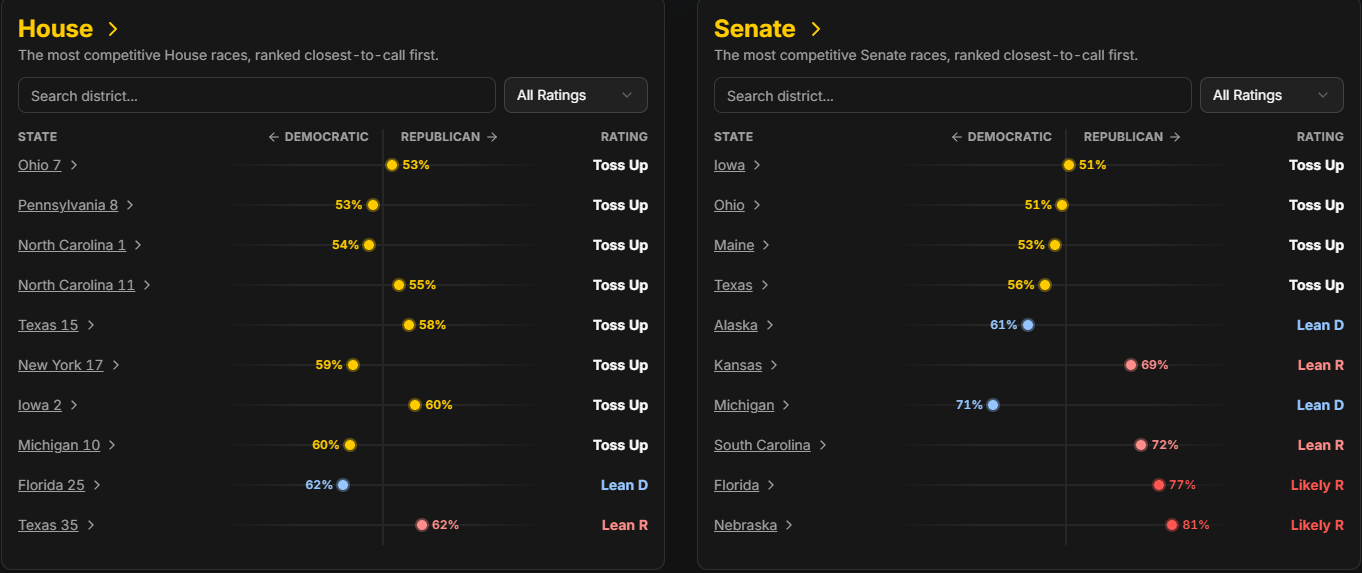
Polls below were conducted in the last week
- Iowa: Democrat Josh Turek narrowly leads Republican Ashley Hinson 48%-44% in a new Suffolk University poll, another red flag for Republicans in traditionally Republican-leaning territory. Iowa lawmakers passed the Mesabi Metallics tax-incentive package on Friday. The package provides up to USD 1.36bln in tax incentives over 10 years for Mesabi Metallics’ planned steel plant in Lee County.
- Ohio: A recent NYT/Siena Poll has Sherrod Brown (D) ahead of John Husted 49%-46% (R).
- Maine: An AARP poll released Oct 1 put Troy Jackson (D) ahead of Susan Collins (R) 50–47. Tuesday’s first debate centred on Trump, abortion and living costs.
- Texas: NYT/Siena put James Talarico (D) ahead of Ken Paxton (R) 51–45; Fox’s poll had 51–49.
-
Michigan: Fox had El-Sayed (D)–Rogers (R) 50–49, and Benson (D) ahead of James (R) 54–45 for governor. Rogers is breaking with Trump on tariffs in a new Michigan campaign ad, calling for an immediate end to the tariff war and saying “Canada is not our enemy,” without directly naming Trump. Meanwhile, James distanced himself from Trump on tariffs and Iran in Tuesday’s debate.
-
Decision Desk forecasts a Dem House majority, 234-201, and a Dem Senate majority, 51-49.
- Cook Political report sees the most likely outcome as the Democrats taking up five to 15 seats, holding 220-230 seats in 2027 (218 needed). It also highlights the vulnerability for Republican held House districts, with 16 out of the 22 toss-up seats held by Republicans. This extends to the Senate, with 5 out of 7 toss up Senate seats held by Republicans.
- Trump has launched his 32-day campaign tour, with stops already completed in Texas, Ohio and Nebraska, all of which feature competitive Senate races.
Recent developments
* Trump temporarily opened cheaper, red-dyed diesel to highway use and deferred federal excise-tax payments through the year-end. * In the last week, the US-Iran conflict has seen no progress. Yesterday, US VP Vance said Iran must cut nuclear enrichment capacity to end the war, needing concrete nuclear concessions for a deal. CBS framed the remarks as softer than before. Today, a Senior Iranian official responded via Reuters, US ideas oppose Iran's demands and that the US must first meet Iran's conditions before the nuclear issue can be discussed. Al Hadath also suggested via sources that mediation efforts with Tehran and Washington have stalled. * AAA gas prices have slightly eased from last week, USD 4.3667 from USD 4.4744 last week. The national average for a gallon of diesel hit USD 6.3015 from 6.5276 on September 22nd. * Senate Democrats blocked a Republican-backed bill to restrict stock trading by members of Congress, arguing it did not go far enough to constitute a full ban and the included voter-ID provision was an unrelated “poison pill,”. The measure failed 53-47 on a procedural vote, falling short of the 60 votes needed to advance. * The Ratepayer Protection Act failed to pass the Senate, which would have required state utility regulators to consider making large electricity users such as data centers cover the incremental costs of power infrastructure built to serve them. The measure failed 57-43, falling short of the 60 votes needed to advance, with only four Democrats voting in favour. Dems wanted a mandatory requirement that large data centers cover the costs of grid upgrades needed to serve them. * Reuters found that 41 of 62 Republican candidates in competitive House and Senate races have either broken with Trump on specific policies or played down their ties to him ahead of the November 3 midterms, suggesting concern that his unpopularity could hurt the party’s congressional prospects. The distancing has generally been selective rather than a broader rejection of Trump, with policy differences appearing in 23 races; the Iran conflict was the biggest contention, with 12 candidates opposing the war or voting to curb Trump’s war powers, while 3 candidates in races have challenged his support for rapid data-center expansion. * Sen. John Curtis (R-Utah) is publicly challenging Donald Trump’s family while arguing that his 2024 primary victory over a Trump-endorsed candidate gives him greater freedom to speak out. Curtis recently called for the Senate Judiciary Committee to subpoena Donald Trump Jr. — and potentially Hunter Biden — as part of a broader investigation into presidential family business dealings, following a ProPublica report that a Russian oligarch paid some of Trump Jr.’s wedding-related expenses. Curtis said he has not heard from Trump since the criticism and believes it is better for Trump to speak openly if he is angered by Curtis’ actions.
Trump's aims ahead of midterms
- Trump is pushing to lower energy prices ahead of the November election. His latest action was on Monday, signing an executive order aimed at lowering near-record diesel prices by waiving restrictions on red-dyed diesel, saying it will allow anyone to purchase tax-free red-dyed diesel for any reason; he said the move would also lower the cost of goods, including groceries. The move follows growing pressure from top Republicans to prioritise domestic needs.
- Speaking at the GOP Convention, Trump urged voters to pretend he is on the ballot and vote as if he were running, noting that if they do not have majorities, so much can be lost.
- Trump promised a Trump dividend of USD 5,0000 to every American adult if Republicans hold power in Congress. Since then, the President has stressed he means it and has the means to do it. Even Treasury Secretary Bessent has said it is possible, although the NPR warned it would cost over USD 1tln.
- Last Friday, Trump also announced plans to give more than 20mln seniors USD 90 each toward Medicare premiums in which most eligible seniors will receive in early October ahead of the midterms.
- Top officials state that Trump is looking for new policy pledges he can present to voters ahead of the midterm election, according to Bloomberg. The report notes that Trump may call on Congress to cut capital gains taxes and create an exemption for certain home sales. One of the measures touted would be indexing capital gains, so taxes would be applied on gains adjusted for inflation, while there could also be exemptions on sales of homes worth USD 2mln or less from capital gains taxes.
Approval vs. Disapproval Ratings on Trump's key issues
The RCP average compiles pollsters and provides an average approval or disapproval rating across key topics.
| Topic | Approve % | Disapprove % | Difference (Approve – Disapprove) |
|---|---|---|---|
| Overall Approval | 38.5 | 59.3 | -20.8 |
| Economy | 33.7 | 63.2 | -29.5 |
| Foreign Policy | 34.8 | 61.1 | -26.3 |
| Immigration | 43.2 | 54.0 | -10.8 |
| Inflation | 27.3 | 69.3 | -42.0 |
| Iran | 32.5 | 63.1 | -30.6 |
| Crime | 43.8 | 51.2 | -7.4 |
| Russia/Ukraine | 34.0 | 58.8 | -24.8 |
| Israel Hamas | 38.5 | 54.5 | -16.0 |
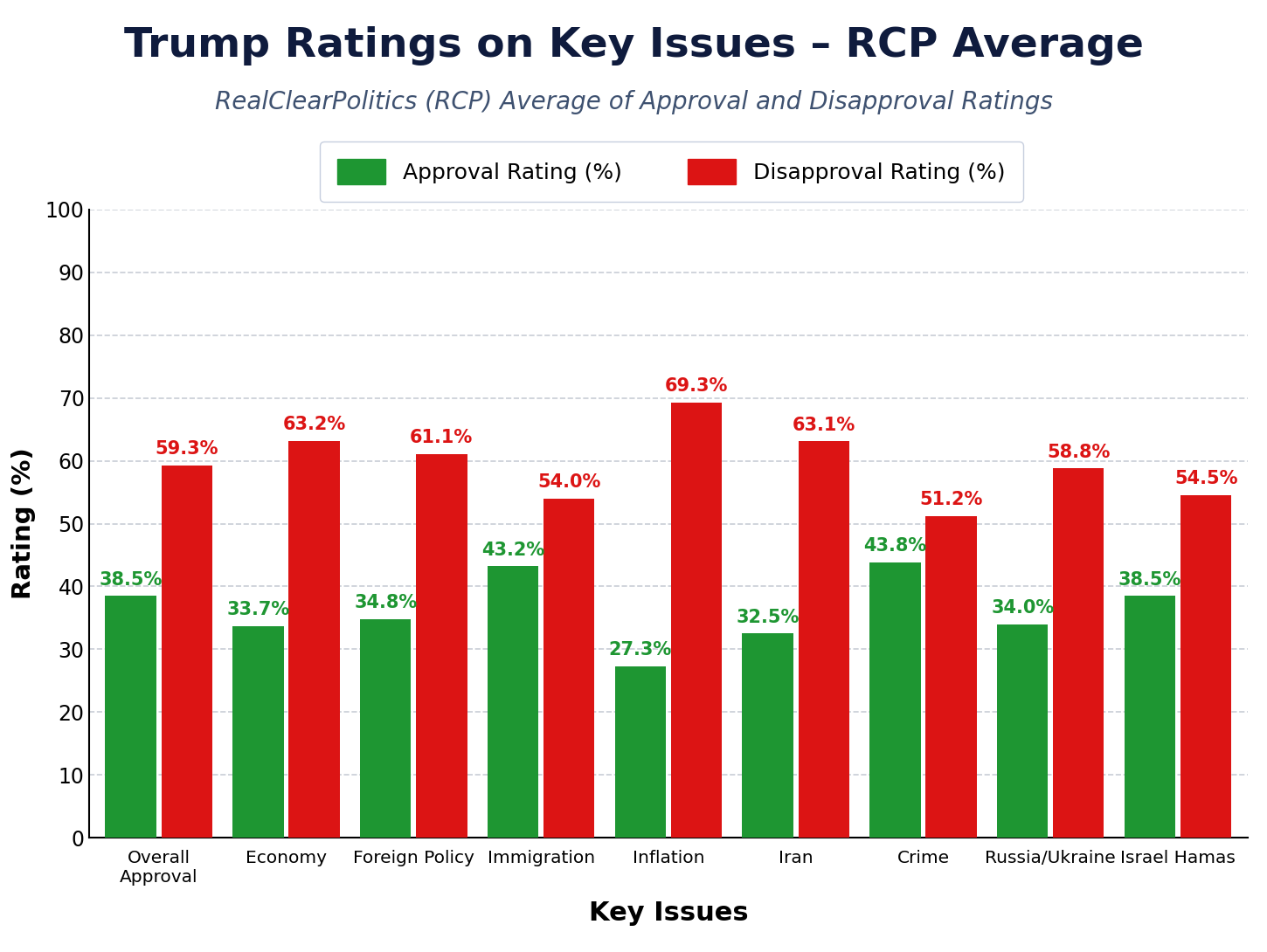
Takeaways:
- All topics show a higher disapproval than approval, indicated by the negative differences.
- Inflation has the largest gap (‑42.0 points), suggesting the strongest public dissatisfaction.
- Crime shows the smallest gap (‑7.4 points), indicating the closest balance between approval and disapproval among the listed issues.
- Throughout the year, polling has shown the spread between those who either unfavour or disapprove of, or favour and approve of, US President Trump's job has widened.
Recent polls
Economist Trump net approval rating
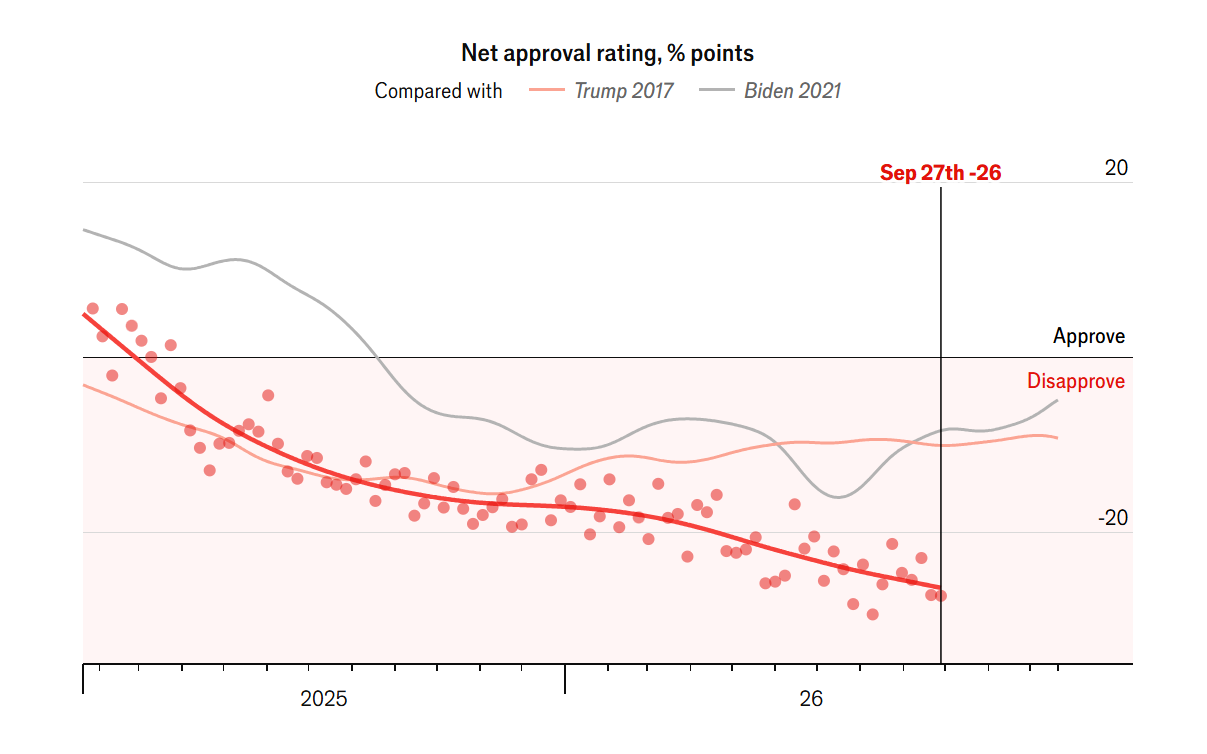
Economist/YouGov (Sep 18–21, 1,568 U.S. adult citizens)
- Among likely voters, 52% would vote for the Democratic candidate in their district, versus 38% for the Republican.
- Among registered voters, Democrats lead 45% to 38%, their largest advantage since Economist/YouGov began tracking 2026 House vote intent in spring 2025.
- 93% of Democrats back their party’s candidate, compared with 90% of Republicans backing theirs, while Independents favour Democrats 52% to 27%.
- Democrats lead across every major age group, by 7 points among voters without college degrees and 22 points among college graduates.
- Men are split 44% Democratic vs. 47% Republican, while women favour Democrats 59% to 30%.
Reuters/Ipsos Poll (Sept 17-20, 1,277 responses from US adults)
- Trump’s approval rating fell to 32%, the lowest of his political career.
- Just 17% of respondents approved of his handling of the cost of living, the top issue Americans say will determine how they vote in the November 3 midterm elections.
- Among Republicans, those who disapprove of Trump’s handling of the cost of living outnumbered those who approve, 51% to 44%.
- Trump remains popular among Republicans on immigration, with 79% of his party approving of his approach, compared with 36% of Americans overall, while 55% disapprove.
- Registered voters preferred Democrats over Republicans by 43% to 35%.
- On the conflict with Iran, 24% of Americans support Trump’s approach.
AI/Data Centre Polls
Reuters/Ipsos (Sept 17-20, 1,277 US adults)
- 73% of Americans worry AI companies have not done enough to prevent AI from causing serious harm to society, while 39% say AI is having a negative impact on society, up from 36% last month and the highest level since Reuters/Ipsos began asking the question in March. 11% view AI as having a positive impact.
- 69% say they followed news about major AI companies calling for slower development and greater oversight and safety standards. 55% say slowing AI development would be a good thing, compared with 13% who say it would be bad.
- 73% say ensuring AI is developed safely and responsibly is more important, compared with 23% who say staying ahead of other countries in AI development is more important.
Equity Impact
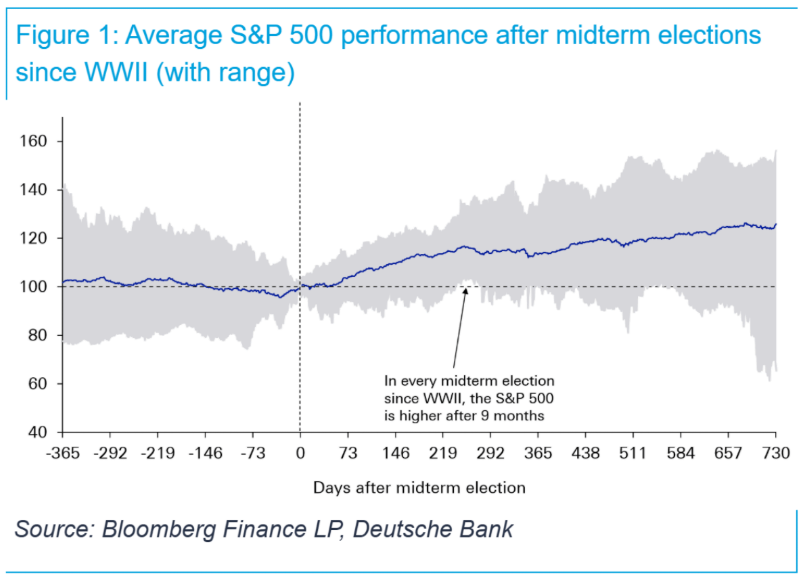
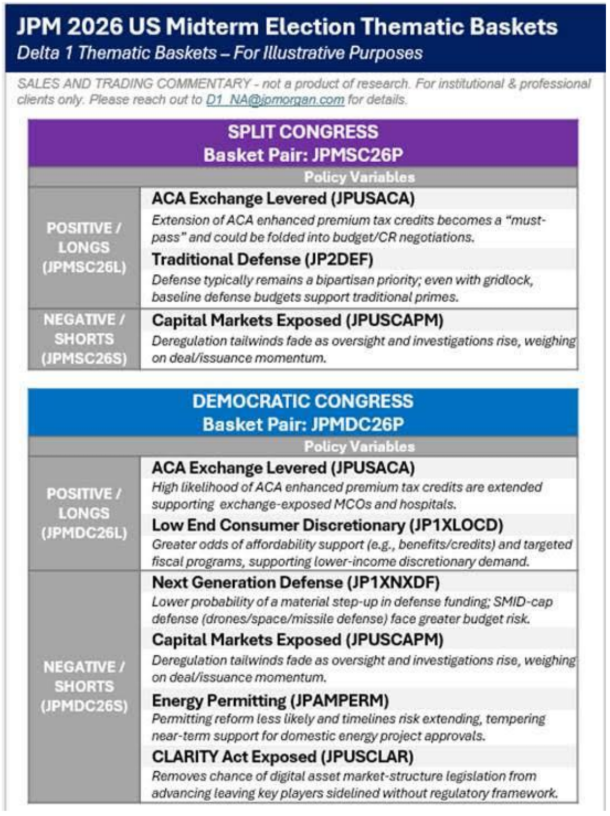
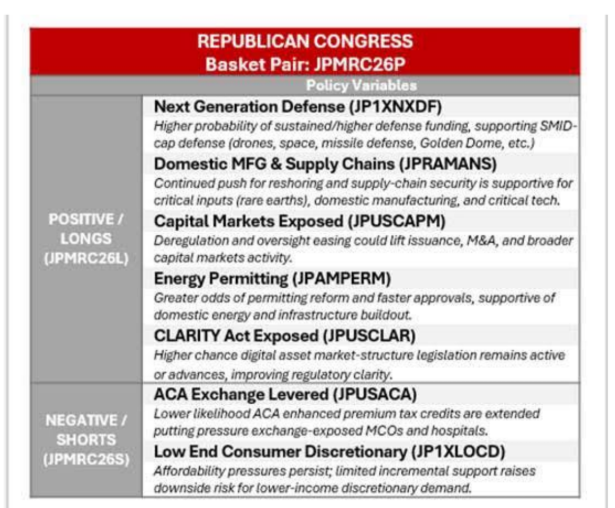
JPM
Goldman Sachs
- In past cycles, economic policy uncertainty has usually risen in August ahead of midterm elections and remained elevated in the subsequent few months.
- Equities have typically traded sideways in the few months ahead of midterms.
- During 13 midterm election years since 1974, the S&P 500 has generated a median return of 0% from the start of August through Election Day. Returns have typically improved post-election. Mirroring this pattern, mutual funds and foreign investors have generally demonstrated reduced demand for US equities ahead of midterm elections but increased allocations afterwards.
- The outcome of the midterms is unlikely to be a major cause of equity volatility.
- Within the equity market, most sectors, factors, and thematic baskets have traded with no substantial correlation to prediction market probabilities of election outcomes in recent months, although this may change as the election draws closer.
BTIG
- BTIG chief market technician Jonathan Krinsky said the S&P 500 has historically experienced a pullback of at least ~7% during the August–October period of midterm election years, citing 1990, 1998, 2002, 2010, 2014, 2018 and 2022; 2006 was the main exception, with its decline occurring in May–July.
- Krinsky said midterm-related volatility is often driven by unforeseen external events, citing the 1990 Kuwait invasion, 1998 Long-Term Capital Management collapse, 2014 Ebola outbreak and 2018 US-China trade war.
- Krinsky said the recent market broadening and rally from the late-July summer slowdown have been strong, but warned that historical patterns point to a more difficult period ahead.
- He said the market is entering a historically volatile downside window with stocks at all-time highs and the VIX at 2026 lows.
- Krinsky said this makes it an attractive time to reduce risk or hedge broad-based equity exposure ahead of what has historically been a difficult part of the calendar.
Citi
- Citi says buy any pre-midterm market dip.
- Remains Overweight equities and recommends adding exposure if markets pull back ahead of the US midterm elections.
- Sees supportive earnings revisions, improving liquidity conditions and limited warning signs despite recent AI-related concerns.
- Continues to favour US stocks and believes sector rotation could limit downside.
- Historically, pre-midterm weakness has often been followed by strong year-end performance, making any dip a potential buying opportunity.
Context
Midterm polling snapshots of this kind rarely reprice assets on the day; what they do is update the probability distribution that sector baskets and event desks trade against. The distinction that matters historically is not House versus Senate headlines but divided government versus a sweep: unified control has tended to widen fiscal impulse assumptions and steepen the curve via term premium, while divided outcomes price gridlock, slower legislation and a policy drift toward executive and tariff actions that bypass Congress. Prediction-market odds drifting steadily in one direction, as here, have in past cycles seen gradual positioning into sector pairs rather than index-level moves, since the base case gets absorbed well before election day. The notable pattern in this report is the approval deterioration on cost of living and the reported distancing of a large share of Republican candidates from the president on tariffs and the Iran conflict, a dynamic that in past cycles has signalled the incumbent party is running behind and has historically accompanied pre-election policy sweeteners of the kind now being floated on diesel, capital gains and direct payments. Worth watching is whether polling in the genuine toss-up states converges with or diverges from prediction markets, whether the floated fiscal pledges acquire legislative form, and how the Iran channel interacts with energy prices given the administration's visible sensitivity on diesel. Precedent across midterm years is of range-bound equities into the vote and improved returns after resolution, though that is a seasonal tendency, not a law.
Related headlines
- USTR releases joint ministerial statement from 12 G20 countries plus EU and Poland calling for steps to eliminate excess capacity and production in all economies 1 hour ago
- US President Trump announcement at 13:00EST/18:00BST will be to host guests to celebrate the announcement of automatic enrollment for Trump Accounts, reports CNN's Jaramillo citing a WH official4 hours ago
- Iranian President Pezeshkian and Russian President Putin stressed the need to continue and strengthen bilateral cooperation, IRNA reports4 hours ago
- US EQUITY OPEN: US indices lower as Treasury yields soar3 hours ago
- Trump admin housing officials are launching an investigation into Wells Fargo (WFC) to examine whether its decade-long efforts to increase black homeownership violated fair lending laws, reports WSJ2 hours ago
- Hormuz is no longer a priority for Washington after Iran lost control of it, reports Al Arabiya citing sources1 hour ago
- Mediation efforts between Washington and Tehran have stalled, reports Al Hadath1 hour ago
- [MARKET UPDATE] Following reports France considers issuing more shorter-term debt amid bond market turmoil, saw immediate risk-on trade; EUR/USD saw upside and OATs rallied, alongside slight upside in stocks and spot gold2 hours ago
- China has rejected an EU request to voluntarily restrict exports of hybrid cars to Europe as the two sides enter last-ditch talks to avert a trade conflict, FT reports46 min ago
- First LNG train at Qatar's Northfield east expansion project is ready to start, and first gas expected in November, according to source reports5 hours ago
- Nvidia’s (NVDA) USD 100bln deal spree could target robots, self-driving cars and local AI next, according to The Information4 hours ago
- Marvell (MRVL) CEO tells CNBC that implied data centre revenue could top USD 30bln by 20283 hours ago
- [MARKET UPDATE] US 10-year Treasury yield rises to 5.3496%, its highest level since 2002; seeing broad Dollar strength, to detriment of global FX peers, and spot gold tumbles to underneath USD 4.1k/oz5 hours ago
- EIA Expectations: Crude +1.9M, Distillate -2.1M, Gasoline -1.7M3 hours ago
- CNBC's Faber confirms that SpaceX's (SPCX) USD 40bln capital raise has not yet been priced4 hours ago
- Daily US Conference Calendar - 7th October 2026: BLK, DELL, HOOD, JPM, MS, MSFT, NDAQ4 hours ago
- US EIA Refinery Crude Runs Change (Oct/02) 0.223M (Prev. -0.554M)3 hours ago
- US EIA Heating Oil Stocks Change (Oct/02) 0.668M (Prev. -0.620M)3 hours ago
- EIA Cushing Crude Oil Stocks Change (Oct/02) 0.444M (Prev. 0.553M)3 hours ago
- US EIA Crude Oil Imports Change (Oct/02) -0.053M (Prev. -0.468M)3 hours ago
The feed had this first.
Use the Platform