
Newsquawk Daily US Opening News - 30th July 2026
Every headline is on the live feed 20 minutes before this site.
Regeneron Pharmaceuticals (REGN) EPS 14.29 (exp. 10.21), Revenue 4.29bln (exp. 3.82bln)
Polish PM Tusk says there is no reason to think Poland was the target for the missile attack and the US is interested in taking part in the investigation into the missile
Newsquawk Daily US Opening News - 30th July 2026
[MARKET UPDATE] USD/JPY accelerates downside, falls 60pips on the hour, losses accelerated in recent trade despite no driver
Low water levels have forced Hungary’s Paks Nuclear Power Plant to reduce output and shut down one of its four reactors, according to operator MVM cited by Euronews
On the Newsquawk feed at , 20 minutes before this page.
- Pakistani Foreign Ministry Spokesperson said discussions between Tehran and Washington are ongoing regarding the situation in the Strait of Hormuz and de-escalation, Al Jazeera reported.
- Al Arabiya added that tangible results have not yet yielded results (Brent -0.1%)
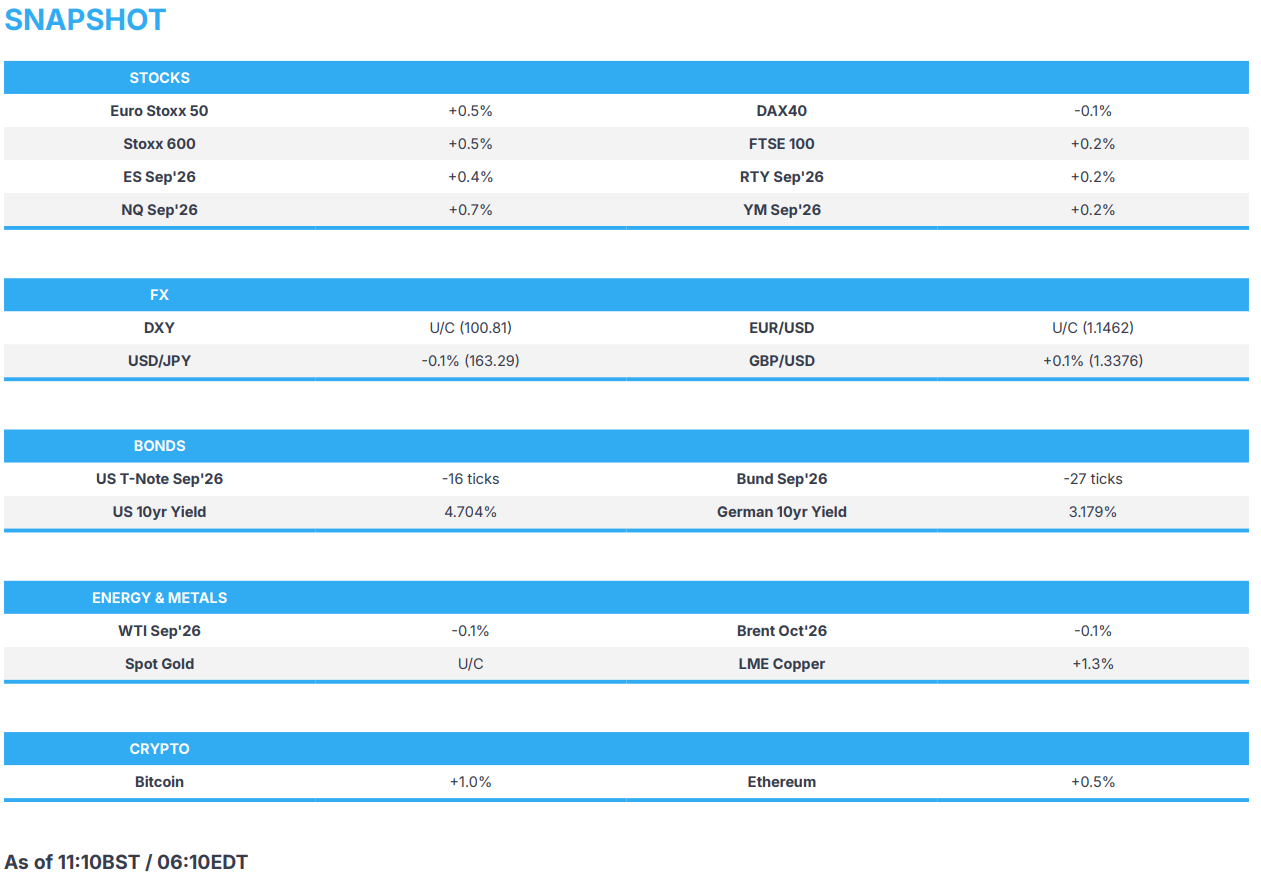
- US equity futures are firmer across the board despite contrasting Meta (-8.8% pre-market) and Microsoft (+8.8% pre-market) earnings.
- DXY rebounds following the FOMC-induced losses, with focus now on PCE and GDP metrics.
- Fixed income benchmarks are lower across the board; BoE policy announcement awaits.
- Looking ahead, highlights include German Inflation Flash (Jul), US GDP Advance (Q2), PCE (Jun), Initial Jobless Claims (Jul/25), Personal Spending (Jun), Chicago Fed Labor Market Indicators (Jul), BoE Policy Announcement & MPR (Jul). Speakers include BoE Governor Bailey, Earnings from Bristol Myers Squibb, Mastercard, Apple & Amazon.
EUROPEAN TRADE
EQUITIES
- European bourses trade entirely in the green following a busy morning of earnings (see more below) and constructive rhetoric by the Pakistani Foreign Ministry. Al Jazeera reported comments by the spokesperson stating that discussions between Tehran and Washington are ongoing regarding the situation in the Strait of Hormuz and de-escalation; however, Al Arabiya added that there have been no tangible results. On the data front, flash GDP figures across the EZ came in broadly stronger than expected (outside of France); however, Spanish inflation came in hotter than expected, with German state CPIs also rising Y/Y.
- Sectors highlight the positive bias. Construction tops the pile, with Chemicals and Basic Resources rounding out the sector outperformers. Health Care, Financial Services and Telecoms are the only sectors in the red.
- A typical busy Thursday of earnings, with L'Oreal, Adidas and Stellantis in focus. L'Oreal LFL sales beat estimates, and it announced a 50-year exclusive deal with Kering. Adidas Q2 operating profit missed estimates while its H1 gross margin ticked lower. The Co. highlighted higher US tariffs and unfavourable currency developments as key reasons for the softer figures. In other news, Adidas' Board appointed a new CFO. Finally, for Stellantis, its H1 adj. operating profit missed estimates while analysts at Bernstein also highlighted that margins for both Europe and North America missed.
- US equity futures are higher; however, there are some big pre-market movers following earnings after-hours. Positively, Microsoft prints gains of over 8% pre-market after it reported Q2 top and bottom lines with Cloud revenue beating and Copilot eclipsing 30mln paid seats. On the other side, Meta slumps 9% after Q2 EPS missed estimates while Q3 revenue guide was a little soft and FY capex and total expense guide was elevated again.
- Samsung Electronics (005930 KS) - Q2 2026 (KRW): Net Income 71.3tln (exp. 68.5tln), Operating profit 89.4tln (prelim. 89.4tln), revenue 171tln (prelim. 171tln). Co. sees demand strength in server chips and chip supply shortage to continue in H2 while seeing a demand slowdown in mobile and PC chips. Says its Foundry business is to post double-digit growth this year.
- Click for the sessions European pre-market equity newsflow
- Click for the additional news
FX
- G10s are mostly weaker against the Buck. Antipodeans outperform, European EMs benefit from softer TTF and other majors are quiet.
- USD is firmer against most G10 peers and resides in a 100.77-101.07 range as it attempts to claw back some FOMC-induced losses from Wednesday. To recap, the treasury curve steepened aggressively, and USD saw broad weakness as markets unwound a c. 33% probability of tightening. The driver today will likely be the PCE and GDP metrics due at 13:30 BST, alongside the familiar geopolitics (which will likely have less of an impact today). Support is below at 100.50 (alongside the 50DMA).
- EUR/USD is a touch weaker, but off worst levels as the dust settles post-FOMC; the pair currently residing at the top of yesterday's range around 1.1450. German prelim GDP was released alongside State CPIs, the latter which indicates the mainland figure will likely be in line with expectations. German GDP surpassed expectations, before the EZ figure also printed firmer. EUR saw a modest bounce on the German data points, sufficient to lift the pair above 1.1450. EUR will likely be dictated by the Buck once again this afternoon, into tier-1 US data (see above). Levels include the 21DMA below @1.1418, and the 50DMA above at 1.1483.
- Focus for GBP today on the BoE meeting and MPR. The bank is widely expected to keep rates unchanged at 3.75%, justified as the BoE retains policy space and neither the energy or second-round effect criteria are met beyond scenario A. A 7-2 vote split is the consensus, though there is a possibility Mann could also join the hawks. Into the meeting, markets imply just 2bps, or an 8% probability of tightening. Should the hawkish risks materialise, Cable could push towards 21-DMA at 1.3380.
- Antipodeans are the clear outperformers against the Buck, with encouraging Australian Building Approvals and New Zealand Business Confidence likely giving a hand. Kiwi is the outperformer after finding a bid above 0.58, while Aussie fails to benefit to the same extent, but remains supported at 0.6950.
FIXED INCOME
- Fixed income is lower across the board as the space focuses on Chair Warsh over the statement itself, though the complex is off worst amid a Pakistan-driven pullback in energy benchmarks.
- USTs reached a 108-06 low this morning, but remains clear of 108-01 and 108-00+ from last week; the latter is also the contract low, for reference. Amidst this, the 10yr yield has been up to 4.71%, near-enough matching the YTD peak from last week. A move that is more pronounced the further out the curve you go, with steepening still very much in play, evidenced by the 30yr yield hitting a YTD peak on Wednesday, and eclipsing it this morning at 5.24%, now looking to 2007’s 5.39% high. The 2yr retreated following Warsh, despite knee-jerking higher on the Fed holding, and has since remained around the mid-point of Wednesday’s 4.21-4.39% band.
- Heading into the Fed, around a 30% chance of a hike was implied. Now looking to September’s meeting, which will come a few weeks after the Jackson Hole Symposium, the odds of a 25bps hike have increased from around a 55% implied probability to c. 57%, though the main move has been a paring of the odds of it target rate being at 4.00-4.25% (i.e. a July and September hike) to just 1% vs 20% pre-July’s hold; in-fitting with the pullback in short-term rates and curve steepening. Finally, the odds of a September hold now stand at 41% from 24%, as the mentioned 4.00-4.25% pricing reallocates.
- Bunds softer, down by 30 ticks as it stands but around 20 ticks clear of the 124.30 base. Broadly, following USTs lower before then finding respite as energy pulled back on the morning’s updates (see Commodities). No move to the morning’s data, with the regional German CPIs in-line with consensus for an uptick in the 13:00BST mainland print, while Q2’s 1st GDP print surpassed expectations at 0.2% Q/Q, benefitting from exports and seemingly indicative of other nations getting hit harder than Germany. Thereafter, the EZ-wide 1st read also surpassed consensus, though once again Ireland may be distorting it.
- Gilts in-fitting with the above, are lower by 25 ticks and the same amount clear of the 86.31 trough. Attention today on the BoE, where a hold is expected but the risks are hawkish, and this may be reflected in the number of dissenters ticking up, with Mann the one to watch; full Newsquawk preview available.
- JGBs, briefly, were in-fitting overnight, though with additional pressure seen after a soft 2yr tap and as participants now look to the Friday policy announcement.
- Italy sells EUR 6.0bln vs. exp EUR 4.75-6.0bln 3.15% 2031, 3.80% 2036, and 1.45% 2036 BTP.
- Japan sells JPY 2.13tln 2-year JGBs b/c 3.63 (prev. 4.82), average yield 1.483% (prev. 1.407%).
COMMODITIES
- In US-Iran geopolitics, US CENTCOM announced that its forces successfully completed a heavy wave of strikes against Iran in response to the previous day’s attempted missile attacks on US forces. The strikes hit dozens of IRGC targets in Iran, including military command centres, missile and drone facilities, coastal surveillance and defence sites, and maritime capabilities. According to the WSJ, CENTCOM Commander Cooper proposed a two-week plan to escalate strikes in Iran. Arab sources reported that explosions were heard in Jordan, according to Nour News. It was later reported that Jordan intercepted five missiles launched by Iran and that there were no casualties, according to local media. Meanwhile, this morning, a Pakistani Foreign Ministry spokesperson said discussions between Tehran and Washington are ongoing regarding the situation in the Strait of Hormuz and de-escalation. Al Arabiya sources later suggested that no tangible results are yet seen in halting the escalation. On the flip side, Iran’s IRGC said it will “punish aggressors today” following recent attacks.
- Elsewhere, it is worth keeping the Russia-Ukraine conflict on the radar, as heavy explosions were reported in Ukraine’s capital, Kyiv, and in other areas, including Lviv, as Russia launched ballistic missiles. Poland also scrambled fighter jets amid Russian airstrikes on Ukraine. Polish PM Tusk said a missile fell inside Poland in an uninhabited area; it appears to be a Russian missile, but this is not 100% certain.
- WTI Sep’26 and Brent Oct’26 futures are on a firmer footing as geopolitics escalate, but gains are capped by ongoing mediation and diplomacy efforts. WTI resides in a current USD 83.21-85.94/bbl range while Brent sits in a USD 86.70-89.50/bbl range at the time of writing, with both contracts towards the top end of the parameters. Dutch TTF meanwhile is softer and back under the EUR 60/MWh mark for the front-month contract, which found early support near EUR 59/MWh. No clear reason for the dichotomy between gas and oil, although a Qatari ship carrying LNG passed the Strait of Hormuz with Iran's permission.
- Metals are mixed, choppy, and within recent ranges. Precious metals spiked on the FOMC yesterday before waning overnight as the Dollar recovered against the backdrop of escalating geopolitics. The yellow metal trades within a relatively narrow USD 4,028-4,100/oz range at the time of writing, within yesterday’s USD 3,996.05-4,116.42/oz. Spot silver resides in a USD 56.93-58.65/oz range at the time of writing, within yesterday’s 56.74-59.26/oz range.
- Base metals are on a firmer footing despite the firmer oil prices and escalating geopolitics, but possibly amid the Chinese Politburo meeting, which said the nation is to boost domestic demand and stabilise the property market. 3M LME copper trades towards the top end of a USD 13,636.00-13,752.83/t range at the time of writing.
- US oil firms trying to get into Venezuela are reportedly facing difficulties, WSJ reported citing sources.
- Caspian Pipeline Consortium reported drone attacks on two more tankers near its Black Sea terminal. Oil loading at the terminal has been suspended, and the pipeline facilities are operating normally, Kommersant reported.
- Shipping data showed that tankers which were intending to load at the CPC terminal are departing the Black Sea,according to sources.
- Jordan is looking to acquire Egypt's stake in the Fajr gas pipeline, Al Arabiya reported citing sources.
NOTABLE EUROPEAN HEADLINES
- EU launched AI Gigafactories call to establish up to seven AI Gigafactories across Europe, unlocking more than EUR 30bln in investments.
NOTABLE EUROPEAN DATA RECAP
- EU GDP Growth Rate QoQ Flash (Q2) Q/Q 0.4% vs. Exp. 0.2% (Prev. -0.2%).
- EU GDP Growth Rate YoY Flash (Q2) Y/Y 1% vs. Exp. 0.5% (Prev. 0.3%).
- German GDP Growth Rate QoQ Flash (Q2) Q/Q 0.2% vs. Exp. 0.1% (Prev. 0.3%).
- German GDP Growth Rate YoY Flash (Q2) Y/Y 0.9% vs. Exp. 0.6% (Prev. 0.4%).
- Italian GDP Growth Rate QoQ Adv (Q2) Q/Q 0.2% vs. Exp. 0.1% (Prev. 0.3%).
- Italian GDP Growth Rate YoY Adv (Q2) Y/Y 1.0% vs. Exp. 0.7% (Prev. 0.8%).
- French GDP Growth Rate QoQ Prel (Q2) Q/Q 0.2% vs. Exp. 0.2% (Prev. -0.1%).
- French GDP Growth Rate YoY Prel (Q2) Y/Y 0.7% vs. Exp. 0.8% (Prev. 0.9%).
- Spanish GDP Growth Rate QoQ Flash (Q2) Q/Q 0.7% vs. Exp. 0.6% (Prev. 0.6%).
- Spanish GDP Growth Rate YoY Flash (Q2) Y/Y 2.7% vs. Exp. 2.5% (Prev. 2.7%).
- Spanish Inflation Rate YoY Prel (Jul) Y/Y 3.5% vs. Exp. 3.4% (Prev. 3.2%); Core 3.0% (Prev. 2.9%).
- Spanish HICP (Jul) Y/Y 3.8% vs Exp. 3.7% (Prev. 3.7%); M/M -0.1% vs Exp. -0.2% (Prev. 0.6%).
- Spanish Inflation Rate MoM Prel (Jul) M/M 0.2% vs. Exp. 0.2% (Prev. 0.6%).
CENTRAL BANKS
- RBA's Hunter said she won't speculate on the August policy meeting, adding that Q2 inflation was slightly softer than expected.
NOTABLE US HEADLINES
- US Senator Cotton (R) urged the US government to ban federal agencies and contractors from using Chinese AI models in a letter sent this week to Commerce Secretary Lutnick, Semafor reported.
- US Senators Thune (R), Cruz (R) and Klobuchar (D) were close to proposing a bill to deal with the risks of advanced AI, though disagreements with Anthropic put the agreement on hold, sources told Punchbowl.
GEOPOLITICS
MIDDLE EAST
- US President Trump said that we've hit Iran very hard and we'll finish off Iran pretty soon.
- US CENTCOM announced its forces successfully completed a heavy wave of strikes against Iran, in response to the prior day's attempted missile attacks on US forces, while they struck dozens of Islamic IRGC targets in Iran, including military command centres, missile and drone facilities, coastal surveillance and defence sites, and maritime capabilities.
- US CENTCOM commander Cooper proposed a 2-week plan to escalate strikes in Iran, according to WSJ.
- US source said the overnight strike was extensive and had a significant impact, while it was about twice as large in intensity and scope as previous operations, according to i24's Stein.
- Pakistani Foreign Ministry Spokesperson said discussions between Tehran and Washington are ongoing regarding the situation in the Strait of Hormuz and de-escalation, Al Jazeera reported. Additionally, Al Arabiya reported, citing sources, that tangible results have not yet yielded results.
- Iran's IRGC said they will "punish aggressors today" following recent attacks.
- Arab sources reported that explosions were heard in Jordan, according to Nour News. It was later reported that Jordan intercepted five missiles launched by Iran and said there were no casualties, according to local media.
- A US-owned and operated, Marshall Islands-flagged LNG floating storage facility was struck by at least one UAV while at Egypt's Mediterranean port of Damietta, according to Ambrey. The Egyptian Cabinet later noted that an initial investigation found that the fires on two vessels at the Damietta port was caused by a drone and that no party has claimed responsibility for the attack.
- Riyadh Airport suspended activities after reports of two explosions heard in Saudi Arabia's capital.
- Saudi Arabia is seeking to build an international coalition to protect Red Sea shipping from Houthi attacks, according to reports, citing sources.
- Talks are progressing for Hamas to declare disarmament, sources say. The sources added that talks are also underway to hold a signing ceremony for the understandings in Egypt in the coming days.
- Israel reportedly conducted an airstrike on Gaza City, according to Al Araby.
RUSSIA-UKRAINE
- Heavy explosions were reported in Ukraine's capital of Kyiv and in other areas including Lviv as Russia launched ballistic missiles, while Poland scrambled fighter jets amid Russian airstrikes on Ukraine.
- Russian press noted a drone attack on Taman port in Russia's Krasnodar region. Additionally, sources reported that the Ukrainian drone attack struck a grain export terminal at Russia's Taman Port, causing significant damage.
- Polish PM Tusk said a missile fell inside Poland in an uninhabited area and that it appears to be a Russian missile but not 100% certain. This came following earlier sirens in cities across eastern Poland after possible reports of Russian cruise missiles having crossed into Polish airspace.
CRYPTO
- Bitcoin extends further above the USD 64k handle amid the positive risk tone across markets.
APAC TRADE
- APAC stocks were mostly lower in somewhat mixed trade as participants reflected on the FOMC and mega-cap earnings, while geopolitics was also in focus after the US conducted retaliatory strikes on Iran.
- ASX 200 traded lower with gold miners and the consumer sectors leading the declines, although downside was stemmed by resilience in tech,
- Nikkei 225 was positive with tech stocks front-running the advances in the index, while participants also look ahead to the BoJ, which began its two-day conclave and is expected to pause after hiking rates at the last meeting.
- KOSPI swung between gains and losses despite early momentum driven by Samsung Electronics earnings.
- Hang Seng and Shanghai Comp were subdued with Hong Kong range-bound after the HKMA kept rates unchanged in lockstep with the Fed, while the mainland was pressured amid ongoing US-China frictions, with MOFCOM criticising the US robot ban and threatening to retaliate if the US insists on acting unilaterally.
NOTABLE ASIA-PAC HEADLINES
- Japanese PM Takaichi said the plan to cut the food sales tax to 1% will be from April 2027 and be effective for 2 years. They aim to get approval by early August. Further comments by Japanese PM Takaichi, stating that she will keep market trust by not resorting to debt issuance to fund temporary tax cuts.
Related headlines
- [MARKET ANALYSIS] Gilts lead on pre-budget reports and post-Pill, USTs await CPI3 hours ago
- [MARKET ANALYSIS] Crude gains amid renewed Middle East tensions and shipping attacks; copper supported after Chinese data3 hours ago
- [MARKET ANALYSIS] DXY is flat awaiting US CPI; Antipodeans outperform on the risk tone and Chinese data3 hours ago
- A source tells the Tehran Times that the the assessment is that the US President Trump, under pressure from Israeli President Netanyahu, is seeking a new confrontation in the region, but does not have the capacity to expand or sustain this3 hours ago
- [CALENDAR ADDITION] US President Trump to hold a political rally in Arizona at 21:00EDT/16:00BST and in Montana at 20:15EDT/01:15BST40 min ago
- Russian President Envoy Dmitriev says they will continue economic cooperation with the US, not only on diesel1 hour ago
- Russian Deputy PM Novak says a diesel supply solution, with reference to supplies to the US, will be determined via negotiation, in the context of ongoing sanctions, Ifx reports. Russian oil output will see a recovery2 hours ago
- A US official says the idea of cutting off intelligence-sharing with Ukraine is being discussed inside the White House, Semafor reports3 hours ago
- Israeli PM Netanyahu says he opposes a preemptive attack on Iran at this time before the elections: "I think it's not convenient for us"3 hours ago
- Russia's Deputy PM Novak says Russia could increase diesel exports to 3.5 million tons per month and take 10% of this market by the end of the year, Tass reports1 hour ago
- Aurubis (NDA GY) reportedly lifts its 2027 European copper premium to USD 347 per metric tonne, Reuters reports4 hours ago
- Primer: US CPI due Wednesday 14th October 2026 at 13:30 BST / 08:30 EDT1 hour ago
- [CALENDAR ADDITION] Fed's Goolsbee (2027 Voter, Neutral) to speak on Yahoo Finance at 15:00EDT/20:00BST48 min ago
- Fed's Bowman (Voter) says not seeing urgency on further action on rates 2 hours ago
- Japan's aluminium premium for Oct-Dec delivers set at USD 255/t, -35% Q/Q, according to sources5 hours ago
- Italian PM Meloni says they see a deal with the EU being close on measures to cut the impact of gas costs on electricity prices5 hours ago
- Commerzbank (CBK GY) CEO says that they are expecting ECB approval for UniCredit (UCG IM) tie up in the coming days or weeks5 hours ago
- State Street (STT) Q3 2026 (USD): EPS 3.69 (exp. 3.68), Revenue 4bln (exp. 4.03bln), NII 864mln (exp. 854.1mln)1 hour ago
- BlackRock Inc. (BLK) Q3 2026 (USD): Adj. EPS 15.93 (exp. 14.32), Revenue 7.75bln (exp. 7.43bln)2 hours ago
- PBoC Governor reportedly to be meeting BoJ and BoJ counterparts on the sidelines of IMF annual meeting being held in Bangkok1 hour ago
The feed had this first.
Use the Platform