
Primer: Quarterly Refunding due Wednesday August 5th at 13:30BST/08:30EDT
Newsquawk Staff ·
The US Treasury will release its Q3 Quarterly Refunding Announcement on Wednesday at 13:30 BST/08:30 EDT.
The Treasury ended Q2 with a cash balance of USD 919bln, above the USD 900bln estimate at the start of the quarter. For Q3, Treasury expects to borrow USD 739bln in privately-held net marketable debt (prev. saw 671bln), assuming an end-of-September cash balance of USD 950bln (prev. saw 950bln). The borrowing estimate is USD 68bln higher than announced in May 2026, primarily due to lower projected net cash flows, partially offset by the higher-than-assumed beginning-of-quarter cash balance. Excluding the higher-than-assumed beginning-of-quarter cash balance, the current quarter borrowing estimate is USD 87bln higher than announced in May. Looking ahead to Q4, the Treasury expects to borrow USD 628bln in privately-held net marketable debt, assuming an end-of-December cash balance of USD 850bln.
As always, focus will lie on the guidance to see whether the Treasury maintains language that the "Treasury anticipates maintaining nominal coupon and FRN auction sizes for at least the next several quarters".
JPMorgan said the USD 3.7tln funding gap it expects to emerge over the next four fiscal years means officials should adjust the wording of their long-standing guidance on auction sizes to meet the Treasury's objective of "prudent debt management". Specifically, it said the words "at least" should be removed from the line stating that auction sizes are expected to remain steady for "at least the next several quarters". However, JPMorgan said political considerations were likely to drive the decision. It added that changing the guidance next week could unsettle the bond market ahead of November's midterm elections, pushing long-maturity borrowing costs higher when they are already near their highest levels since President Trump took office. Treasury Secretary Bessent last year explicitly linked issuance plans to yield levels. JPMorgan therefore believes the US Treasury will avoid unsettling bond markets ahead of the crucial midterm elections and defer changes that would raise the prospect of larger bond sales in its QRA statement.
Wrightson also expects guidance to be left unchanged, but states that "the question of when to start raising them is probably creeping higher on the Treasury’s planning agenda".
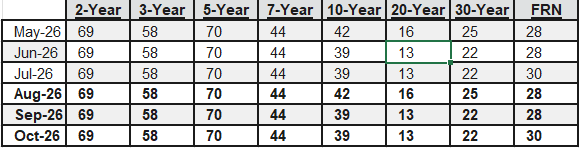
Providing the Treasury maintains next quarter's auction sizes as expected, the issuance table should look like this:
- US Midterm Preview: Democrats Favoured to Flip the House, Senate Too Close to Call
- White House says President Trump has further modified Canadian products subject to tariffs under Section 338; tariff changes will take effect on 30th October 2026
- Newsquawk Weekly Economic Release 26th - 30th October 2026
- Newsquawk European Market Wrap - 23rd October 2026
- US EQUITY OPEN: Breadth poor at the open: Energy leads gains on oil rally, Tech sees slight bounce
Related headlines
- CRUDE WRAP: WTI (Z6) SETTLES USD 3.80 HIGHER AT USD 103.27/BBL; BRENT (Z6) SETTLES USD 3.55 HIGHER AT USD 116.72/BBL2 hours ago
- Week in Focus 26-30th October 2026: FOMC, BoC, RBNZ, ECB, BoJ Policy Decisions, US PCE45 min ago
- US President Trump says we’re close to ending, I hope, the Russia-Ukraine war1 hour ago
- US President Trump, on Iran, says we may do another operation against Iran; doubts Iran will say ‘let’s get down to business’1 hour ago
- US President Trump expected to remove some tariffs on Canada in a bid to help Senator Susan Collins, WSJ reports3 hours ago
- The Trump administration plans to introduce voluntary “US Caught Seafood” labels to help consumers identify seafood origins, according to CBS5 hours ago
- US President Trump says they are "very close" to a deal with Mexico. Canada is working hard to make a deal.6 hours ago
- US President Trump says he discussed the North Sea with the UK PM. Conversation also include Iran and Ukraine.6 hours ago
- US President Trump says "we could end the Iran war very quickly", adds "do we want to finish it or let it within is the question"6 hours ago
- US President Trump is set to speak with UK PM Burnham this afternoon on the Russia-Ukraine situation, BBG reports6 hours ago
- Citi says it remains neutral on copper until more energy-market and tariff clarity emerges; views any associated risk-off episodes as good long-term buying opportunities2 hours ago
- Russia's Kremlin says Russian and Ukrainian militaries are working to determine dates for ceasefire talks6 hours ago
- US Ambassador to Turkey Tom Barrack says US could strike Iran as soon as this weekend, AFP reports citing an interview on Israeli radio3 hours ago
- Foreign Ministers of Egypt, Saudi Arabia, Turkey and Pakistan say ‘Israeli occupation is the main source of instability in the region and beyond’, according to a statement2 hours ago
- Senior Ukrainian Official says that a ceasefire in Russian-occupied Oleshky is to be established soon6 hours ago