
US Midterm Update: Democratic sweep odds little changed at 63%
US Midterm Update: Democratic sweep odds little changed at 63%
ECB President Lagarde says debt situation in France is serious at 120% of GDP and without a path to lowering, reports La Croix Newspaper
USTR Greer says he will release Milwaukee framework for coordinated action to address excess steel capacity at G20 trade minister event
Open the platform and use it. The whole workspace is free to try, with no signup and no card. When you want the headlines arriving live instead of on a delay, Newsquawk Pro is £24.99 for 7 days.
What is priced?
- 34 days until the election, and the House is still widely expected to go to the Democrats, whilst the Senate has continued to tilt in the Dems' favour.
- Polymarket odds show participants have continued to heavily favour Democrats to win the House at 93% (prev. 94% on Sept 23th), whilst for the Senate, Democrats are little changed at 63% from 66% last week.
- Polymarket shows the probability of a Democrat sweep at 63% (prev. 66% W/W), while pricing a Republican Senate and Democratic House at 29% (prev. 26%), and a Republican sweep at 8% (prev. 8%).
Toss-up Senate & House races (Decision Desk HQ)
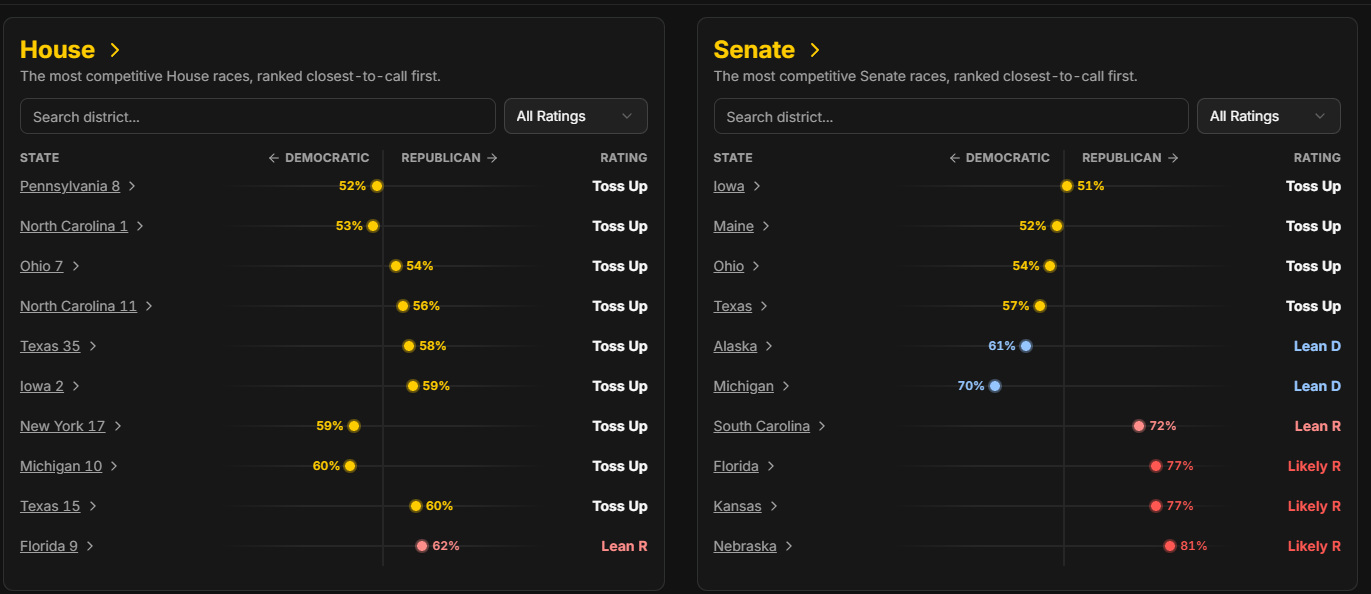
- Decision Desk forecasts a Dem House majority, 234-201, and a Dem Senate majority, 51-49.
- Cook Political report sees the most likely outcome as the Democrats taking up five to 15 seats, holding 220-230 seats in 2027 (218 needed). It also highlights the vulnerability for Republican held House districts, with 16 out of the 22 toss-up seats held by Republicans. This extends to the Senate, with 5 out of 7 toss up Senate seats held by Republicans.
- Trump on Tuesday announced he is starting a 32-day campaign tour this week, campaigning in Texas Ohio and Nebraska, all of which are key senate races.
- Iowa: On Monday, US President Trump announced for a new USD 15bln steel mill in Iowa, giving the administration a major manufacturing investment to highlight ahead of the November midterm elections. The project is expected to create 1,750 jobs. Punchbowl highlights Iowa's 1st is one of the three most expensive House races in the country.
- Nebraska: US President Trump will reportedly be headlining a midterm rally in Nebraska on Monday, reports CNN. Currently, Democratic Mary Peltola is the betting market favourite to take the Senate in November at 73% vs Sen. Dan Sullivan (R).
Recent developments
- The Trump admin remains undecided on an diesel export ban even after US Energy Secretary Wright advocated for a voluntary cap. A recent FT report notes a White House official said Trump is "evaluating all the options on the table". One official floated curbs on international diesel sales whilst sources aid Trump could make a sudden decision in favour of a ban.
- In the last week, the US-Iran war has seen a couple round of talks via mediators, with markets optimistic a deal can be found. However, reports caveat that progress has been limited, i.e. Trump rejecting Iran's proposal, Trump rejecting the reports that he would unfreeze Iranian assets to fuel progress, and disagreement over the next steps and who will make the first move. Reports on Monday suggest Iranian officials are pessimistic about a deal before the US midterms. Trump has continued to avoid specifying a timeline on the Iran war, saying it could end before or after the midterms.
- AAA gas prices have slightly eased from last week, USD 4.4343 from USD 4.4744 last week. The national average for a gallon of diesel hit USD 6.51 on September 22nd.
- The last Democrats attempt to pass a Iran war powers vote before the midterms failed last week, 49-50, with one Democrat, John Fetterman, voting against it.
- Trump is expected to announce South Korea’s planned ~USD 200bln of US investment later today, including USD 54bln for an Alaska natural gas export project, as the first tranche of projects under last year’s US-South Korea trade deal, which included a USD 350bln US investment pledge; other investments are expected to include energy projects such as nuclear, with the announcement expected Wednesday in the Oval Office.
- Senate Republicans plan pre-midterm procedural votes on two House-passed bills — one banning congressional stock trading while including a voter ID mandate, and another targeting data-centre energy costs — before potentially leaving Washington early to campaign; Democrats are expected to block both Punchbowl reports, allowing Republicans to say they backed the measures but preventing them from reaching Trump’s desk. The data-centre bill passed the House 417-3.
- The US Treasury said Trump Accounts will begin auto-enrolling millions of children as early as Oct. 1 under temporary regulations, potentially increasing 2026 enrolment by more than 60mln accounts from the 7mln-8mln currently signed up; Treasury Secretary Scott Bessent said enrolment could reach ~70mln within a month. The tax-deferred accounts, launched July 4, can include a one-time USD 1,000 Treasury contribution for children born between 2025 and 2028.
AI
- Following Trump's meeting with top AI executives on Tuesday, the US President said said AI should be subject to “tremendous self-regulation”, with the DOJ and FBI providing existing government oversight, rather than new federal guardrails. He also said AI companies would work with local communities hosting data centres, including through support for oil and gas, education, teachers and residents, arguing this would make data centres more beneficial to communities. Trump said the US has a significant lead in AI and intends to maintain it, while framing the technology as potentially larger than the Industrial Revolution.
Trump's aims ahead of midterms
- The Trump admin is still reportedly examining a diesel export ban. The move follows growing pressure from top Republicans to prioritise domestic needs. Ashley Hinson, a Republican member of the House of Representatives, on Monday urged the use of “every option at our disposal to provide some relief from high prices”, including “pausing diesel exports . . . and creating a diesel relief programme to help our farmers and truckers being crushed by the high costs”. Iowa Senator Grassley wrote, “If our [government] can embargo chips to China it can embargo diesel to help American farmers [and] truckers”. Last weekend, Energy Secretary Wright, Interior Secretary Burgum and other White House officials were working on the issue. Ag secretary. Rollins said she expects an announcement “very soon on some potential actions”.
- Speaking at the GOP Convention, Trump urged voters to pretend he is on the ballot and vote for as if he were running, noting that if they do not have majorities, so much can be lost.
- Trump promised a Trump dividend of USD 5,0000 to every American adult if Republicans hold power in Congress. Since then, the President has stressed he means it and has the means to do it. Even Treasury Secretary Bessent has said it is possible, although the NPR warned it would cost over USD 1tln.
- Top officials state that Trump is looking for new policy pledges he can present to voters ahead of the midterm election, according to Bloomberg. The report notes that Trump may call on Congress to cut capital gains taxes and create an exemption for certain home sales. One of the measures touted would be indexing capital gains, so taxes would be applied on gains adjusted for inflation, while there could also be exemptions on sales of homes worth USD 2mln or less from capital gains taxes.
Approval vs. Disapproval Ratings on Trump's key issues
The RCP average compiles pollsters and provides an average approval or disapproval rating across key topics.
| Topic | Approve % | Disapprove % | Difference (Approve – Disapprove) |
|---|---|---|---|
| Overall Approval | 38.8 | 59.6 | -20.8 |
| Economy | 33.4 | 62.9 | -29.5 |
| Foreign Policy | 34.1 | 61.3 | -27.2 |
| Immigration | 42.7 | 54.2 | -11.5 |
| Inflation | 26.6 | 69.6 | -43.0 |
| Iran | 32.5 | 63.1 | -30.6 |
| Crime | 44.0 | 51.0 | -7.0 |
| Russia/Ukraine | 34.0 | 58.8 | -24.8 |
| Israel Hamas | 38.5 | 54.5 | -16.0 |
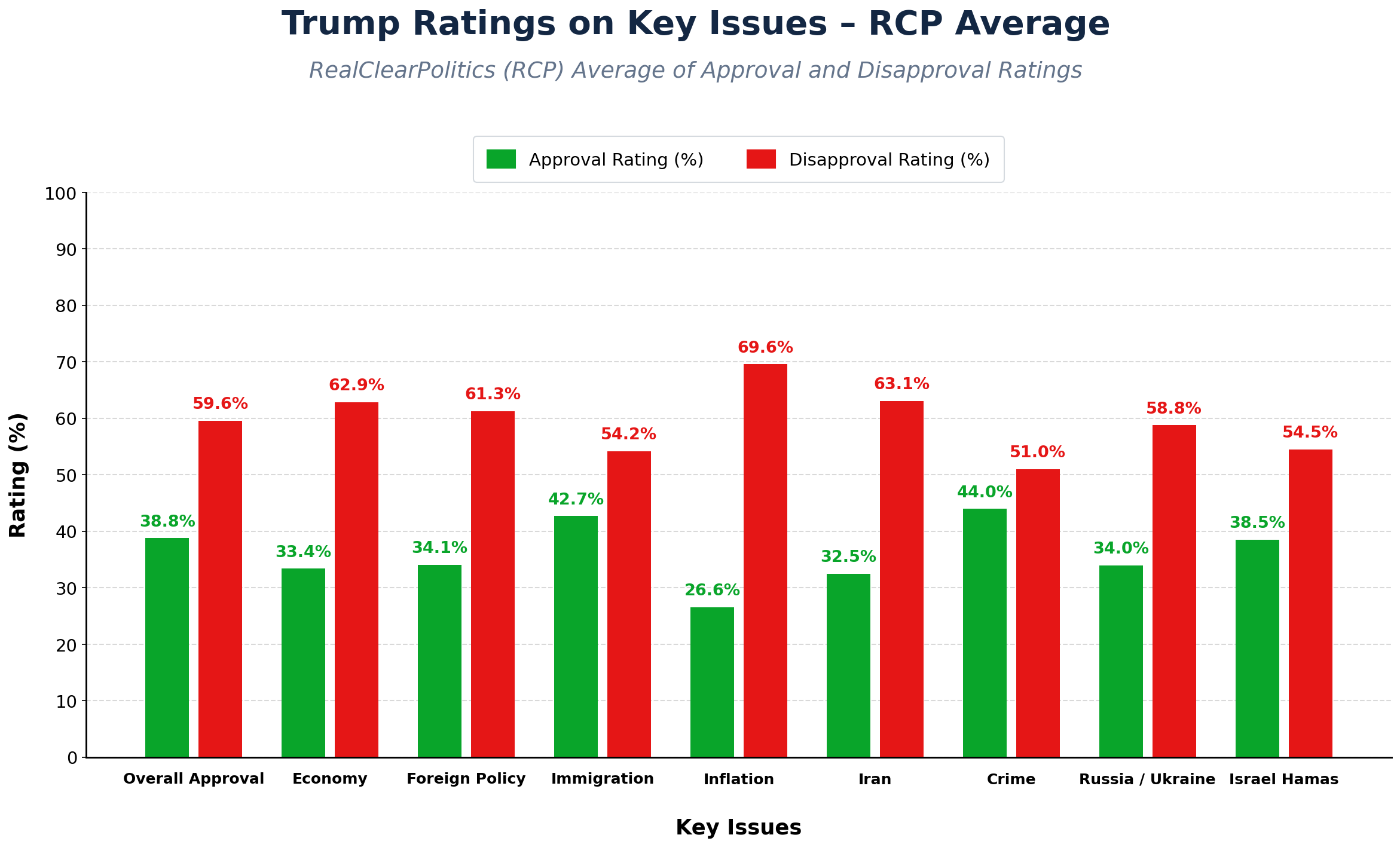
Takeaways:
- All topics show a higher disapproval than approval, indicated by the negative differences.
- Inflation has the largest gap (‑43.0 points), suggesting the strongest public dissatisfaction.
- Crime shows the smallest gap (‑7.0 points), indicating the closest balance between approval and disapproval among the listed issues.
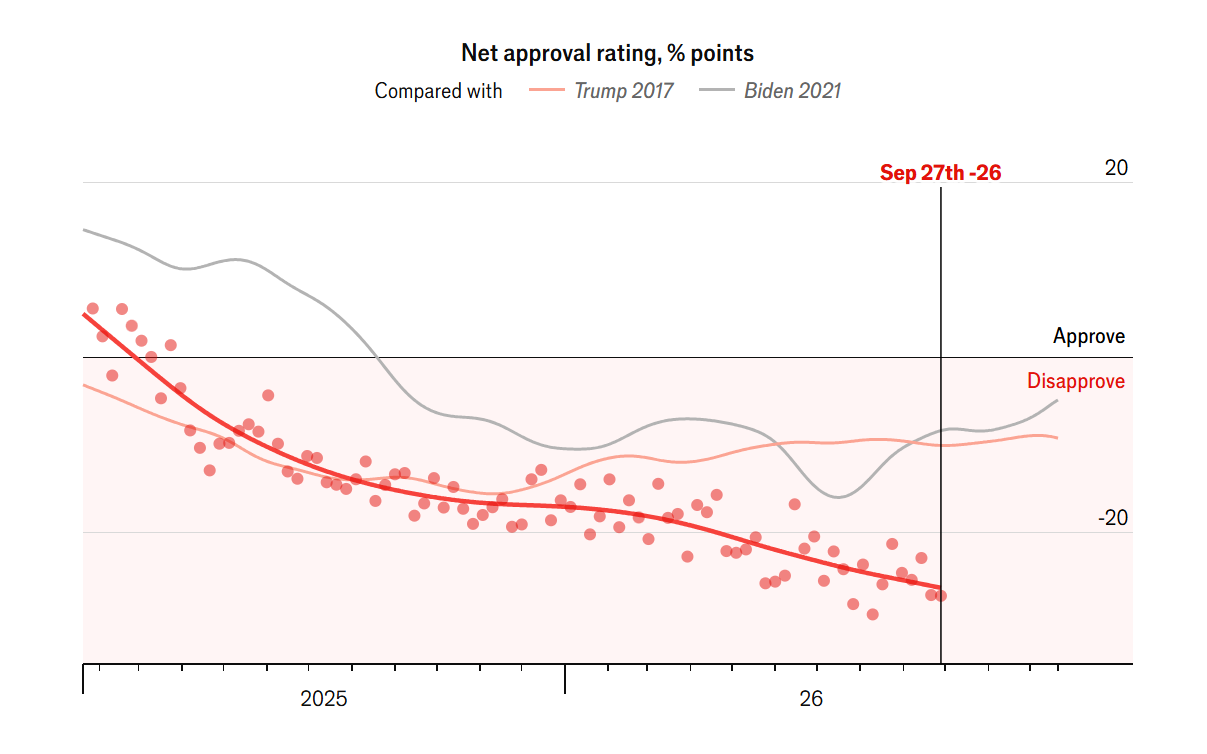
- Throughout the year, polling has shown the spread between those who either unfavour or disapprove of, or favour and approve of, US President Trump's job has widened.
Recent polls
Economist Trump net approval rating
Economist/YouGov (Sep 18–21, 1,568 U.S. adult citizens)
- Among likely voters, 52% would vote for the Democratic candidate in their district, versus 38% for the Republican.
- Among registered voters, Democrats lead 45% to 38%, their largest advantage since Economist/YouGov began tracking 2026 House vote intent in spring 2025.
- 93% of Democrats back their party’s candidate, compared with 90% of Republicans backing theirs, while Independents favour Democrats 52% to 27%.
- Democrats lead across every major age group, by 7 points among voters without college degrees and 22 points among college graduates.
- Men are split 44% Democratic vs. 47% Republican, while women favour Democrats 59% to 30%.
Reuters/Ipsos Poll (Sept 17-20, 1,277 responses from US adults)
- Trump’s approval rating fell to 32%, the lowest of his political career.
- Just 17% of respondents approved of his handling of the cost of living, the top issue Americans say will determine how they vote in the November 3 midterm elections.
- Among Republicans, those who disapprove of Trump’s handling of the cost of living outnumbered those who approve, 51% to 44%.
- Trump remains popular among Republicans on immigration, with 79% of his party approving of his approach, compared with 36% of Americans overall, while 55% disapprove.
- Registered voters preferred Democrats over Republicans by 43% to 35%.
- On the conflict with Iran, 24% of Americans support Trump’s approach.
AI/Data Centre Polls
Reuters/Ipsos (Sept 17-20, 1,277 US adults)
- 73% of Americans worry AI companies have not done enough to prevent AI from causing serious harm to society, while 39% say AI is having a negative impact on society, up from 36% last month and the highest level since Reuters/Ipsos began asking the question in March. 11% view AI as having a positive impact.
- 69% say they followed news about major AI companies calling for slower development and greater oversight and safety standards. 55% say slowing AI development would be a good thing, compared with 13% who say it would be bad.
- 73% say ensuring AI is developed safely and responsibly is more important, compared with 23% who say staying ahead of other countries in AI development is more important.
Equity Impact
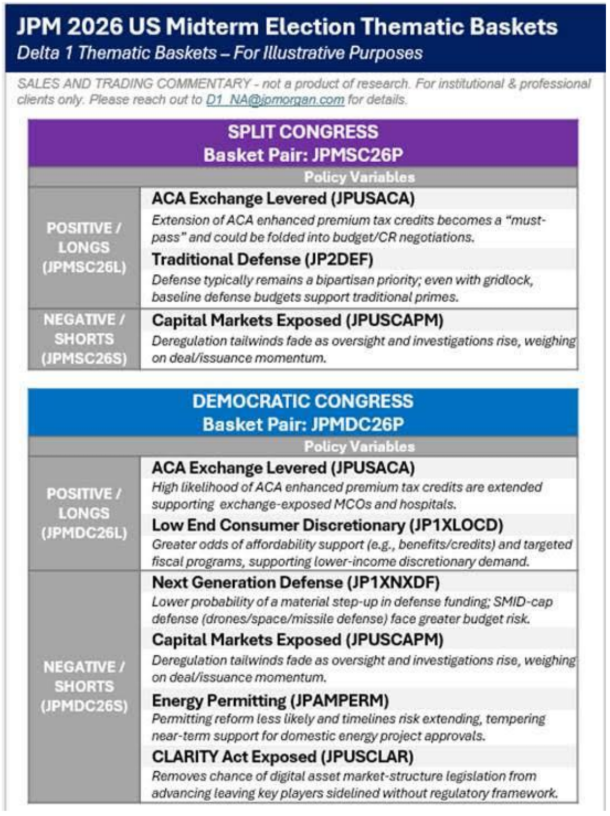
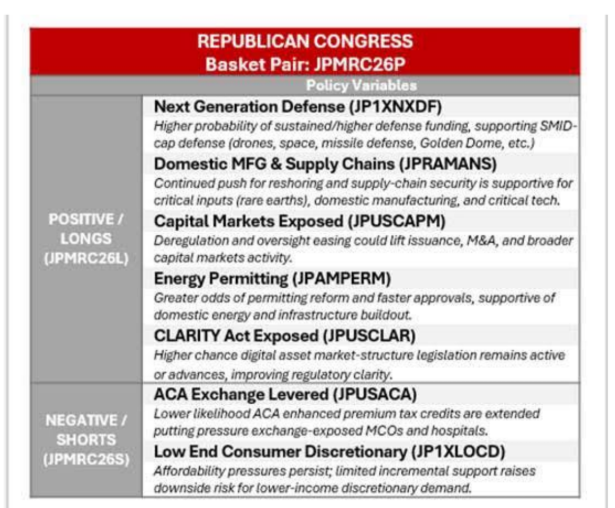
JPM
Goldman Sachs
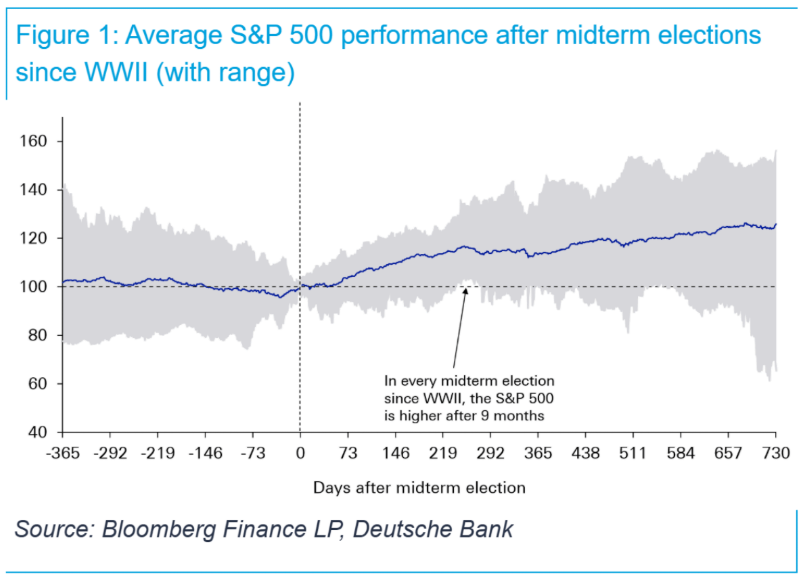
- In past cycles, economic policy uncertainty has usually risen in August ahead of midterm elections and remained elevated in the subsequent few months.
- Equities have typically traded sideways in the few months ahead of midterms.
- During 13 midterm election years since 1974, the S&P 500 has generated a median return of 0% from the start of August through Election Day. Returns have typically improved post-election. Mirroring this pattern, mutual funds and foreign investors have generally demonstrated reduced demand for US equities ahead of midterm elections but increased allocations afterwards.
- The outcome of the midterms is unlikely to be a major cause of equity volatility.
- Within the equity market, most sectors, factors, and thematic baskets have traded with no substantial correlation to prediction market probabilities of election outcomes in recent months, although this may change as the election draws closer.
BTIG
- BTIG chief market technician Jonathan Krinsky said the S&P 500 has historically experienced a pullback of at least ~7% during the August–October period of midterm election years, citing 1990, 1998, 2002, 2010, 2014, 2018 and 2022; 2006 was the main exception, with its decline occurring in May–July.
- Krinsky said midterm-related volatility is often driven by unforeseen external events, citing the 1990 Kuwait invasion, 1998 Long-Term Capital Management collapse, 2014 Ebola outbreak and 2018 US-China trade war.
- Krinsky said the recent market broadening and rally from the late-July summer slowdown have been strong, but warned that historical patterns point to a more difficult period ahead.
- He said the market is entering a historically volatile downside window with stocks at all-time highs and the VIX at 2026 lows.
- Krinsky said this makes it an attractive time to reduce risk or hedge broad-based equity exposure ahead of what has historically been a difficult part of the calendar.
Citi
- Citi says buy any pre-midterm market dip.
- Remains Overweight equities and recommends adding exposure if markets pull back ahead of the US midterm elections.
- Sees supportive earnings revisions, improving liquidity conditions and limited warning signs despite recent AI-related concerns.
- Continues to favour US stocks and believes sector rotation could limit downside.
- Historically, pre-midterm weakness has often been followed by strong year-end performance, making any dip a potential buying opportunity.
Prediction-market pricing of this kind tends to matter less for its level than for its drift: at roughly two-thirds odds for a unified outcome with a month to run, the signal is that the race has stabilised rather than shifted, and steady pricing this late in the cycle has historically been associated with lower realised volatility around the event itself. The relevant transmission channel for markets is the divided-versus-unified-government distinction: unified control implies a clearer legislative path on tax, spending and energy policy, while a split outcome implies gridlock, and past episodes of gridlock pricing have tended to be mildly supportive for duration and neutral-to-positive for equities once the uncertainty resolves, regardless of which party prevails. The administration's pre-election policy push, including the floated export curbs, fiscal transfer proposals and sector-specific pledges, is the more immediate market-sensitive thread, since such measures can be acted on before polling day and have in past cycles produced discrete moves in the affected parts of the curve and commodity complex. The approval data, with cost-of-living the weakest issue, is consistent with the historical pattern in which incumbent parties underperform when inflation dominates the ballot. What bears watching is any sharp repricing in the toss-up Senate races, since that is where the sweep probability actually lives, and whether the administration commits on the trade and fiscal measures before the vote.
Related headlines
- US EQUITY OPEN: Indices open in the green post cooler-than-expected PCE as MU numbers await2 hours ago
- US President Trump to announce eight nuclear power plants funded by South Korea as part of South Korea's USD 200bln US investment2 hours ago
- India PM Modi says he had a productive conersation with US President Trump2 hours ago
- Pakistan Defence Minister, while refusing to comment on any possible participation of his country's forces in Saudi attacks on Yemen, claimed that Pakistan will use every possible means to defend Saudi Arabia against what he called foreign attacks.52 min ago
- Russian Foreign Ministry spokesperson says European weapons factories producing arms for Ukraine are legitimate military targets for Russia1 hour ago
- Newsquawk Calendar of Key Events - October 20263 hours ago
- China's MOFCOM says China and Canada hold meeting on economy and trade2 hours ago
- Atlanta Fed GDPNow cuts its Q3 GDP growth estimate to 3.7% (prev. 5.0%)1 hour ago
- US Federal Reserve finalises changes to enhance the transparency and public accountability of its stress test and reduce volatility in its stress test-related capital requirements3 hours ago
- Caterpillar (CAT) intends to invest approximately USD 1bln in North Carolina to expand manufacturing capacity for products that support its growing Cat CompactSM business3 hours ago
- Synopsys (SNPS) and Amazon (AMZN) announce strategic, Multi-year IP agreement for Custom Silicon; Collaboration also extends to cloud and AI-powered engineering; agreement worth USD 1bln3 hours ago
- Treasury Block Trades [Rolling headline, 30th September 2026]54 min ago
- EIA Expectations: Crude 0.5M, Distillate -0.351M, Gasoline -1M2 hours ago
- EIA Cushing Crude Oil Stocks Change (Sep/25) 0.553M (Prev. 2.266M)1 hour ago
- US EIA Refinery Crude Runs Change (Sep/25) -0.554M (Prev. -0.519M)1 hour ago
- US EIA Heating Oil Stocks Change (Sep/25) -0.620M (Prev. 0.346M)1 hour ago
- US EIA Crude Oil Imports Change (Sep/25) -0.468M (Prev. 0.369M)1 hour ago
- US EIA Crude Oil Stocks Change (Sep/25) 0.922M vs. Exp. -0.3M (Prev. 2.969M)1 hour ago
- Yemeni armed forces reportedly attacked the Abqaiq oil city in eastern Saudi Arabia this afternoon, reports IRNA citing "some news sources"2 hours ago
- US EIA Distillate Fuel Production Change (Sep/25) -0.156M (Prev. -0.068M)1 hour ago
The whole workspace, free to try.
Try it free