
US Midterm Update: Latest Polymarket pricing puts Democratic sweep at 49%
Newsquawk Staff ·
What is priced?
- 69 days until the election, and the House is still widely expected to go to the Democrats whilst the Senate remains a close call.
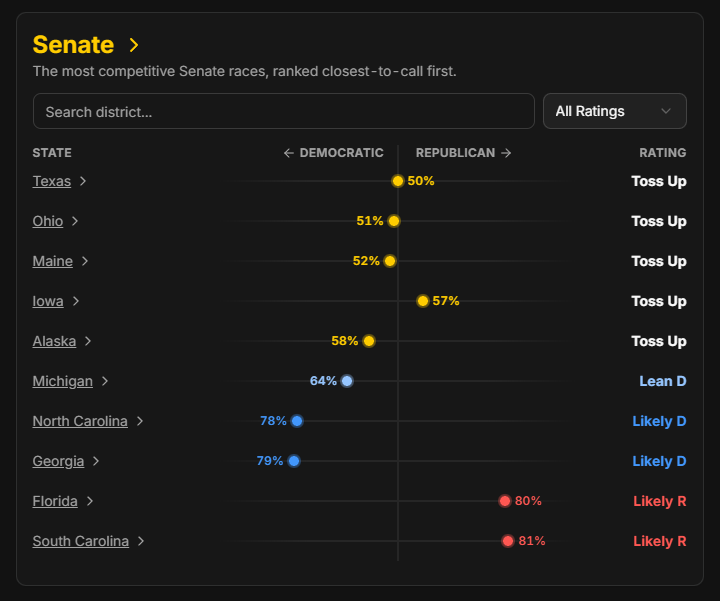
- Polymarket odds show participants have continued to heavily favour Democrats to win the House at 88% (prev. 88% on August 19th), whilst for the Senate, it is evenly priced as for both parties at 50% (19th August: Democrats had a 52% chance to take the Senate).
- Polymarket shows the probability of a Democrat sweep at 49%, while pricing a Republican Senate and Democratic House at 38%, and a Republican sweep at 12%.
Trump eyes new policies ahead of midterms
- Top officials state that Trump is looking for new policy pledges he can present to voters ahead of the midterm election, according to Bloomberg. The report notes that Trump may call on Congress to cut capital gains taxes and create an exemption for certain home sales. One of the measures touted would be indexing capital gains, so taxes would be applied on gains adjusted for inflation, while there could also be exemptions on sales of homes worth USD 2mln or less from capital gains taxes.
- On 12th August, NEC Director Hassett stated in an interview with Fox Business' Kudlow, "You can expect a lot more policy between now and the midterms".
- Politico reported that the Trump admin is sunsetting a subsidy programme that lowered Medicare prescription drug coverage premiums for older Americans — just ahead of the midterm elections, giving the Democrats an attack point against the Republicans.
- DoJ plans to deploy 1,000 election monitors for the November midterms, which Assistant AG Harmeet Dhillon said would likely be a historic number for a Republican admin, via a Bloomberg interview. Monitors will observe election procedures and follow up on potential issues, including barriers to voting for people with disabilities and election fraud, but will not intervene. DoJ has filed more than 30 lawsuits seeking state voter data, including partial Social Security numbers, and has lost nearly two dozen; Dhillon did not rule out taking the issue to the Supreme Court before the election. Dhillon said concerns over noncitizen voting could discourage eligible citizens from voting, while acknowledging that such voting is relatively small numerically but “not trivial.” * On August 21st, according to security sources cited by The Jerusalem Post following meetings with senior US officials, US President Donald Trump’s decision to impose another harsh package of economic sanctions on Iran instead of renewed military action is intended to “buy time” until after the US midterm elections.
Recent developments
- House Minority Leader Hakeem Jeffries again predicted that House Democrats will win in November: “Well, I expect that there will be at least 220 members of the House Democratic Caucus when we take back the majority, if not a number much greater than that.”
- House Majority Leader Steve Scalise told Punchbowl he thinks Republicans will have a six-seat majority in the 120th Congress.
- Republicans are projected to net approximately five seats this cycle solely through redistricting efforts, according to the Cook Political Report. * House Minority Leader Hakeem Jeffries (D., N.Y.) met privately in recent weeks with Jared Kushner, NYT, citing people familiar with the meeting. They discussed housing, immigration and the high cost of living as potential areas of common ground; Kushner suggested that Jeffries should meet with the White House chief of staff, Susie Wiles. The report notes that the timing of the meeting underscored that those around Trump were well aware of the likelihood of a Democratic-led House, and trying to foster as much of a working relationship as possible before any change.
- The Supreme Court on Monday cleared the way for President Trump to move ahead with his executive order restricting mail-in voting, although it remains unclear how much of the policy can be implemented before the midterm elections, AP reported. The decision leaves room for further legal challenges that could delay implementation, with some states set to begin sending mail ballots to voters within weeks. Trump’s executive order, signed in March, directs his administration to create lists of eligible voters and orders the US Postal Service to deliver mail ballots only to voters on those lists. The Justice Department had asked the Supreme Court to allow work on implementing the changes ahead of the midterms, while the case could become one of several voting-related disputes before the justices.
- A Missouri judge on Wednesday ruled that the state’s newly drawn congressional map can be used in the November elections, handing Republicans a victory in their effort to strengthen their position in the House, NYT reported. The ruling has been appealed to the Missouri Supreme Court, with attorney Charles Hatfield saying, “There are some more games left to play here,” and adding, “We are optimistic about our chances at the Supreme Court.” The case remains time-sensitive, with Missouri’s deadline to add a referendum to the November ballot set for Sept. 8, while the state Supreme Court has previously upheld lawmakers’ authority to redraw the map outside the normal once-a-decade redistricting cycle.
- A federal appeals court ruled Tuesday that political parties and joint fundraising committees cannot use the discounted “lowest unit rate” reserved for candidates when buying broadcast ads coordinated with candidates, potentially limiting a strategy Republicans had viewed as a way to stretch their larger party war chests further in the midterms. DSCC executive director Devan Barber and DCCC executive director Julie Merz said, “Put plainly, today's ruling makes clear that lowest unit rate is an exclusive right given to candidates and incumbent campaigns and that is the law of the land,” while NRSC communications director Joanna Rodriguez called it “an incorrect ruling that ignores decades of precedent,” adding, “We plan on appealing and this is the first word not the last.”
- Trump said he controls MAGA Inc. and “could spend it on pretty much anything I want,” while adding, “I'm going to help Republicans”, Punchbowl reported. The pro-Trump super PAC has now begun putting that financial firepower behind candidates, spending more than USD 827,000 to support Darline Graham in South Carolina’s Republican Senate runoff, one of its largest 2026 midterm investments. The spending comes as Republicans look toward the RNC playing a larger role in the midterms, with the committee holding USD 128 mln in cash compared with USD 16 mln for the DNC, which also has USD 18 mln in debt.
Alaska:
- The Senate seat has shifted towards the Dems, with Polymarket now pricing Mary Peltola (D) at a 61% chance (prev. 51% on August 17th) vs Dan Sullivan (R) at 39%.
South Carolina
- Appointed Sen. Darline Graham, the sister of the late Senator Lindsey Graham, won the GOP nomination for a full Senate term, preserving Trump’s perfect record in 2026 Senate primary contests at 20-0. She now faces Democrat Annie Andrews in November.
Oklahoma
- Former state Sen. Mike Mazzei narrowly won Oklahoma’s Republican gubernatorial runoff Tuesday, defeating Attorney General Gentner Drummond after receiving President Trump’s endorsement and significant financial backing, including a substantial personal loan.
Virginia
- The Virginia Beach rematch between Republican Rep. Jen Kiggans and former Democratic Rep. Elaine Luria is emerging as a key test of whether Republicans can retain control of the House, with the district among roughly 20 of the most closely contested seats on the 2026 map.
- Kiggans, who defeated Luria in 2022 and held the seat in 2024, is campaigning as a Trump-backed Republican focused on defence, veterans and lower energy prices, while Luria is presenting herself as a moderate Democrat and criticising Kiggans’ support for Trump’s policies, including his tariffs and Iran strategy, WSJ reported.
- Kyle Kondik, managing editor of the political rating organisation Sabato's Crystal Ball, said that the Virginia Beach district is a bellwether. If Republicans hold it, they are more likely to keep Democrats to a small majority-or potentially keep the House. "Unless the ship starts to clearly kind of turn around for the Republicans, you'd assume that the Democrats would win the lion's share" of the toss-up races, and even pick up some of the seats currently rated lean or likely Republican.
Toss up Senate races (Decision Desk HQ)
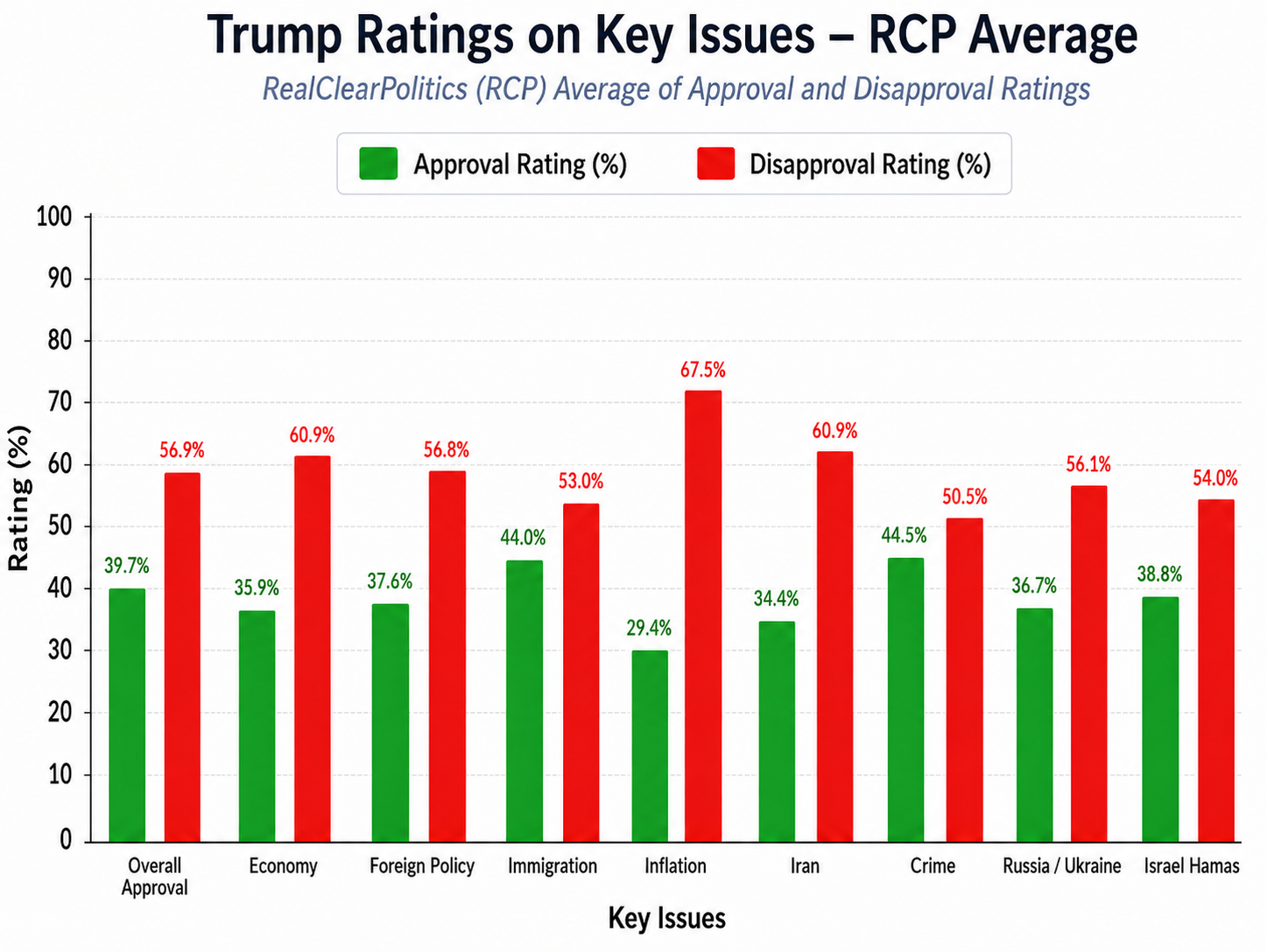
Approval vs. Disapproval Ratings on Trump's key issues
The RCP average compiles pollsters and provides an average approval or disapproval rating across key topics.
| Topic | Approve % | Disapprove % | Difference (Approve – Disapprove) |
|---|---|---|---|
| Overall Approval | 39.7 | 56.9 | -17.2 |
| Economy | 35.9 | 60.9 | -25.0 |
| Foreign Policy | 37.6 | 56.8 | -19.2 |
| Immigration | 44.0 | 53.0 | -9.0 |
| Inflation | 29.4 | 67.5 | -38.1 |
| Iran | 34.4 | 60.9 | -26.5 |
| Crime | 44.5 | 50.5 | -6.0 |
| Russia/Ukraine | 36.7 | 56.1 | -19.4 |
| Israel Hamas | 38.8 | 54.0 | -15.2 |
Takeaways:
- All topics show a higher disapproval than approval, indicated by the negative differences.
- Inflation has the largest gap (‑38.1 points), suggesting the strongest public dissatisfaction.
- Crime shows the smallest gap (‑6.0 points), indicating the closest balance between approval and disapproval among the listed issues.
- Throughout the year, polling has shown the spread between those who either unfavour or disapprove, or favour and approve of US President Trump's job, has widened.
Latest Reuters/Ipsos poll (August 20-24th 1,215 US adults)
- 36% of respondents said Democrats had a better plan/approach to handle the cost of living, 8 points above the 28% that picked Republicans; the remaining respondents said they weren't sure or said neither party was good on the matter.
Reuters/Ipsos Poll (August 14-17th, 1,166 US adults)
- 33% of respondents said they approved of Trump’s performance in the White House (prev. 35% on Aug 3rd), while 64% disapproved; approval rating is now at its lowest level of his current term, matching the low reached in December 2017 during his previous term.
- 80% of Americans, including 87% of Democrats and 71% of Republicans, believe US involvement in Iran will continue for an extended period, while just 16% expect the conflict to end within a few weeks.
- 69% of Americans believe Trump's business interests are influencing his decisions as President; this includes half of Republicans, roughly two-thirds of independents and nine in 10 Democrats.
- Republicans are divided over whether graft under Trump has improved, remained unchanged or worsened.
- 63% of respondents said it was inappropriate for Trump and his family to profit in that manner, while 32% said it was appropriate; the remainder did not answer.
- Around three in 10 Republican respondents viewed the deals as inappropriate, compared with seven in 10 who considered them appropriate.
Reuters/Ipsos Poll (August 3rd, 4,505 US adults)
- Democrats lead Republicans 37% to 36% on stewardship of the US economy, which Fox highlights is the first time since 2007. 27% said they are not sure that a different party would do a better job.
- In congressional elections, 42% of registered voters would vote for a democrat, and 37% would vote for a Republican if the contest were held now. Independents favoured democrats over Republicans by 12 points.
- Regarding the House and Senate votes, the poll finds that roughly 36 of the 435 seats are expected to be competitive, while eight Senate seats are expected to be competitive.
- Despite the polling, US President Trump continues to claim he is doing well in the polls and to ignore the fake news media.
- A previous Reuters/Ipsos poll (July 27th) found 1/3 Americans support the war on Iran, the lowest reading in a Reuters/Ipsos poll since the five-month-old conflict's early days, with most respondents saying that Trump has failed to explain his goals.
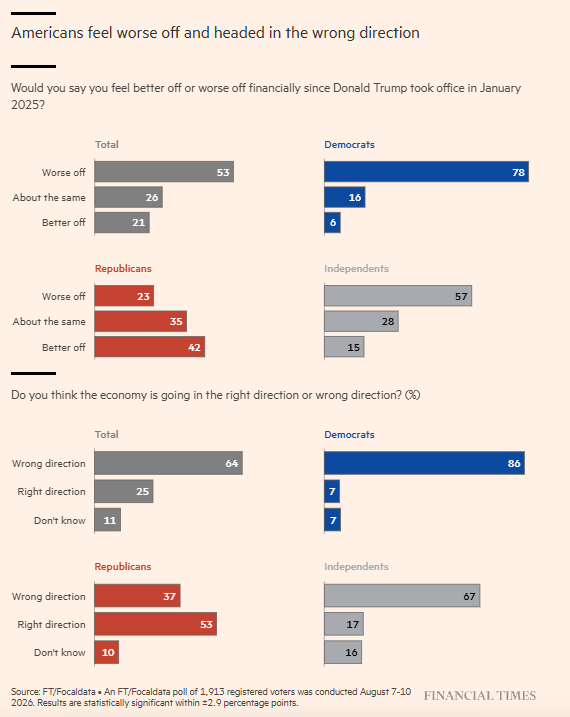
Americans feel worse off and headed in the wrong direction (Financial Times)
US-Canada
- US-Canada trade tensions threaten to add to inflationary pressures ahead of the midterm elections, with Canada imposing retaliatory tariffs after talks broke down;
- Canada vowed to match 50% US tariffs after talks broke down over the weekend.
- Trump’s decision to impose 50% tariffs on USD 20bln of Canadian goods has prompted pushback from GOP lawmakers and candidates, particularly in border states such as Maine, Michigan, New Hampshire and Alaska, as well as agriculture-heavy states including Iowa and North Carolina.
- Retiring Sen. Thom Tillis (R-NC.) said, “Right now we don’t have a positive message to tell farm country,” adding that the Canada tariffs were creating “tension” and that “the party that owns that tension is the party that will probably suffer the consequences in November.”
- Sen. Susan Collins (R-Maine.) called the Canada tariffs a “mistake,” warning that tariffs on Canadian goods processed across the border could increase “The cost of eating, building homes.”
Beef
- More than a dozen Republican senators have publicly criticised President Trump’s decision to allow discounted, tariff-free beef imports, highlighting a growing divide within the party over efforts to lower grocery prices and concerns from US cattle producers, Axios reported.
- Among those speaking out are Senate leaders and Trump allies, with Sen. John Barrasso (R- Wyo.) saying, “Americans want US beef on the table — not foreign imports,” while Sen. Tom Cotton (R-Ark.) said, “I have advised the President against this ill-advised action in the past, and I now urge him to reconsider.”
- Other Republicans, including Sen. Katie Britt (R-Ala.), who said she “share[s] their deep concerns,” and Sen. Steve Daines (R-Mont.), who argued that “importing foreign beef is only going to hurt our ranchers and increase prices over the long-term,” have also opposed the policy.
- Sens. Pete Ricketts (R-Neb.) and Mike Rounds (R-S.D) warned of the impact on Nebraska and South Dakota cattle producers, with Rounds saying, “This hurts! American cattle producers have been disadvantaged for far too long.”#
SAVE America Act
- SAVE America Act sidelined after Senate unanimously agrees to August exit.
- Trump has previously suggested that Republican success in the midterms is contingent on passage of the SAVE America Act.
- That has so far failed to materialise: the legislation has passed the House multiple times but remains stalled in the Senate, where it faces the 60-vote threshold required to overcome a filibuster.
- Trump has pushed the SAVE America Act into Reconciliation 3.0, a mega bill consisting of USD 73bln in defense funding, USD 12bln in farm aid, and a USD 10bln fund aimed at incentivising states to adopt elements of the SAVE America Act.
- The Reconciliation 3.0 mega bill would only need a simple majority to pass in the Senate.
- So far, the budget framework of Reconciliation 3.0 passed in the House earlier in July. Senate GOP leadership pulled a planned vote in early August rather than bring it to the floor, having concluded they didn't yet have the 50 votes needed to proceed.
- On defence funding, Trump had originally sought as much as USD 350bln for the reconciliation package, well above the USD 73bln that ultimately passed the House — reporting suggests Sen. Ron Johnson may push to revisit a larger number when the Senate takes this up in September.
- Now, having failed to secure the votes before the August recess, the White House is shifting its focus to September, when the Senate returns to face a similar vote alongside the broader government-funding deadline.
CLARITY Act
- Over the last month, odds of passage in 2026 on Polymarket have fallen from 38% to 14%.
- Senate Majority Leader John Thune (R-S.D.) filed cloture on the CLARITY Act, setting up a procedural vote for Sept. 15; invoking cloture requires 60 votes and would allow the Senate to advance to consideration of the bill.
- Sen. Thom Tillis (R-N.C.) is very pessimistic on the CLARITY Act, “If there's no interest in the White House in trying to bridge the gap on the ethics language, it is going to fail.”
Equity Impact
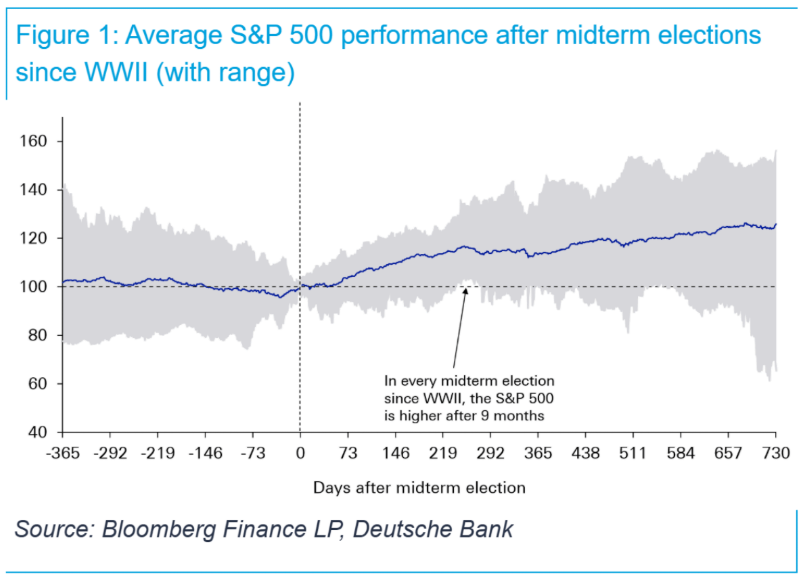
Goldman Sachs
- In past cycles, economic policy uncertainty has usually risen in August ahead of midterm elections and remained elevated in the subsequent few months.
- Equities have typically traded sideways in the few months ahead of midterms.
- During 13 midterm election years since 1974, the S&P 500 has generated a median return of 0% from the start of August through Election Day. Returns have typically improved post-election. Mirroring this pattern, mutual funds and foreign investors have generally demonstrated reduced demand for US equities ahead of midterm elections but increased allocations afterwards.
- The outcome of the midterms is unlikely to be a major cause of equity volatility.
- Within the equity market, most sectors, factors, and thematic baskets have traded with no substantial correlation to prediction market probabilities of election outcomes in recent months, although this may change as the election draws closer.
BTIG
- BTIG chief market technician Jonathan Krinsky said the S&P 500 has historically experienced a pullback of at least ~7% during the August–October period of midterm election years, citing 1990, 1998, 2002, 2010, 2014, 2018 and 2022; 2006 was the main exception, with its decline occurring in May–July.
- Krinsky said midterm-related volatility is often driven by unforeseen external events, citing the 1990 Kuwait invasion, 1998 Long-Term Capital Management collapse, 2014 Ebola outbreak and 2018 US-China trade war.
- Krinsky said the recent market broadening and rally from the late-July summer slowdown have been strong, but warned that historical patterns point to a more difficult period ahead.
- He said the market is entering a historically volatile downside window with stocks at all-time highs and the VIX at 2026 lows.
- Krinsky said this makes it an attractive time to reduce risk or hedge broad-based equity exposure ahead of what has historically been a difficult part of the calendar.
Citi
- Citi says buy any pre-midterm market dip.
- Remains Overweight equities and recommends adding exposure if markets pull back ahead of the US midterm elections.
- Sees supportive earnings revisions, improving liquidity conditions and limited warning signs despite recent AI-related concerns.
- Continues to favour US stocks and believes sector rotation could limit downside.
- Historically, pre-midterm weakness has often been followed by strong year-end performance, making any dip a potential buying opportunity.
What it means
Prediction-market pricing of this kind has become a standard input in the run-up to US midterms, and the relevant pattern is well established: a split Congress, which current pricing treats as the modal outcome, has historically been the market-friendly configuration, since it caps the legislative agenda and reduces tail risk on tax, spending and regulatory surprises. The distinction worth drawing is between the House and the Senate: House flips in a president's first midterm are the historical norm, so a Democratic House at high implied probability carries little incremental information, whereas the Senate at even money is where the genuine two-sided risk sits, and where pricing has moved around most between updates. On the policy side, floated pledges of this kind, capital gains indexation and housing exemptions in this instance, follow a familiar pre-election sequence in which few survive contact with Congress, but they do shape the sector-level narratives that develop as the vote approaches. Equities have tended to trade sideways into midterm election days and reprice positively once the uncertainty resolves, a pattern the sell-side notes reproduced here all lean on from different directions. The follow-ons that matter are Senate-race-level repricing, any further court rulings on redistricting and election mechanics that alter seat math, and the September legislative calendar, where stalled bills and the funding deadline will test how much of the agenda is actually deliverable before the vote.
- US Midterm Preview: Democrats Favoured to Flip the House, Senate Too Close to Call
- Week in Focus 26-30th October 2026: FOMC, BoC, RBNZ, ECB, BoJ Policy Decisions, US PCE
- White House says President Trump has further modified Canadian products subject to tariffs under Section 338; tariff changes will take effect on 30th October 2026
- Citi says it remains neutral on copper until more energy-market and tariff clarity emerges; views any associated risk-off episodes as good long-term buying opportunities
- Newsquawk Weekly Economic Release 26th - 30th October 2026
Related headlines
- US TREASURY WRAP: T-NOTE FUTURES (Z6) SETTLE 8 TICKS LOWER AT 106-0512 hours ago
- US Ambassador to Turkey Tom Barrack says US could strike Iran as soon as this weekend, AFP reports citing an interview on Israeli radio13 hours ago
- Foreign Ministers of Egypt, Saudi Arabia, Turkey and Pakistan say ‘Israeli occupation is the main source of instability in the region and beyond’, according to a statement12 hours ago
- Russia's Kremlin says Russian and Ukrainian militaries are working to determine dates for ceasefire talks16 hours ago
- Senior Ukrainian Official says that a ceasefire in Russian-occupied Oleshky is to be established soon16 hours ago
- CRUDE WRAP: WTI (Z6) SETTLES USD 3.80 HIGHER AT USD 103.27/BBL; BRENT (Z6) SETTLES USD 3.55 HIGHER AT USD 116.72/BBL12 hours ago
- US FX WRAP: DXY rises; hawkish Japan CPI report/BoJ sources; EUR hit on weak PMI data12 hours ago
- US President Trump says we’re close to ending, I hope, the Russia-Ukraine war11 hours ago
- US President Trump, on Iran, says we may do another operation against Iran; doubts Iran will say ‘let’s get down to business’11 hours ago
- US President Trump says "we could end the Iran war very quickly", adds "do we want to finish it or let it within is the question"16 hours ago
- US President Trump is set to speak with UK PM Burnham this afternoon on the Russia-Ukraine situation, BBG reports16 hours ago
- The Trump administration plans to introduce voluntary “US Caught Seafood” labels to help consumers identify seafood origins, according to CBS15 hours ago
- US President Trump expected to remove some tariffs on Canada in a bid to help Senator Susan Collins, WSJ reports13 hours ago
- US President Trump says they are "very close" to a deal with Mexico. Canada is working hard to make a deal.16 hours ago
- US President Trump says he discussed the North Sea with the UK PM. Conversation also include Iran and Ukraine.16 hours ago