
US Midterms (8 days out): Democrats’ early-vote lead narrows in 7 states; Texas and Nebraska flip to Republicans
Newsquawk Staff ·
SUMMARY
- On November 3rd, voters head to the polls to decide 35 Senate seats, all 435 House seats, 36 governorships, and public utility commissioners in 9 states.
- Midterm elections, which take place two years into a presidency, are viewed as a referendum on the ruling party’s handling of key issues.
- 35/100 Senate seats are up for election, of which 22 are held by Republicans and 13 by Democrats. The current balance of power in the Senate favours the Republicans, who have 53 seats to the Democrats’ 45, with two Independents caucusing with the Democrats. **Polls show the Senate race remains close, with the majority of key races in Republican-held seats, leaving the party vulnerable (Alaska, Iowa, Kansas, Maine, Ohio, Texas, and North Carolina). Polymarket prices a 65% chance of the Democrats winning the Senate, which would require a net gain of 4 seats.
- All 435 House of Representatives seats are up for election, and the Democrats are widely expected to take a majority, which markets price at 92%. Republicans currently hold a slim majority in the House, with 218 seats to the Democrats’ 214, plus one Independent and two vacancies.
- Balance-of-power betting odds have increasingly favoured a Democratic sweep, following President Trump’s declining approval ratings amid an Iran war that has weighed on the cost of living for Americans through higher diesel and gasoline prices.
- Polymarket odds of congressional outcomes are as follows: Democratic sweep (66%); Democratic House and Republican Senate (26%); and Republican sweep (8%).
- Extra focus will be on gubernatorial and Public Utility Commission (PUC) commissioner elections, as near-term data-centre policy is likely to be set at the state level. Gubernatorial elections will take place in 36 states: 18 Democratic-held and 18 Republican-held.
- Traders will be attentive to the gubernatorial races for any potential change in stance on the AI trade at either state or federal level.
Recent developments
- Trump is swapping some Canadian goods on the Section 338 tariff list: plywood, some paper, machinery, refrigeration equipment and packing crates come off; valves, carpets, waste products and others go on.
- The WSJ reports the exemptions were requested by Sen. Susan Collins, who is in a tight re-election race in trade-dependent Maine; they could also help Republicans like Mike Rogers in Michigan and John Sununu in New Hampshire, who have criticised the Canada tariffs.
- The Trump administration is suing to block certification of Alaska’s Senate election if Republican Sen. Dan Sullivan loses to Democrat Mary Peltola, arguing votes may have been mistakenly cast for a second candidate, Daniel J. Sullivan. That said, Attorney General Todd Blanche said the department isn’t trying to stop any ballots or certification, only to preserve ballots so Alaska officials can determine whether voters were misled, adding that the suit relied solely on federal law and wasn’t coordinated with any campaign.
- On Friday, the UoM October report showed consumer sentiment held steady this month; year-ahead business conditions improved about 14% but remain 16% below last October; the decline in current conditions was driven by durables buying conditions, which plunged 18% on higher interest rates and affordability concerns; sentiment is 10% below a year ago and 15% below February, prior to the Iran war.
- Trump said Audi has committed USD 4.2bln in Macon to begin construction next month on a plant producing 200,000 cars a year, with Trump aiming to boost Georgia Republicans in a tight race. Audi said the plant, its first in Georgia, would create about 4,500 jobs, with construction starting in 2027 and production in the early 2030s.
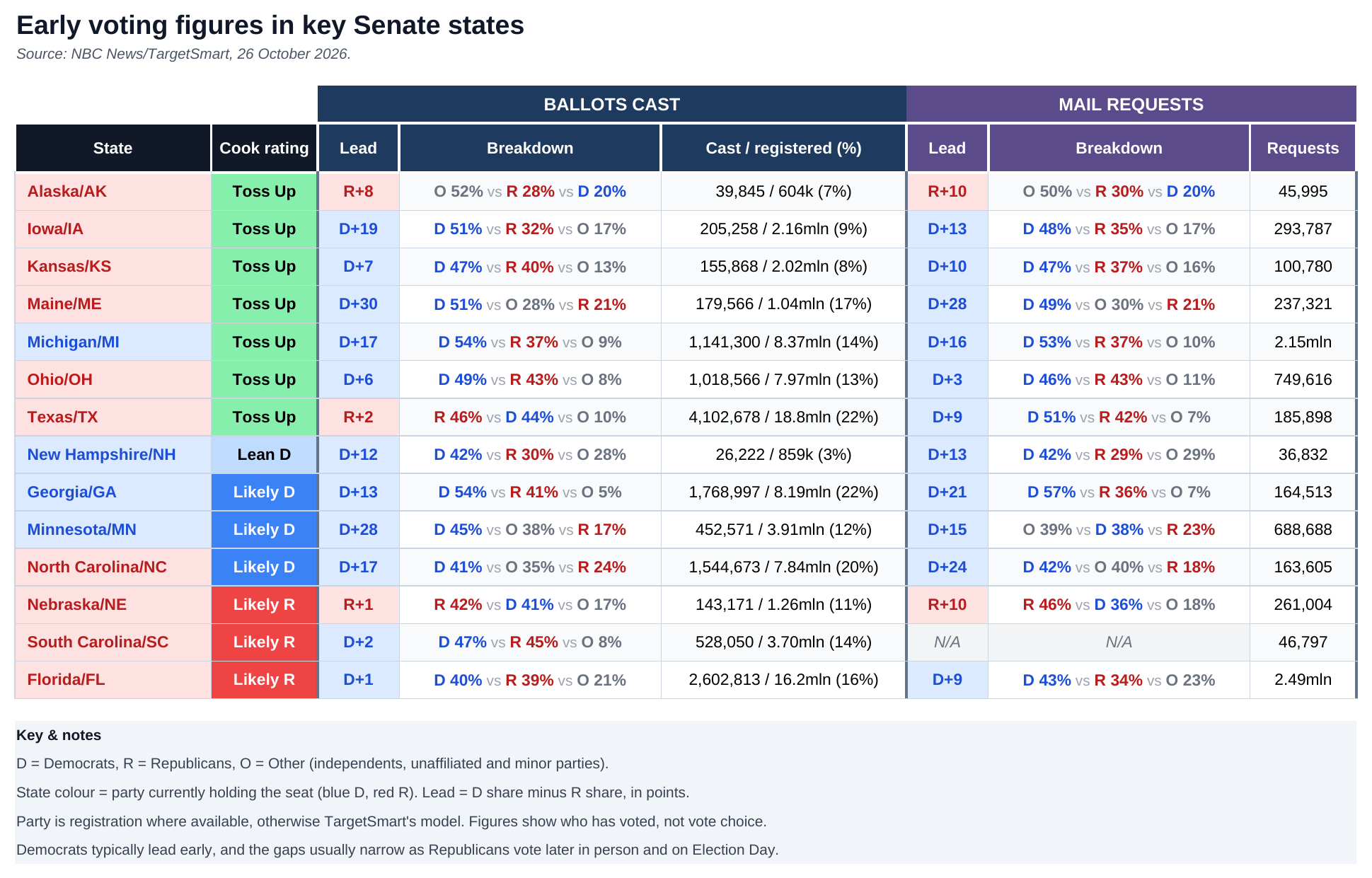
Early Voting in Key Senate Races (NBC/TargetSmart - October 26th)
- National: 28,942,282 early ballots cast (14.7mln by mail, 14.2mln in person). Democrats lead Republicans 47%–35% (+12), leaving Other at 18%; Mail ballots requested or sent (57.82mln): 46%–31% (D+15), with Other at 23%.
- Senate battlegrounds via NBC (AK, GA, IA, KS, ME, MI, NC, NH, OH, TX): 10,182,973 early ballots cast (2.3mln by mail, 7.9mln in person). Democrats lead Republicans 47%–40% (+7); Mail ballots requested or sent (4.12mln): 50%–37% (D+13).
- Since Friday, the Democratic lead has narrowed in seven states, most sharply in Kansas (D+13 to D+7), with Texas and Nebraska flipping to Republican leads. It widened only in Minnesota.
- In five states (Iowa, Maine, Michigan, Minnesota, Ohio), Democrats' lead among ballots cast is wider than their lead among mail requests, pointing to faster Democratic returns.
- Nebraska stands out: Republicans lead requests by 10 but lead ballots cast by just 1.
- Texas runs the other way: Democrats lead mail requests by 9, but Republicans lead ballots cast by 2, as almost all of the state's early vote is in person.
- The figures below show who has voted, not how. Democrats typically lead early, and the gaps usually narrow as Republicans vote later in person and on Election Day.
What it means
Early-vote partisan splits are a soft read at best: the structural pattern in US elections is that Democrats bank mail and early votes while Republicans concentrate in person and on Election Day, so a narrowing Democratic lead in the final week is the normal sequence rather than new information, and the who-has-voted data says nothing about how they voted. The state-level texture matters more than the topline: where Democrats' lead among ballots cast exceeds their lead among mail requests, returns are coming in faster than usual, which has historically been the more informative tell for campaign ground operations, while in-person-heavy states like Texas can flip colour on small absolute numbers. The market-relevant transmission is the divided-government question: episodes where one chamber changes hands have tended to matter most through fiscal expectations, with the curve's pricing of gridlock versus sweep scenarios concentrated in the long end and in sectors with direct policy exposure, here tariffs, energy and the state-level data-centre permitting that gubernatorial and utility commission races govern. The disputes over certification and litigation around contested Senate races are worth tracking as a tail risk on timing rather than outcome, since prolonged uncertainty over control has on previous occasions extended volatility beyond election night itself. The follow-ons are the final-week polling in the listed Republican-held seats, prediction-market repricing of the sweep versus split outcomes, and any post-election litigation calendar that delays certified control of either chamber.
- Newsquawk Daily Economic Release - 27th October 2026
- US intelligence officials believe Iran & the Houthis are unlikely to carry out preemptive escalatory attacks against US personnel or Israel, CNN reports citing sources; but, would not hesitate if targeted first
- US EQUITY OPEN: Indices in the green as risk events await
- [MARKET ANALYSIS] Crude benchmarks extend on losses, though remain within Friday's range; Dutch TTF bucks the trend
- [MARKET ANALYSIS] DXY grinds higher; GBP lags ahead of Wednesday's Budget, whilst EUR holds after Moody's spares France
Related headlines
- Russian Deputy Foreign Minister says Russia is considering proposals to ensure the security of grain shipments through the Black Sea and remains in contact with Turkey, Interfax reports2 hours ago
- Russian Kremlin says any agreement to resume talks with Ukraine and the US do not prevent Russia or Ukraine from conducting military activity in the meantime6 hours ago
- [MARKET ANALYSIS] European bourses start the week on a strong footing; CAC 40 outperforms as France escapes a Moody's downgrade7 hours ago
- [PRIMER] Israeli Election: A change of government is unlikely to soften Israel's Iran stance5 hours ago
- Iranian President says he will discuss securing energy transportation routes, freedom of trade and efforts to end regional insecurity during his visit to Moscow, Sabereen News reports1 hour ago
- Newsquawk Daily US Opening News - 26th October 20266 hours ago
- [MARKET ANALYSIS] Fixed gloomy, but OATs are anything but moody6 hours ago
- HSBC lowers its gold rating to Overweight, whilst increasing oil to Overweight6 hours ago
- US PRE-MARKET MOVERS: META, VZ, RRC, FICO, Brazil ADRs4 hours ago
- UK Budget, 28th October 2026: An uneventful budget expected, but the reaction risks are skewed negative3 hours ago
- Auction History: US Treasury to auction USD 69bln in 2-year notes at 17:00GMT/13:00EDT23 min ago
- Newsquawk Daily US Equity Opening News - META plans up to $95bln stock offering; TSLA upgraded at Barclays3 hours ago
- [MARKET UPDATE] Gradual pressure in the crude complex helps lift sentiment across European and US equity futures; a move which lacks a clear driver, but with markets potentially focusing on a delegation meeting in Tehran on Monday7 hours ago
- US Treasury announces a preliminary liquidity support buyback of up to USD 6bln in nominal coupon securities with maturities of 20-30 years, scheduled for October 27th, with settlement on October 28th1 hour ago
- EQT (EQT) agrees to acquire Range Resources (RRC) in an all-stock deal, valuing the combined company at over USD 50bln6 hours ago