
US Midterm Update: Democratic sweep odds rise on Polymarket to 66% from 59% last week
A weekly shift in prediction-market odds of this size is within the normal noise band for these contracts, which are thin relative to polling and have historically moved late and fast on marginal information rather than leading it.
US Midterm Update: Democratic sweep odds rise on Polymarket to 66% from 59% last week
Senators aim to fast-track Chinese vehicle ban legislation this week as China's Xi visits Washington, according to reports, citing a document
Experian (EXPN LN) becomes first personal finance app integrated with Google (GOOGL) Gemini
Open the platform and use it. The whole workspace is free to try, with no signup and no card. When you want the headlines arriving live instead of on a delay, Newsquawk Pro is £24.99 for 7 days.
What is priced?
- 41 days until the election, and the House is still widely expected to go to the Democrats, whilst the Senate has continued to tilt in the Dems' favour.
- Polymarket odds show participants have continued to heavily favour Democrats to win the House at 94% (prev. 88% on Sept 16th), whilst for the Senate, Democrats have improved to 66% from 59% last week.
- Polymarket shows the probability of a Democrat sweep at 66% (prev. 59% W/W), while pricing a Republican Senate and Democratic House at 26% (prev. 32%), and a Republican sweep at 8% (prev. 11%).
Recent developments
- Trump on Tuesday said he is examining a diesel export ban, with Treasury Secretary Bessent exploring whether it's feasible. The move follows growing pressure from top Republicans to prioritise domestic needs. However, US Energy Secretary Wright said a diesel export ban would not work; it would raise gasoline and jet fuel prices.
- Since the last update, the US/Iran stalemate has continued. Direct strikes have stopped, with market optimism growing over a path to diplomacy through meetings with Gulf leaders at the UNGA. On Tuesday, US envoys Witkoff and Kushner met with the Iranian delegation, meeting for three hours. Trump described the meeting as very productive, with another meeting scheduled in the near future. Trump added, "But certainly, it's to their advantage to make a deal. And we can do that. It's preferable, I guess." Trump didn't specify a timeline on the Iran war, saying it could end before or after the midterms.
- A senior Iranian official said that Tehran is reviewing the US' response to its proposal to end hostilities, Reuters reports. The official added that many differences remain between Iran and US positions, but diplomacy continues.
- On Sunday, the NYT reported that Trump appeared to hold off on attacking the Houthis, at least for the time being, according to an admin official.
- Democrats are expected to force another Iran war powers vote, the last chance pre-election for any vulnerable GOP incumbents to break with Trump on the issue, Punchbowl reports. Sen. Thom Tillis (R-N.C.) has also said he’ll support the resolution. The exact vehicle + timing aren’t yet set.
- AAA gas price averages hit USD 4.4744 (prev. 4.3672 on Sept 16th), about the highest level in three months, at a crucial time when they should be trending in the other direction. US President Trump and VP Vance have stated the war will likely be completed after the midterm elections.
- The Trump administration is halting Obamacare coverage for more than 760,000 enrollees it believes were fraudulently or improperly enrolled, with the effort estimated to save USD 2.2bn in taxpayer funds. CMS also plans to bar 569 brokers over allegedly improper applications, while a further 419,000-450,000 enrollees will undergo eligibility checks. * Democrats are accusing the Trump administration of redirecting USD 2.5bn in foreign aid, including USD 1.3bn for global health and USD 1.2bn for development assistance, to cover USAID “closeout costs,” while allowing another USD 725mln in aid to expire. The dispute comes amid broader congressional concerns over the administration’s control of federal spending, including Republican opposition to proposed changes to NIH grant funding.
- Virginia kicked off early in-person voting for the 2026 midterms on September 18, marking the start of the first major early-voting period ahead of the November 3 election, as Trump continues his push to restrict the use of mail-in ballots nationwide. According to Fox News, Justice Brett Kavanaugh left the door open to Trump’s ballot-mail rules, but says it’s too soon to implement them ahead of the November midterms.
- AI has been in focus after major CEO's, including OpenAI's Altman, Anthropic's Amodei and xAI's Musk, agreed on the need for a slowdown in the development of AI over safety concerns. However, US President Trump pushed back on this, stating the US needs to stay competitive with China. Lawmakers have been calling for AI safety regulations.
Trump's aims ahead of midterms
- Trump on Tuesday said he is examining a diesel export ban, with Treasury Secretary Bessent exploring whether it's feasible. The move follows growing pressure from top Republicans to prioritise domestic needs. Ashley Hinson, a Republican member of the House of Representatives, on Monday urged the use of “every option at our disposal to provide some relief from high prices”, including “pausing diesel exports . . . and creating a diesel relief programme to help our farmers and truckers being crushed by the high costs”. Iowa Senator Grassley wrote, “If our [government] can embargo chips to China it can embargo diesel to help American farmers [and] truckers”. Last weekend, Energy Secretary Wright, Interior Secretary Burgum and other White House officials were working on the issue. Ag secretary. Rollins said she expects an announcement “very soon on some potential actions”.
- Speaking at the GOP Convention, Trump urged voters to pretend he is on the ballot and vote for as if he were running, noting that if they do not have majorities, so much can be lost.
- Trump promised a Trump dividend of USD 5,0000 to every American adult if Republicans hold power in Congress. Since then, the President has stressed he means it and has the means to do it. Even Treasury Secretary Bessent has said it is possible, although the NPR warned it would cost over USD 1tln.
- Top officials state that Trump is looking for new policy pledges he can present to voters ahead of the midterm election, according to Bloomberg. The report notes that Trump may call on Congress to cut capital gains taxes and create an exemption for certain home sales. One of the measures touted would be indexing capital gains, so taxes would be applied on gains adjusted for inflation, while there could also be exemptions on sales of homes worth USD 2mln or less from capital gains taxes.
- Politico reported that the Trump admin is sunsetting a subsidy programme that lowered Medicare prescription drug coverage premiums for older Americans — just ahead of the midterm elections, giving the Democrats an attack point against the Republicans.
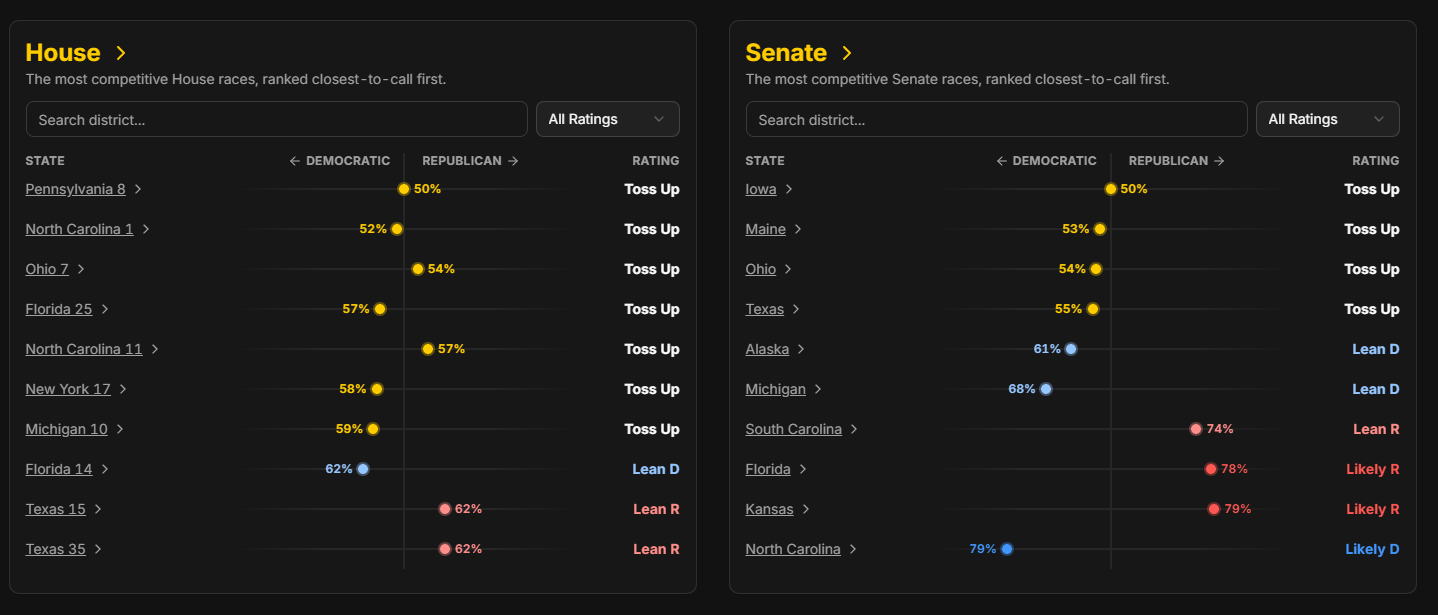
Toss up Senate & House races (Decision Desk HQ)
Approval vs. Disapproval Ratings on Trump's key issues
The RCP average compiles pollsters and provides an average approval or disapproval rating across key topics.
| Topic | Approve % | Disapprove % | Difference (Approve – Disapprove) |
|---|---|---|---|
| Overall Approval | 39.0 | 59.5 | -20.5 |
| Economy | 34.0 | 62.8 | -28.8 |
| Foreign Policy | 35.4 | 59.6 | -24.2 |
| Immigration | 43.2 | 54.0 | -10.8 |
| Inflation | 27.4 | 69.1 | -41.7 |
| Iran | 32.6 | 62.5 | -29.9 |
| Crime | 44.2 | 50.7 | -6.5 |
| Russia/Ukraine | 34.0 | 58.8 | -24.8 |
| Israel Hamas | 38.5 | 54.5 | -16.0 |
Takeaways:
- All topics show a higher disapproval than approval, indicated by the negative differences.
- Inflation has the largest gap (‑41.7 points), suggesting the strongest public dissatisfaction.
- Crime shows the smallest gap (‑6.5 points), indicating the closest balance between approval and disapproval among the listed issues.
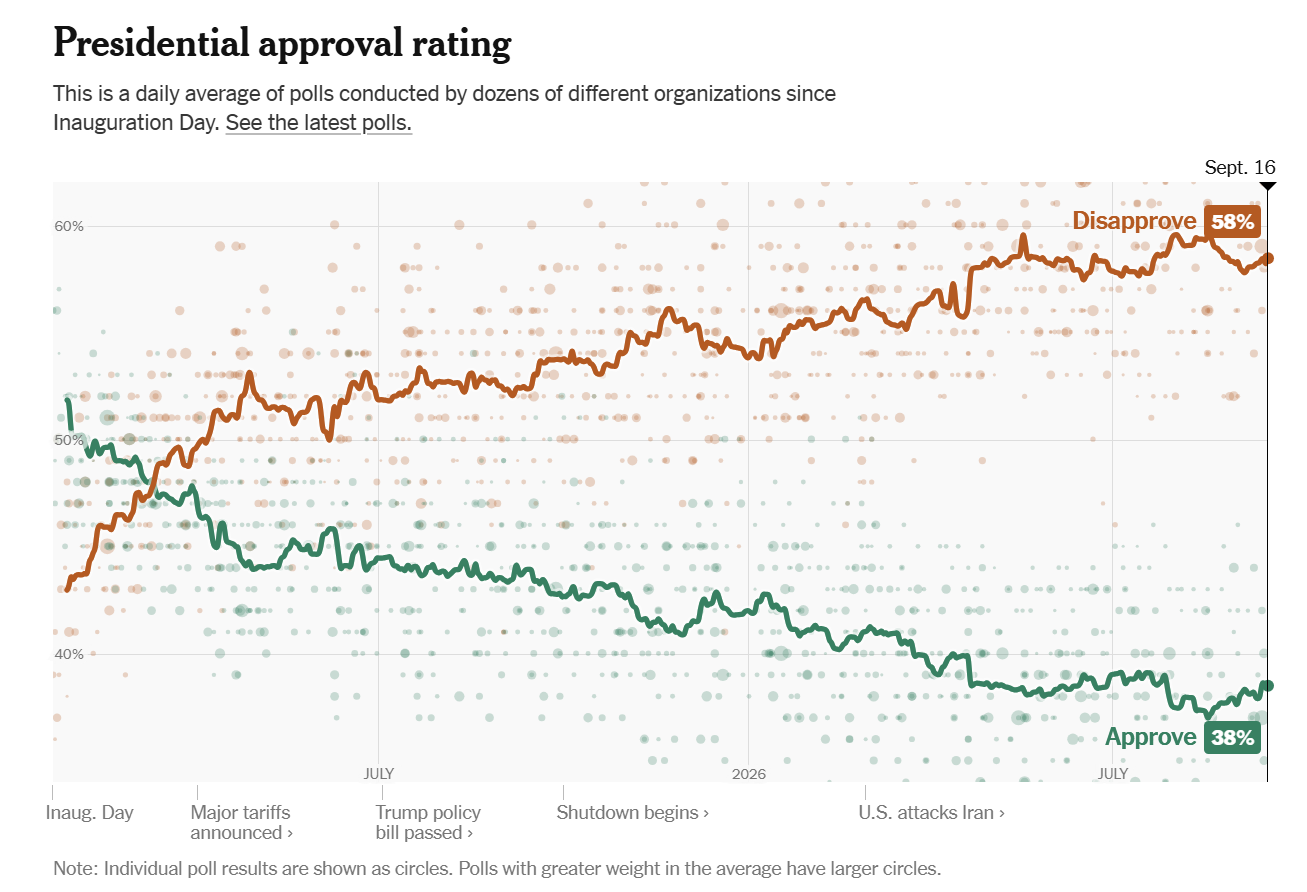
- Throughout the year, polling has shown the spread between those who either unfavour or disapprove of, or favour and approve of, US President Trump's job has widened.
Economist/YouGov (Sep 18–21, 1,568 U.S. adult citizens)
- Among likely voters, 52% would vote for the Democratic candidate in their district, versus 38% for the Republican.
- Among registered voters, Democrats lead 45% to 38%, their largest advantage since Economist/YouGov began tracking 2026 House vote intent in spring 2025.
- 93% of Democrats back their party’s candidate, compared with 90% of Republicans backing theirs, while Independents favour Democrats 52% to 27%.
- Democrats lead across every major age group, by 7 points among voters without college degrees and 22 points among college graduates.
- Men are split 44% Democratic vs. 47% Republican, while women favour Democrats 59% to 30%.
Reuters/Ipsos Poll (Sept 17-20, 1,277 responses from US adults)
- Trump’s approval rating fell to 32%, the lowest of his political career.
- Just 17% of respondents approved of his handling of the cost of living, the top issue Americans say will determine how they vote in the November 3 midterm elections.
- Among Republicans, those who disapprove of Trump’s handling of the cost of living outnumbered those who approve, 51% to 44%.
- Trump remains popular among Republicans on immigration, with 79% of his party approving of his approach, compared with 36% of Americans overall, while 55% disapprove.
- Registered voters preferred Democrats over Republicans by 43% to 35%.
- On the conflict with Iran, 24% of Americans support Trump’s approach.
AI/Data Centre Polls
Reuters/Ipsos (Sept 17-20, 1,277 US adults)
- 73% of Americans worry AI companies have not done enough to prevent AI from causing serious harm to society, while 39% say AI is having a negative impact on society, up from 36% last month and the highest level since Reuters/Ipsos began asking the question in March. 11% view AI as having a positive impact.
- 69% say they followed news about major AI companies calling for slower development and greater oversight and safety standards. 55% say slowing AI development would be a good thing, compared with 13% who say it would be bad.
- 73% say ensuring AI is developed safely and responsibly is more important, compared with 23% who say staying ahead of other countries in AI development is more important.
Polling
NYT Presidential Approval Rating
Data Centres
- Trump has doubled down on his data centre push, which has become a key debate, claiming the only reason that communities throughout the USA should not want data centres is if they want to end up being backwards and poor. A senior WH official told Politico that Trump looks at the polling, “Polling isn’t necessarily great on data centres, but it’s incumbent upon us to explain our position. I think that’s part of what he was trying to do.”
US-Canada
- US-Canada trade tensions threaten to add to inflationary pressures ahead of the midterm elections, with Canada's retaliatory tariffs in effect.
- Trump’s decision to impose fresh tariffs on Canadian goods has prompted pushback from GOP lawmakers and candidates, particularly in border states such as Maine, Michigan, New Hampshire and Alaska, as well as agriculture-heavy states including Iowa and North Carolina.
- A Reuters/Ipsos poll over August 28th-30th (1,023 US adults) found that 20% of respondents supported higher tariffs on Canadian goods compared to 57% who opposed them and 21% who couldn't say where they stood. About 20% hadn't heard about the development. Meanwhile, 14% of American respondents said they supported changing the name of Lake Ontario; 63% opposed the change.
SAVE America Act
- Trump has previously suggested that Republican success in the midterms is contingent on passage of the SAVE America Act.
- That has so far failed to materialise: the legislation has passed the House multiple times but remains stalled in the Senate, where it faces the 60-vote threshold required to overcome a filibuster.
- Trump has pushed the SAVE America Act into Reconciliation 3.0, a mega bill consisting of USD 73bln in defense funding, USD 12bln in farm aid, and a USD 10bln fund aimed at incentivising states to adopt elements of the SAVE America Act.
- The Reconciliation 3.0 mega bill would only need a simple majority to pass in the Senate.
- So far, the budget framework of Reconciliation 3.0 passed in the House earlier in July. Senate GOP leadership pulled a planned vote in early August rather than bring it to the floor, having concluded they didn't yet have the 50 votes needed to proceed.
- On defence funding, Trump had originally sought as much as USD 350bln for the reconciliation package, well above the USD 73bln that ultimately passed the House — reporting suggests Sen. Ron Johnson may push to revisit a larger number when the Senate takes this up in September.
Equity Impact
JPM
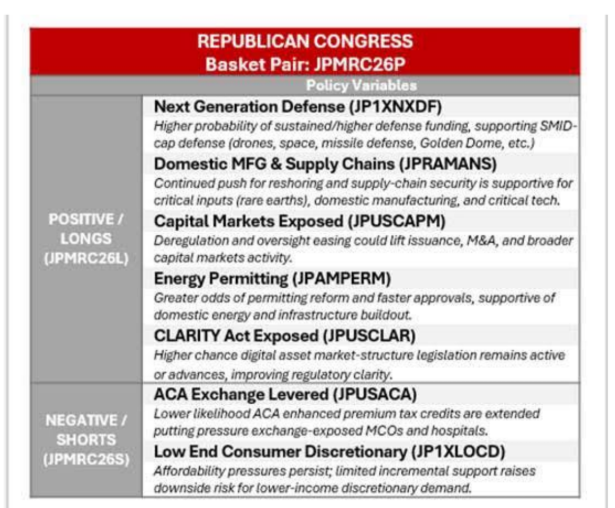
Goldman Sachs
- In past cycles, economic policy uncertainty has usually risen in August ahead of midterm elections and remained elevated in the subsequent few months.
- Equities have typically traded sideways in the few months ahead of midterms.
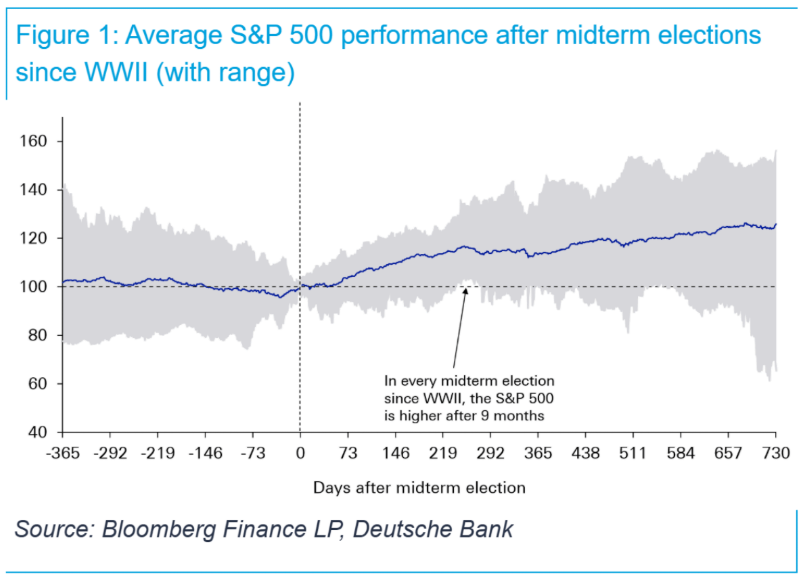
- During 13 midterm election years since 1974, the S&P 500 has generated a median return of 0% from the start of August through Election Day. Returns have typically improved post-election. Mirroring this pattern, mutual funds and foreign investors have generally demonstrated reduced demand for US equities ahead of midterm elections but increased allocations afterwards.
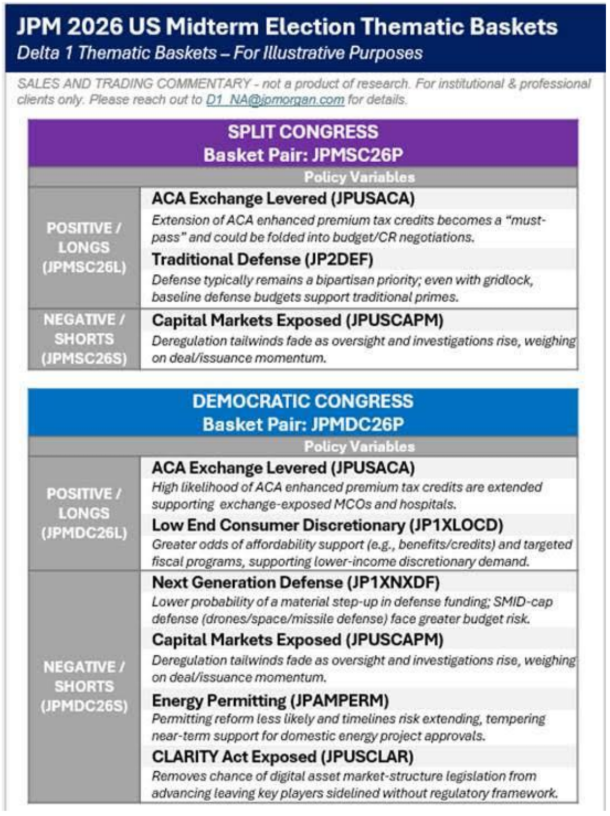
- The outcome of the midterms is unlikely to be a major cause of equity volatility.
- Within the equity market, most sectors, factors, and thematic baskets have traded with no substantial correlation to prediction market probabilities of election outcomes in recent months, although this may change as the election draws closer.
BTIG
- BTIG chief market technician Jonathan Krinsky said the S&P 500 has historically experienced a pullback of at least ~7% during the August–October period of midterm election years, citing 1990, 1998, 2002, 2010, 2014, 2018 and 2022; 2006 was the main exception, with its decline occurring in May–July.
- Krinsky said midterm-related volatility is often driven by unforeseen external events, citing the 1990 Kuwait invasion, 1998 Long-Term Capital Management collapse, 2014 Ebola outbreak and 2018 US-China trade war.
- Krinsky said the recent market broadening and rally from the late-July summer slowdown have been strong, but warned that historical patterns point to a more difficult period ahead.
- He said the market is entering a historically volatile downside window with stocks at all-time highs and the VIX at 2026 lows.
- Krinsky said this makes it an attractive time to reduce risk or hedge broad-based equity exposure ahead of what has historically been a difficult part of the calendar.
Citi
- Citi says buy any pre-midterm market dip.
- Remains Overweight equities and recommends adding exposure if markets pull back ahead of the US midterm elections.
- Sees supportive earnings revisions, improving liquidity conditions and limited warning signs despite recent AI-related concerns.
- Continues to favour US stocks and believes sector rotation could limit downside.
- Historically, pre-midterm weakness has often been followed by strong year-end performance, making any dip a potential buying opportunity.
The structural pattern is well established: the president's party typically loses House seats in midterms, and the market-implied map here, Democrats favoured in the House and competitive in the Senate, is consistent with that baseline rather than exceptional. The tradable distinction is between a split Congress and a sweep: divided government has historically been the low-volatility outcome for equities, with policy gridlock limiting fiscal and regulatory surprises, while single-party control raises the probability of reconciliation-driven fiscal action, which transmits through term premium at the long end and through sector-level rotation rather than the index. Desk research in the piece reflects the standard midterm seasonality: equities tending to chop or soften into November and recover once the outcome resolves, with the caveat that the selloffs in past cycles were usually driven by exogenous shocks rather than the vote itself. The near-term catalysts are the ones flagged: the war powers vote as a test of GOP cohesion, any diesel export decision feeding directly into gasoline prices and the inflation polling that is driving the generic ballot, and whether the reconciliation vehicle advances. Odds will likely reprice on candidate-level polling in the toss-up races rather than on national approval numbers.
Related headlines
- European Market Wrap - 23rd September 20262 hours ago
- US EQUITY OPEN: Stocks lower while yields and dollar climb on strong PMI data 2 hours ago
- US Pre-Market Movers: SOXX, MSFT, BABA, FUN, KBH, GIS, MPC, GEHC, IMVT, PAYX, CTAS3 hours ago
- US White House official says, on Energy Secretary Wright's diesel export ban comments, says the US President makes a decision best for the US, and he wants to see pump prices fall. All options are being considered, Reuters' Renshaw reports1 hour ago
- Primer: US to sell USD 70bln of 5-year notes at 18:00BST/13:00EDT26 min ago
- US Secretary of State Rubio says if Russian President Putin attends the G20, it could be an opportunity to speak with US President Trump1 hour ago
- US Democratic Senators reportedly sent a letter to US President Trump to establish an agreement with China to mutually slow or pause AI development, Politico reports2 hours ago
- Republican lawmakers reportedly press US President Trump administration on stalled Taiwan aid and arms2 hours ago
- US President Trump criticises Canada's immigration and warns of big unemployment in Canada3 hours ago
- Newsquawk Daily Economic Releases - 24th September 20262 hours ago
- Cintas (CTAS) Q1 2026 (USD): EPS 1.36 (exp. 1.35), Revenue 3.01bln (exp. 2.98bln)3 hours ago
- Fed's Barr (Voter) says further rate hikes are likely needed to ensure a timely return to the 2% inflation target2 hours ago
- Disney+ (DIS) to lift price by 13% to USD 21.49 per month, sources suggest1 hour ago
- US BROKER MOVES: MSFT upgraded at Sitfel; ALV downgraded at Wolfe Research3 hours ago
- EIA Expectations: Crude -0.595M, Distillate -0.599M, Gasoline 0M2 hours ago
- US sells USD 28bln 2yr FRNs: High discount margin 0.040%53 min ago
- US Treasury announces buyback of up to USD 6bln coupons maturing Nov 2046–Aug 2056, for Sep 24 (Preliminary)1 hour ago
- RBI Deputy Governor Gupta says the current account deficit will continue to shrink ahead as dependency on oil reduces 4 hours ago
- [PREVIEW] Norges Bank Policy Announcement on 24th September 20263 hours ago
- [PREVIEW] Riksbank Policy Announcement on 24th September 20263 hours ago
The whole workspace, free to try.
Try it free